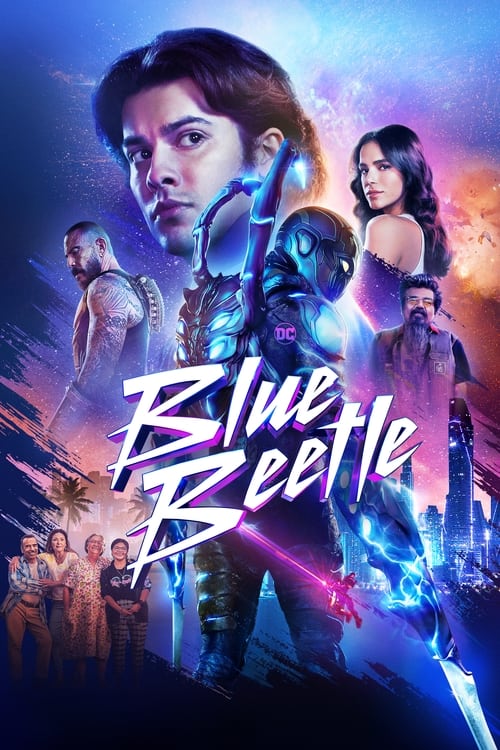
Blue Beetle (2023)
Directed by Ángel Manuel Soto
Yes — Blue Beetle is woke, scoring 61 out of 100 on our wokeness meter.
Blue Beetle arrives as the fourteenth installment of a franchise already shuffling toward its own funeral, and it carries itself with the earnest bearing of a film that knows it will be remembered for something other than its grosses.
Consciousness Markers
A Latino lead and a predominantly Latino cast anchor the film, with Spanglish dialogue and cultural specificity treated as central rather than incidental; it is the first live-action superhero film with a Latino lead.
The film explicitly engages Latino identity, immigrant family dynamics, gentrification, and U.S. intervention in Latin America, with the villain framed as an imperialist CEO.
Kord Industries is a military-industrial corporation whose CEO exploits workers, displaces families, and pursues imperial projects; the Reyes family's eviction and the villain's greed provide a clear anti-corporate streak.
The film invokes the School of the Americas and U.S. intervention in Latin America as backstory for the antagonist, offering a critical historical framing, but it is not a sustained revisionist historical narrative.
Themes of imperialism, gentrification, and Latino representation are present but delivered through genre action and family comedy rather than direct preaching.
Women occupy positions of authority (Jenny Kord, Victoria Kord) and Nana has a revolutionary past, but the film does not advance a feminist critique or center gender politics.
No LGBTQ+ characters, relationships, or themes are present; Harvey Guillén's casting does not translate into textual representation.
No climate change, environmental activism, or ecological themes appear.
No body-positive themes or plus-size representation are present.
No neurodivergent characters or themes are present.
Why it received this score
Blue Beetle arrives as the fourteenth installment of a franchise already shuffling toward its own funeral, and it carries itself with the earnest bearing of a film that knows it will be remembered for something other than its grosses. Ángel Manuel Soto directs Xolo Maridueña as Jaime Reyes, a law graduate who returns to a working-class neighborhood, finds his family facing eviction, and winds up bonded to an alien Scarab. The cast is almost entirely Latino, the dialogue slips between English and Spanish without apology, and the cultural texture is offered as the point rather than the garnish. It is the first live-action superhero picture with a Latino lead, and it never lets us forget the weight of that fact, though it wears the weight lightly enough.
The politics are visible but mostly routed through the machinery of the genre. Kord Industries is a military contractor run by a CEO who displaces families, exploits her workers, and dreams of imperial projects abroad; Susan Sarandon has described her character as embodying imperialism in the name of democracy. The film gestures at the School of the Americas and American intervention in Latin America as villain backstory, and Jaime's neighborhood sits under the threat of gentrification. This is anti-corporate sentiment delivered with a punch and a joke, not a pamphlet.
What the film declines to do is instructive. There is no LGBTQ content, no environmental sermon, no body-positive subplot, no neurodivergent character. Women hold power (a ruthless CEO, a capable heiress, a grandmother with a revolutionary past) but gender is not the film's argument. The messaging that does exist arrives through family comedy and armored fistfights, which keeps the sermonizing at a tolerable volume. The result is a superhero film that is culturally specific, politically pointed, and ultimately more interested in a family's grief and resilience than in converting anyone. A respectable vintage, if not a memorable one.
Analysis generated by our Consciousness Algorithm
Part of


Synopsis
Recent college grad Jaime Reyes returns home full of aspirations for his future, only to find that home is not quite as he left it. As he searches to find his purpose in the world, fate intervenes when Jaime unexpectedly finds himself in possession of an ancient relic of alien biotechnology: the Scarab.
Questions about Blue Beetle
Is Blue Beetle woke?
Yes — Blue Beetle is woke, scoring 61 out of 100 on our wokeness meter. That earns it a verdict of Woke.
What makes Blue Beetle woke?
5 of the 10 markers register at 30 or above, led by Representation Casting (90), Racial Consciousness (85) and Eat the Rich (60). On Representation Casting: A Latino lead and a predominantly Latino cast anchor the film, with Spanglish dialogue and cultural specificity treated as central rather than incidental; it is the first live-action superhero film with a Latino lead.
How does Blue Beetle compare to other 2023 movies?
It ranks #13 of the 200 films from 2023 we've scored; their average is 24. The wokest is Origin (84).
How is the Woke Score calculated?
An AI-assisted process researches the film and its reception, scores it 0–100 on ten markers, then combines those into one 0–100 Woke Score. It measures a specific set of 2020s cultural themes, not film quality.