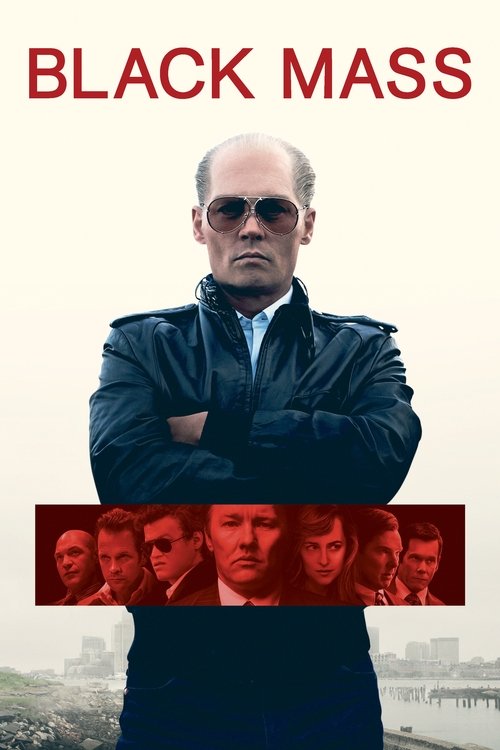
Black Mass (2015)
Directed by Scott Cooper
No — Black Mass is not woke, scoring 4 out of 100 on our wokeness meter.
This sprawling procedural crime drama attempts to capture the brutal, unglamorous reality of 1980s South Boston.
Consciousness Markers
The only racial element is background graffiti reading 'Stop Forced Busing,' a passing nod to Boston's busing crisis that the film never develops into a theme.
The ensemble is almost entirely white, which is historically accurate for the South Boston Irish mob milieu of the 1970s-80s; there is no deliberate or commented-upon diversity casting.
A grim procedural crime drama that shows rather than preaches; it offers no moralizing monologues or didactic messaging.
No LGBTQ+ characters, themes, or subtext appear anywhere in the film.
Women function as girlfriends, wives, and victims (Lindsey Cyr, Marianne Connolly, Deborah Hussey) with no feminist framing or critique of patriarchy.
No environmental or climate content of any kind.
The film concerns organized crime and FBI corruption, not economic critique; there is no eat-the-rich messaging.
No body-positivity themes or body-diverse representation.
No neurodivergent characters or themes; the son's Reye syndrome is a medical illness, not a neurodivergence narrative.
The film presents a conventional, fact-based account of Whitey Bulger's crimes and the FBI's complicity, without reinterpreting history through a modern ideological lens.
Why it received this score
This sprawling procedural crime drama attempts to capture the brutal, unglamorous reality of 1980s South Boston. It is a film concerned with power and corruption, rather than with the progressive sensibilities that define so much modern cinema. The aesthetic is appropriately grim, focusing on the gritty mechanisms of organized crime and the eventual entanglement with the federal apparatus. We find little attempt at ideological framing here. The ensemble cast reflects the historical milieu, which is perhaps more honest than the overly curated diversity we see in contemporary projects.
The social awareness in the narrative is notably sparse. Any nod toward civil rights or broader societal tensions arrives as a brief piece of street signage, quickly obscured by the narrative momentum. This is not a film concerned with systemic injustice, but with the specific, visceral details of criminality. The characters function within a rigid, old-school framework that prioritizes violence and loyalty over complex, modern social commentary. There is no attempt to elevate the narrative beyond the gangster’s internal rot.
It is a grim watch, one that demands attention for its commitment to the historical record rather than its willingness to preach. The directorial choices serve the procedure, showing the audience the mechanics of a powerful man’s downfall instead of lecturing us on the nature of power. The film succeeds as a historical account, perhaps failing only in the ways that contemporary viewers might expect it to engage with issues outside of the organized crime sphere. It is a stark, uncompromising document of a brutal era.
Analysis generated by our Consciousness Algorithm


Synopsis
The true story of Whitey Bulger, the brother of a state senator and the most infamous violent criminal in the history of South Boston, who became an FBI informant to take down a Mafia family invading his turf.
Questions about Black Mass
Is Black Mass woke?
No — Black Mass is not woke, scoring 4 out of 100 on our wokeness meter. That earns it a verdict of Ultra Based.
Does Black Mass have any woke elements?
Very few. None of the 10 markers reaches 30, the level where a marker counts as present; the highest is Racial Consciousness at 8.
How does Black Mass compare to other 2015 movies?
It ranks #226 of the 289 films from 2015 we've scored; their average is 15. The wokest is Chi-Raq (78).
How is the Woke Score calculated?
An AI-assisted process researches the film and its reception, scores it 0–100 on ten markers, then combines those into one 0–100 Woke Score. It measures a specific set of 2020s cultural themes, not film quality.