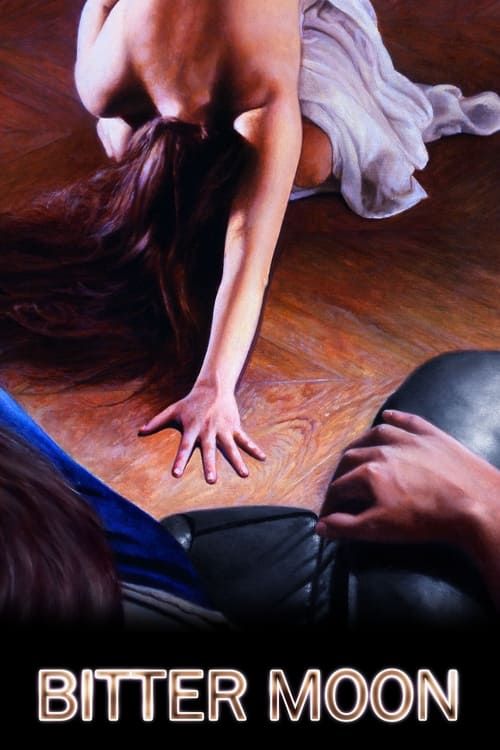
Bitter Moon (1992)
Directed by Roman Polanski
No — Bitter Moon is not woke, scoring 11 out of 100 on our wokeness meter.
Roman Polanski's Bitter Moon arrives on a Mediterranean cruise ship bound for Istanbul, where a British couple (Hugh Grant, Kristin Scott Thomas) fall into the orbit of a paraplegic American writer and his young French wife.
Consciousness Markers
A same-sex kiss between Fiona and Mimi anchors the New Year's Eve climax, and Oscar claims the women slept together, but it is staged as a titillating provocation for a male audience rather than affirming representation.
The cast is overwhelmingly white European and American, with Victor Banerjee and Sophie Patel providing the only non-white presence as a minor Indian gentleman and his daughter aboard the cruise.
Mimi eventually dominates and humiliates Oscar and Fiona asserts she can outdo her husband, but the film remains a male-gaze fantasy built on the objectification and degradation of its central woman.
Mr. Singh offers a mild aphorism about children being better marital therapy than a trip to India, but the film preaches nothing and revels in amoral provocation.
The Indian characters exist as decorous background figures dispensing marital wisdom; the film engages no racial themes or commentary whatsoever.
A storm at sea interrupts the party, but it is a dramatic device, not an environmental statement.
No economic critique or class commentary is present in this tale of erotic obsession.
Oscar's paraplegia is used as a weapon of cruelty and grotesquerie, the opposite of any body-positive sensibility.
No exploration of neurodivergence appears in the film.
The film is a contemporary psychological drama with no historical revisionism.
Why it received this score
Roman Polanski's Bitter Moon arrives on a Mediterranean cruise ship bound for Istanbul, where a British couple (Hugh Grant, Kristin Scott Thomas) fall into the orbit of a paraplegic American writer and his young French wife. The film is a study in erotic obsession told as a long, malicious anecdote. Its cast is white European and American to the last deckhand, with Victor Banerjee and Sophie Patel drifting through as a distinguished Indian gentleman and his daughter, present chiefly to dispense a gentle aphorism about marriage and children before the narrative resumes its business. They are decorative, and the film has no interest in them beyond that.
The provocations are plentiful and pointed at a male spectator. A same-sex kiss between Fiona and Mimi caps the New Year's Eve party, staged for the cheers of the assembled guests and the presumed gratification of the men watching. Oscar claims the women slept together, a boast that lands as titillation, not affirmation. Mimi does eventually dominate and humiliate her husband, and Fiona insists she can outdo anything Nigel manages. Yet the camera never stops appraising Mimi as an object to be degraded, which undercuts whatever authority the women are granted.
What the film refuses to do is sermonize. There is no economic critique, no environmental conscience, no meditation on disability beyond Oscar's paralysis as an instrument of cruelty and grotesquerie. Mr. Singh's mild observation about marital therapy is the closest thing to a thesis, and it is a throwaway. Polanski revels in amorality, and the picture ends in gunfire and embraces without a lesson attached. We are left with a nasty, well-made provocation that asks nothing of us but our attention, and offers nothing back but a chill.
Analysis generated by our Consciousness Algorithm
Synopsis
A passenger on a cruise ship develops an irresistible infatuation with an eccentric paraplegic's wife.
Questions about Bitter Moon
Is Bitter Moon woke?
No — Bitter Moon is not woke, scoring 11 out of 100 on our wokeness meter. That earns it a verdict of Ultra Based.
Does Bitter Moon have any woke elements?
Very few. None of the 10 markers reaches 30, the level where a marker counts as present; the highest is LGBTQ+ Themes at 25.
How does Bitter Moon compare to other 1992 movies?
It ranks #28 of the 74 films from 1992 we've scored; their average is 12. The wokest is The Crying Game (62).
How is the Woke Score calculated?
An AI-assisted process researches the film and its reception, scores it 0–100 on ten markers, then combines those into one 0–100 Woke Score. It measures a specific set of 2020s cultural themes, not film quality.