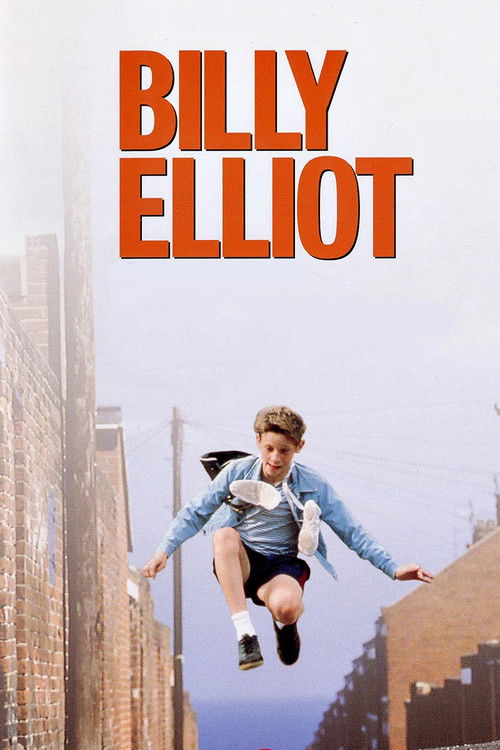
Billy Elliot (2000)
Directed by Stephen Daldry
No — Billy Elliot is not especially woke, scoring 34 out of 100 on our wokeness meter.
In 1984 County Durham, a boy trades boxing gloves for ballet shoes while his father and brother stand on a picket line.
Consciousness Markers
The 1984-85 miners' strike, solidarity, police brutality against strikers, and the devastation of de-industrialisation and privatisation are central, giving the film a strong class-struggle, eat-the-rich spine.
Billy's best friend Michael is gay and there is a cross-dressing scene, with homophobia treated as a real social pressure; the content is present and sympathetic but not centered or framed in modern identity-politics terms.
The film challenges rigid gender norms around male ballet dancing and features the strong-willed mentor Mrs. Wilkinson, but its focus is class and masculinity rather than a feminist agenda.
The class politics are embedded in the emotional coming-of-age narrative rather than delivered as a sermon; the film aims to charm and move rather than preach.
The cast is almost entirely white British, authentically reflecting the County Durham mining community; there is no deliberate diverse or color-conscious casting effort.
The story is set entirely within a white working-class community and engages no racial themes whatsoever.
There is no environmental or climate-related content in the film.
No body-positivity themes or messaging are present.
The grandmother's Alzheimer's is depicted, but this is not framed as neurodivergence in the modern identity sense.
The film sympathetically depicts a real historical event from a working-class perspective but does not reinterpret history through a modern ideological lens.
Why it received this score
In 1984 County Durham, a boy trades boxing gloves for ballet shoes while his father and brother stand on a picket line. Billy Elliot has been read for two decades as a charming crowd-pleaser, and it is one, but beneath the charm sits a sturdy class-struggle spine. The strike is not wallpaper. Police brutality, solidarity, the neighbourhood passing a hat, a father pawning his dead wife's jewellery: the film treats de-industrialisation as a wound inflicted by the state upon a community. That is old-fashioned labour politics, not the newer cultural variety, and the distinction matters for our purposes.
The film's engagement with sexuality is real but modest. Billy's friend Michael is gay, a cross-dressing scene lands with warmth, and the adults' fear that ballet will make Billy gay is presented as a genuine social pressure of the era. The material is sympathetic without being organised around identity as a thesis. Similarly, the story pushes against rigid gender expectations, and Julie Walters's jaded Mrs. Wilkinson is a fine creation, yet the engine here is class and masculinity, not a feminist programme.
Where other markers are concerned, the cupboard is bare. This is a white working-class community and race never enters the frame. There is no environmental content, no body-positivity messaging, and the grandmother's Alzheimer's is presented as illness, not as neurodivergence in any contemporary sense. History is depicted sympathetically from below without being recast through a modern lens. Above all, the film declines to lecture. Its politics arrive through a boy dancing in a gym while the world outside collapses, and the audience is invited to feel it. Charming, moving, and only lightly touched by the preoccupations of a later decade.
Analysis generated by our Consciousness Algorithm
Part of


Synopsis
County Durham, England, 1984. The miners' strike has started and the police have started coming up from Bethnal Green, starting a class war with the lower classes suffering. Caught in the middle of the conflict is 11-year old Billy Elliot, who, after leaving his boxing club for the day, stumbles upon a ballet class and finds out that he's naturally talented. He practices with his teacher Mrs. Wilkinson for an upcoming audition in Newcastle-upon Tyne for the royal Ballet school in London.
Questions about Billy Elliot
Is Billy Elliot woke?
No — Billy Elliot is not especially woke, scoring 34 out of 100 on our wokeness meter. That earns it a verdict of Based.
Does Billy Elliot have any woke elements?
3 of the 10 markers register at 30 or above, led by Eat the Rich (65), LGBTQ+ Themes (45) and Feminist Agenda (30). On Eat the Rich: The 1984-85 miners' strike, solidarity, police brutality against strikers, and the devastation of de-industrialisation and privatisation are central, giving the film a strong class-struggle, eat-the-rich spine.
How does Billy Elliot compare to other 2000 movies?
It ranks #10 of the 125 films from 2000 we've scored; their average is 13. The wokest is But I'm a Cheerleader (72).
How is the Woke Score calculated?
An AI-assisted process researches the film and its reception, scores it 0–100 on ten markers, then combines those into one 0–100 Woke Score. It measures a specific set of 2020s cultural themes, not film quality.