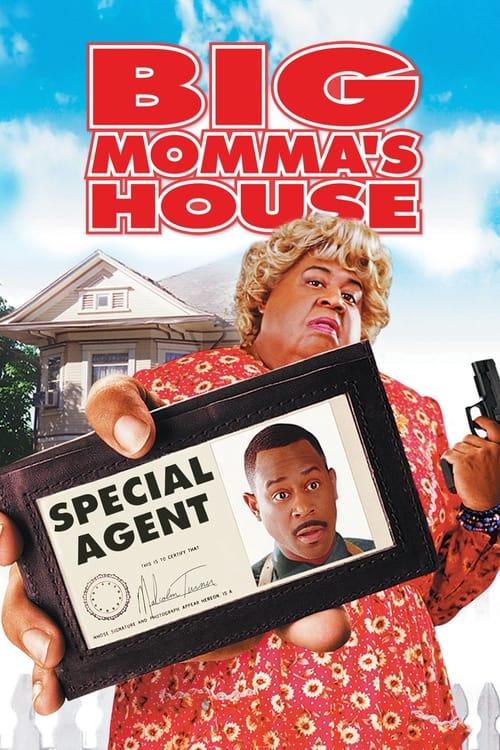
Big Momma's House (2000)
Directed by Raja Gosnell
No — Big Momma's House is not woke, scoring 18 out of 100 on our wokeness meter.
Big Momma's House arrives in the year 2000 with a fat suit, a prosthetic face, and no apparent interest in saying anything at all.
Consciousness Markers
The film features a predominantly Black cast, including Martin Lawrence, Nia Long, and Terrence Howard, but this is a natural element of the story rather than a modern diversity initiative.
No LGBTQ+ themes or characters are present; the cross-dressing is purely a comedic disguise.
The female lead is a single mother in need of protection, and the film does not engage with feminist themes.
While set in a Black community, the film does not explore racial issues or consciousness.
No environmental or climate-related themes.
The plot involves a bank robbery, but it is not framed as a critique of capitalism.
The film uses a fat suit and makes jokes about Big Momma's weight, which is contrary to body positivity.
No neurodivergent characters or themes.
No historical revisionism.
The film is a broad comedy with no preachy or lecture-like messaging.
Why it received this score
Big Momma's House arrives in the year 2000 with a fat suit, a prosthetic face, and no apparent interest in saying anything at all. Martin Lawrence plays Malcolm Turner, an FBI agent who impersonates an elderly Southern woman to stake out a house in Georgia. The premise is an engine for slapstick, and the film knows it, and the film does not care. Raja Gosnell directs with the efficiency of a man delivering a package. The cast is largely Black, from Lawrence to Nia Long to Terrence Howard, and the film treats that fact as ordinary. No announcement is made. No lesson is offered. In the current accounting, that quiet ordinariness registers as a modest, honest figure, not a campaign.
The cross-dressing here carries no identity politics whatsoever. It is a disguise, a means of entry, and a running gag about a lecherous boyfriend and a midwife's duties. Any reading of the material through a contemporary lens of self-expression would be an act of generous misreading. The fat suit invites the audience to laugh at Big Momma's bulk from the opening scene, which places the film at active odds with the modern insistence that bodies be celebrated as they are. Sherry Pierce is a single mother in need of protection, and the screenplay never questions the arrangement. The stolen money is a plot device, not an indictment of banking. Race, class, and climate go unexamined, because the film has other business.
That business is the joke. The climax lands in a church, where Malcolm confesses his love and the choir breaks into Oh Happy Day. The setting supplies warmth and a closing musical number. It does not supply a sermon on social virtue. There is no lecture in this film, only the sound of a man falling over furniture. Critics were unmoved, thirty-one percent on Rotten Tomatoes, and audiences handed it an A, and the box office returned $174 million against a $30 million budget. The classification is straightforward. This is a broad comedy from a less self-conscious era, and its cultural footprint is faint. We file it accordingly, with a small nod to the cast and nothing else.
Analysis generated by our Consciousness Algorithm


Synopsis
When a street-smart FBI agent is sent to Georgia to protect a beautiful single mother and her son from an escaped convict, he is forced to impersonate a crass Southern granny known as Big Momma in order to remain incognito.
Questions about Big Momma's House
Is Big Momma's House woke?
No — Big Momma's House is not woke, scoring 18 out of 100 on our wokeness meter. That earns it a verdict of Ultra Based.
Does Big Momma's House have any woke elements?
1 of the 10 markers register at 30 or above, led by Representation Casting (30). On Representation Casting: The film features a predominantly Black cast, including Martin Lawrence, Nia Long, and Terrence Howard, but this is a natural element of the story rather than a modern diversity initiative.
How does Big Momma's House compare to other 2000 movies?
It ranks #30 of the 125 films from 2000 we've scored; their average is 13. The wokest is But I'm a Cheerleader (72).
Is Big Momma's House the most woke Big Momma's House movie?
Yes. It scores highest of the 3 Big Momma's House films we've scored.