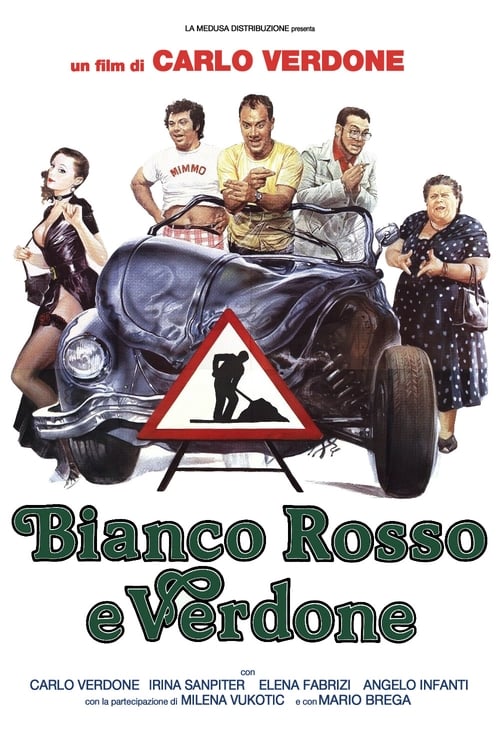
Bianco, rosso e Verdone (1981)
Directed by Carlo Verdone
No — Bianco, rosso e Verdone is not woke, scoring 0 out of 100 on our wokeness meter.
We approach Bianco, rosso e Verdone with the weary professionalism of a sommelier uncorking a bottle of Lambrusco.
Consciousness Markers
Pasquale's final rant delivers an explicit political message about voting and the Italian state, but the film remains primarily a comic satire rather than a lecture.
The cast is overwhelmingly Italian, with a Russian actress and a German character present as narrative elements rather than modern representation casting.
There are no LGBTQ+ themes or characters in the film.
Magda's frustration and eventual escape from her pedantic husband are played for comedy, not framed as a feminist agenda.
The film touches on Southern Italian emigration and regional stereotypes, but not modern racial consciousness.
No environmental or climate themes are present.
The satire targets election-day bureaucracy and political disillusionment, not capitalism or wealth inequality.
There is no body-positivity theme or messaging.
Furio's obsessive pedantry and Mimmo's naivety are comedic character traits, not framed as neurodivergence.
The film is a contemporary 1981 satire and does not revise historical events.
Why it received this score
We approach Bianco, rosso e Verdone with the weary professionalism of a sommelier uncorking a bottle of Lambrusco. Carlo Verdone's 1981 comedy follows three men on election day, each journey a study in Italian dysfunction. The film's cultural sensibilities are those of a previous era, a time when a pedantic clerk driving his wife to distraction was simply funny, not a teachable moment about emotional labor. There is no modern representation casting to speak of, unless we count a Russian actress with striking blue eyes as a stand-in for Roman wifehood. The LGBTQ+ themes are absent, as are climate concerns and body positivity. We searched for a feminist agenda and found only Magda's escape with a handsome stranger, played for laughs. Racial consciousness is not on the menu either, though the film does note the regional condescension shown to southern emigrants. None of this is a failing. It is simply a film from 1981 that has not been retrofitted with contemporary pieties.
The lone flicker of sermonizing arrives late, when Pasquale, a nearly mute immigrant in Germany, finally snaps. His rant against the Italian state and the pointlessness of voting is impassioned and unintelligible, a burst of political exasperation that lasts just long enough to register as a message. But the film quickly returns to its comic business, and we are left with the impression that the rant is less a lecture than a pressure valve. The other characters offer no such relief. Furio's obsessive nitpicking is a character trait, not a diagnosis. Mimmo's naivety is not neurodivergence. The grandmother's death in the voting booth is a grim punchline, not a revisionist history. We note these absences without judgment, as a botanist might note the absence of orchids in a parking lot.
The result is a film that scores near zero on every marker of modern social consciousness, except for that brief, wearying rant. We award it a negligible nod for lecture energy, and nothing else. It is a relic, but a harmless one, like a faded campaign poster for a party that no longer exists. We watched it with the mild fatigue of a critic who has seen every cause and every backlash, and we found it refreshingly free of both.
Analysis generated by our Consciousness Algorithm


Synopsis
Three very different Italians travel to their hometowns on election day: Pasquale, a Southern immigrant living in Munich, finds a country far removed from the one he left behind; Roman civil servant Furio's relentless nitpicking threatens to push his wife Magda over the edge; young Mimmo's journey is repeatedly interrupted by concerns about his grandmother's health.
Questions about Bianco, rosso e Verdone
Is Bianco, rosso e Verdone woke?
No — Bianco, rosso e Verdone is not woke, scoring 0 out of 100 on our wokeness meter. That earns it a verdict of Ultra Based.
Does Bianco, rosso e Verdone have any woke elements?
Very few. None of the 10 markers reaches 30, the level where a marker counts as present; the highest is Lecture Energy at 10.
How does Bianco, rosso e Verdone compare to other 1981 movies?
It ranks #32 of the 43 films from 1981 we've scored; their average is 5. The wokest is The Fox and the Hound (18).
How is the Woke Score calculated?
An AI-assisted process researches the film and its reception, scores it 0–100 on ten markers, then combines those into one 0–100 Woke Score. It measures a specific set of 2020s cultural themes, not film quality.