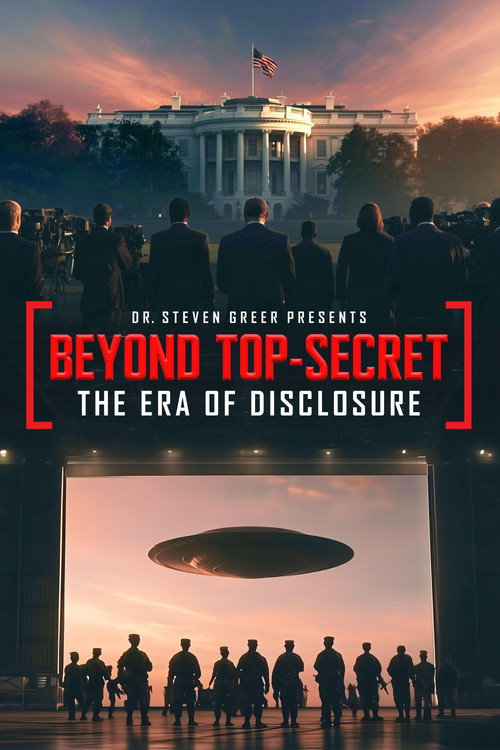
Beyond Top Secret: The Era of Disclosure (2026)
Beyond Top Secret: The Era of Disclosure arrives as a document of considerable sincerity, which is either its greatest strength or its most bewildering quality, depending on your prior relationship with Dr. Steven Greer.
Consciousness Markers
Dr. Greer is not a man who entertains the possibility that he might be wrong, and the film carries his evangelical certainty throughout. The lecture energy is real, but it is directed at the Deep State rather than at the audience's moral failings, which places it outside the standard woke register.
The film frames corporate energy cartels and shadow financial interests as the primary enforcers of the cover-up, which carries a recognizable anti-capitalist charge. It stops well short of class analysis, preferring to blame specific shadowy elites rather than the system itself.
The film argues that suppressed off-world zero-point energy technology could end fossil fuel dependence and resolve global resource scarcity. This is climate adjacency by way of conspiracy theory, which is a genuinely novel route to the genre.
The witnesses are predominantly former military officers and defense contractors, a demographic that skews heavily toward a specific type. No discourse around representation exists, and the film makes no apparent effort to foreground it.
There is no LGBTQ+ content, framing, or subtext of any kind. The film is entirely preoccupied with beings from other solar systems, not human identity categories.
No feminist framing is present. The cast of witnesses appears to be largely male military and intelligence figures, and the film does not comment on this in any way.
Racial consciousness is entirely absent from the film's concerns. The cover-up being alleged is equal-opportunity: it apparently oppresses all of humanity regardless of demographic.
Body positivity does not feature. The film's relationship to bodies is limited to the claim that some of them have been in contact with non-human intelligence.
No neurodivergence themes are present. The film does not address cognitive difference, though a mainstream psychiatrist might find the subject matter an interesting case study.
The film presents itself as revealing suppressed truth rather than revising a historical consensus on social justice grounds. Revisionist history in the woke sense requires a corrective social lens; this film's lens is a telescope pointed at the sky.
Why it received this score
Beyond Top Secret: The Era of Disclosure arrives as a document of considerable sincerity, which is either its greatest strength or its most bewildering quality, depending on your prior relationship with Dr. Steven Greer. The film proceeds with the calm assurance of a man who has already won the argument and is simply waiting for the rest of civilization to catch up. Former military personnel testify about reverse-engineered spacecraft, psionic weapons programs, and the institutional machinery of secrecy, all presented with the solemn gravity of a Senate hearing that will never actually happen. As a work of progressive social consciousness, it scores approximately as well as a 1987 Air Force procurement manual. The film's concerns are elsewhere.
Where the film brushes against the modern progressive register, it does so accidentally. The argument that suppressed zero-point energy could end fossil fuel dependence is, in structural terms, a climate argument, though it arrives via a route that the Sierra Club has not yet endorsed. The villains are corporate energy cartels and unaccountable shadow agencies, which gives the film a faint anti-establishment flavor. This is not, however, the targeted critique of capital that earns points on our scale. It is more the generalized suspicion of powerful institutions that unites libertarians, conspiracy theorists, and certain strands of the left in an uneasy coalition that none of them particularly enjoy.
The film's social consciousness, such as it is, concerns a cover-up affecting all of humanity in aggregate, with no particular attention to which segments of humanity have been more or less covered up. Dr. Greer advocates for peaceful contact protocols, which is a pacifist position, and he charges for the app that teaches you to practice them, which is a capitalist one. The film does not appear to notice the tension. We observe, classify, and move on.
Analysis generated by our Consciousness Algorithm
Synopsis
Dr. Steven Greer leads the charge toward ultimate disclosure. Bringing forward firsthand military whistle-blowers, the film exposes the decades-long institutional cover-up surrounding off-world technology and classified programs.