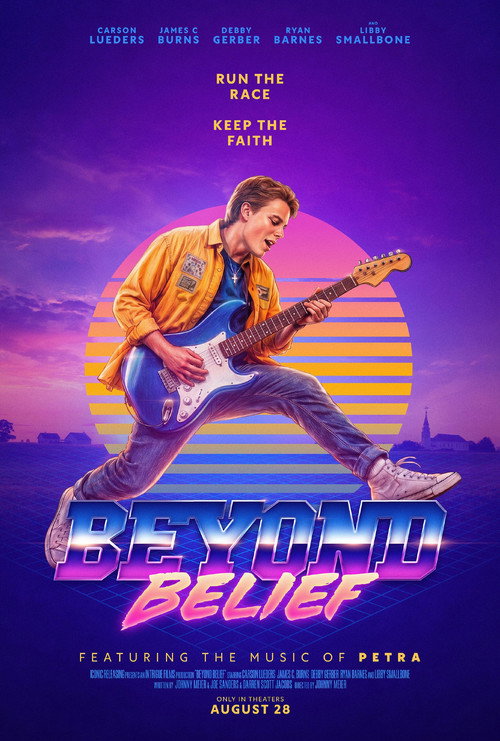
Beyond Belief (2026)
Directed by Johnny Meier
A grieving teenager hears a voice telling him to run.
Consciousness Markers
Faith-based films carry an inherent tendency toward sermonizing, and reviews note multiple subplots converging on the film's theological thesis. The lecturing here is of the traditional evangelical variety rather than the progressive social justice variety, which places it outside the scoring criteria but earns a token acknowledgment that someone is definitely telling you what to think.
The film is set in the 1980s and targets a traditional Christian family audience. There is no evidence of intentional diversity casting or representation-forward choices in the ensemble.
No LGBTQ+ themes, characters, or subtext are present. The film is distributed via Angel Studios and endorsed by evangelical Christian organizations, making this the least likely address on the street.
The central narrative follows a teenage boy processing grief and divine calling. No feminist framing or gender-politics commentary is present or reported.
There is no racial consciousness messaging in the film. The discourse around it is entirely contained within faith and 1980s nostalgia communities, with zero engagement on racial themes.
A 1980s-set story about a teenager running a marathon at God's behest offers no opening for climate messaging, and none was found.
The film's concerns are theological, not economic. No critique of capitalism, wealth, or corporate power is present or implied.
No body positivity themes are present. The protagonist training for a marathon is, if anything, a fairly traditional endorsement of physical discipline.
No neurodivergent characters or themes are identified in the research or in the film's premise. The mysterious voice is framed as divine, not neurological.
The 1980s setting is used for nostalgia and authenticity around Christian rock, not to reframe or critique the era through a modern lens.
Why it received this score
A grieving teenager hears a voice telling him to run. He runs. This is the film. That the voice is understood to be God's, and that the resulting marathon training is set against a backdrop of Petra deep cuts and 1980s Christian rock nostalgia, tells you everything you need to know about where this film sits on the cultural spectrum. It sits very far from the progressive end. It sits, in fact, so far from it that the needle does not so much as quiver.
Beyond Belief is a faith-based family drama distributed by Angel Studios, endorsed by evangelical Christian musicians, and reviewed warmly by Focus on the Family. It is, in the taxonomy of modern cultural classification, the antimatter to the particle this instrument is designed to detect. Every marker returns an empty reading. The representation is unremarkable, the gender politics are nonexistent, and the closest the film comes to a radical act is suggesting that a teenager should perhaps listen to God instead of pursuing rock stardom. Theologians may debate this. Our instrument does not.
The only faint signal comes from the film's sermonizing tendencies, which are, by all accounts, present and committed. But the sermon being delivered is a traditional Christian one about grief, perseverance, and divine calling, which predates the current cultural moment by approximately two thousand years. We score what we find, and what we find here is a film that would have been equally at home in 1986, which is, one suspects, precisely the point.
Analysis generated by our Consciousness Algorithm

Synopsis
An aspiring teenage rock star trains for a marathon after hearing a mysterious voice.