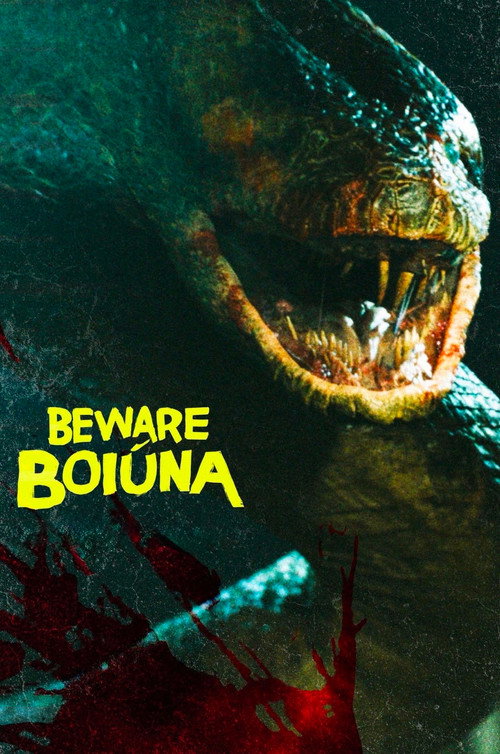
Beware Boiúna (2026)
Directed by Mike P. Nelson
Beware Boiúna arrives as a creature feature that has looked at the Anaconda franchise and decided, with some conviction, that what the genre truly needed was a third act staged at an illegal mining operation accompanied by reflections on Amazonian ecological trauma.
Consciousness Markers
The film's eco-fable framing is overt: the Boiúna is explicitly a force defending the jungle against human encroachment and industrial extraction. Critics noted endless pontificating about the delicate state of the Amazon after decades of industrial incursion, and the climax is staged at a construction site in the creature's habitat.
The film is anchored by a female duo: one American white woman and one Afro-Latina local woman. The broader cast includes Colombian and Latin American actors in substantive roles, and the film was shot on location in Colombia, suggesting a deliberate effort at regional authenticity.
Critics specifically flagged endless pontificating about Amazon destruction, and the RogerEbert.com review noted the film's commentary on colonization. The creature's symbolic role as ecological avenger is delivered with the seriousness of a nature documentary narrated by someone who has just finished reading a UNEP report.
The narrative is structured around two female leads who drive the survival plot. The creature herself is gendered female and framed as a powerful, sovereign force who decides who lives and who dies, lending the film a notably matriarchal symbolic register.
The plot explicitly involves an Afro-Latina character whose brother disappeared while investigating illegal mining operations, tying racial and indigenous identity to the film's environmental conflict. Critics noted explicit commentary on white colonization of the region.
Illegal mining operations serve as the inciting backstory, and the film frames industrial resource extraction in the Amazon as the moral transgression that awakens the creature. The villains are not cartoonish but are structurally tied to extractive capitalism.
The film draws on Indigenous Brazilian folklore and frames the Amazon's colonial history as an ongoing wound. The framing of Western presence as encroachment rather than exploration carries a mild revisionist perspective, though the film does not engage in explicit historical rewriting.
No LGBTQ+ themes, characters, or subtext are present in the available research or plot summary.
No body positivity themes or messaging are present in the film's research summary or plot.
No neurodivergence themes or characters are identified in the available material.
Why it received this score
Beware Boiúna arrives as a creature feature that has looked at the Anaconda franchise and decided, with some conviction, that what the genre truly needed was a third act staged at an illegal mining operation accompanied by reflections on Amazonian ecological trauma. Director Mike P. Nelson has made a film in which a colossal mythological serpent serves as the Amazon's self-appointed enforcement mechanism, and the film would very much like you to understand why she is right to do so. The Boiúna is gendered female, described as reclaiming her domain, and is framed throughout as a corrective force against Western industrial encroachment. This is, to be clear, a lot of symbolic freight for a giant snake.
The human architecture supporting this allegory is consciously assembled: a white American medical volunteer paired with an Afro-Latina local mechanic whose activist brother vanished while documenting illegal mining. Critics at ScreenAnarchy noted the film's "endless pontificating" about Amazonian degradation, and the climax at a construction site drives the point home with the subtlety of a bulldozer clearing protected rainforest. To the film's partial credit, the creature's indiscriminate appetite does blunt the eco-parable somewhat, as the Boiúna does not appear to have read the script closely enough to spare the more sympathetic characters. Nature, it turns out, is not a particularly nuanced ally.
The film scores respectably across several markers of contemporary social consciousness, most notably in its climate messaging, its female-led structure, and its racial framing of the Amazon conflict. What keeps it from the upper reaches of the scale is a genre that ultimately demands the monster eat people regardless of their carbon footprint, and a production that, for all its sermonizing, still needs a third-act chase sequence. It is a film that wants to be a rebuke of extractive capitalism and also, occasionally, a movie where a snake eats someone. It manages both, with varying degrees of grace.
Analysis generated by our Consciousness Algorithm
Part of
Synopsis
Deep in the Amazon, a medical mission spirals into a fight for survival when Boiúna, a colossal ancient predator, awakens to reclaim her domain. In the jungle where nature holds absolute power, she decides who lives and who dies.