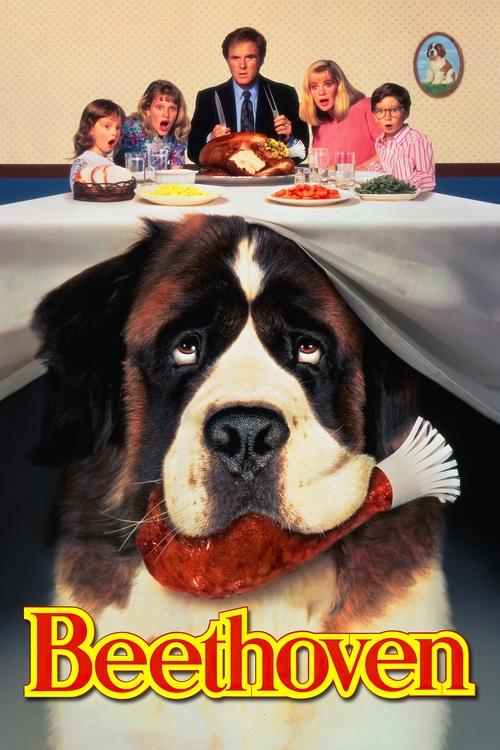
Beethoven (1992)
Directed by Brian Levant
No — Beethoven is not woke, scoring 6 out of 100 on our wokeness meter.
Beethoven arrives in 1992 as a Universal family comedy with John Hughes hiding behind the pseudonym Edmond Dantès, which remains the most subversive act anyone involved commits.
Consciousness Markers
The villains include unpleasant venture capitalists trying to swindle the father's small firm, but this is stock family-film villainy rather than a systemic anti-capitalist critique.
The cast and suburban family milieu are overwhelmingly white and contain no meaningful diverse casting or commentary.
There are no LGBTQ+ characters, themes, or subtext.
The film places the mother in a domestic role and was criticized for apparent bias against working mothers; it offers no feminist argument.
There is no engagement with race, racism, or racial consciousness.
There is no environmental or climate theme.
The film does not promote body positivity or challenge body norms.
There is no depiction or discussion of neurodivergence.
The film is not engaged in revising or reframing historical narratives.
The story delivers gentle family and animal-rights messages without a preachy, issue-driven lecture.
Why it received this score
Beethoven arrives in 1992 as a Universal family comedy with John Hughes hiding behind the pseudonym Edmond Dantès, which remains the most subversive act anyone involved commits. A stolen St. Bernard puppy wanders into the Newton household, a comfortable white suburban home with a workaholic father, a patient mother, and three children who exist largely to be rescued. The dog drools, the father grumbles, the vet turns out to be testing ammunition on large-skulled canines. This is the cinema of the well-fed household, and it knows precisely what it is.
The film's only faint political pulse comes from Brad and Brie Wilson, venture capitalists looking to swindle George out of his car air freshener firm. They are villains because they are rich and rude, the oldest shorthand in the family-film playbook, and it carries no systemic weight at all. The rest is a closed loop of domestic anxiety. Alice leaves her job after a babysitter lets Emily nearly drown, a plot beat several critics read as a quiet rebuke of working mothers. The film does not argue the point. It arranges the furniture that way and moves on.
There is no racial consciousness on display, no queerness, no environmental sermon, no disability, no reframing of history, and only the mildest gesture toward animal welfare by way of a murderous veterinarian. The American Veterinary Medical Association wrote letters of protest, which is more ideological engagement than the screenplay manages. This is a well-engineered dog picture that earned its money and asked for nothing from us but a ticket. Classification is swift and merciful. The cultural ledger remains untouched.
Analysis generated by our Consciousness Algorithm
Part of


Synopsis
The Newton family live in their comfortable home, but there seems to something missing. This "hole" is filled by a small puppy, who walks into their home and their lives. Beethoven, as he is named, grows into a giant of a dog... a St Bernard. Doctor Varnick, the local vet has a secret and horrible sideline, which requires lots of dogs for experiments. Beethoven is on the bad doctor's list.
Questions about Beethoven
Is Beethoven woke?
No — Beethoven is not woke, scoring 6 out of 100 on our wokeness meter. That earns it a verdict of Ultra Based.
Does Beethoven have any woke elements?
Very few. None of the 10 markers reaches 30, the level where a marker counts as present; the highest is Eat the Rich at 10.
How does Beethoven compare to other 1992 movies?
It ranks #46 of the 74 films from 1992 we've scored; their average is 12. The wokest is The Crying Game (62).
How is the Woke Score calculated?
An AI-assisted process researches the film and its reception, scores it 0–100 on ten markers, then combines those into one 0–100 Woke Score. It measures a specific set of 2020s cultural themes, not film quality.