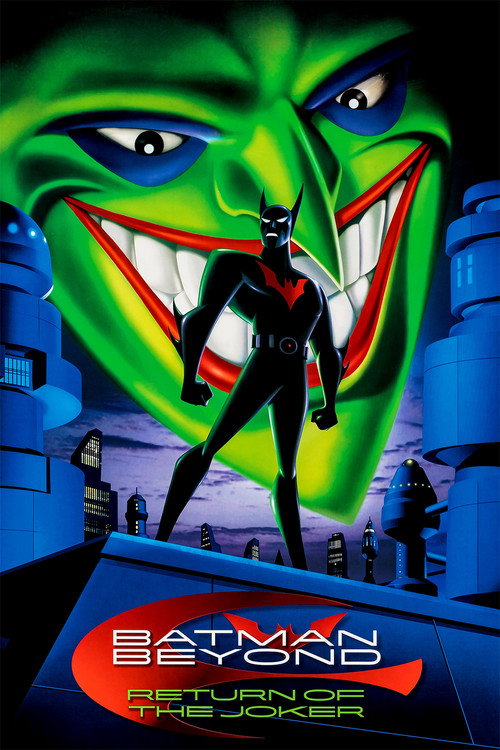
Batman Beyond: Return of the Joker (2000)
Directed by Curt Geda
No — Batman Beyond: Return of the Joker is not woke, scoring 4 out of 100 on our wokeness meter.
Batman Beyond: Return of the Joker arrives from the year 2000 with a straightforward mission: let Terry McGinnis trade punches with a resurrected clown and let Mark Hamill enjoy the microphone.
Consciousness Markers
Barbara Gordon serves as Police Commissioner and a capable former Batgirl, but this is standard competent characterization rather than a feminist thesis; the film is a male-led action narrative.
The voice cast is overwhelmingly white, with no diverse casting choices made as a statement; characters exist as written for the series without any representational intent.
A scheming corporate executive (Jordan Pryce) appears as a secondary antagonist, but the film offers no systemic critique of capitalism or wealth.
A straightforward action-mystery with no preachy moralizing or social messaging directed at the audience.
No LGBTQ+ characters, themes, or subtext appear anywhere in the film.
No engagement with racial themes or racial consciousness whatsoever.
No environmental or climate themes present.
No body positivity themes or messaging.
The Joker's madness is villainous caricature, not a depiction of neurodivergence; no neurodivergent representation is present.
The film operates within established Batman continuity without reinterpreting or revising historical events.
Why it received this score
Batman Beyond: Return of the Joker arrives from the year 2000 with a straightforward mission: let Terry McGinnis trade punches with a resurrected clown and let Mark Hamill enjoy the microphone. It performs this mission with efficiency and a certain grim polish. The cultural inventory, however, is sparse. The voice cast is drawn from the existing series and the broader animation talent pool of the period, with no representational architecture behind it. Barbara Gordon has become Police Commissioner and retains her Batgirl history, which registers as competent continuity, not a thesis. The film is male-led, and its feminism is the kind that arrives by inheritance.
Elsewhere the ledger is emptier. There are no LGBTQ themes or subtext, no engagement with racial consciousness, no climate concerns, no body positivity, and no neurodivergent representation. The Joker's madness remains villainous theater, not a case study. A Wayne Enterprises executive schemes for money and revenge, but the screenplay has no systemic critique in mind; he is a plot obstacle in a suit. The story works inside established Batman continuity and does not revise history. Its moral address is minimal. This is an action-mystery that wants to unsettle children and satisfy fans, not lecture them.
None of this makes the film bad. It makes it a clean specimen of its era, a direct-to-video superhero picture with a famous villain, a dark flashback, and a PG-13 reputation earned through violence instead of sermonizing. The serious critic can admire the craft and still note that the social consciousness is nearly absent. A film can be effective without being a pamphlet. This one is effective, and it is almost entirely unpamphleted.
Analysis generated by our Consciousness Algorithm


Synopsis
The Joker is back with a vengeance, and Neo-Gotham's Dark Knight, Terry McGinnis, needs answers as he stands alone to face the old Gotham's most infamous Clown Prince of Crime.
Questions about Batman Beyond: Return of the Joker
Is Batman Beyond: Return of the Joker woke?
No — Batman Beyond: Return of the Joker is not woke, scoring 4 out of 100 on our wokeness meter. That earns it a verdict of Ultra Based.
Does Batman Beyond: Return of the Joker have any woke elements?
Very few. None of the 10 markers reaches 30, the level where a marker counts as present; the highest is Feminist Agenda at 12.
How does Batman Beyond: Return of the Joker compare to other 2000 movies?
It ranks #92 of the 125 films from 2000 we've scored; their average is 13. The wokest is But I'm a Cheerleader (72).
How is the Woke Score calculated?
An AI-assisted process researches the film and its reception, scores it 0–100 on ten markers, then combines those into one 0–100 Woke Score. It measures a specific set of 2020s cultural themes, not film quality.