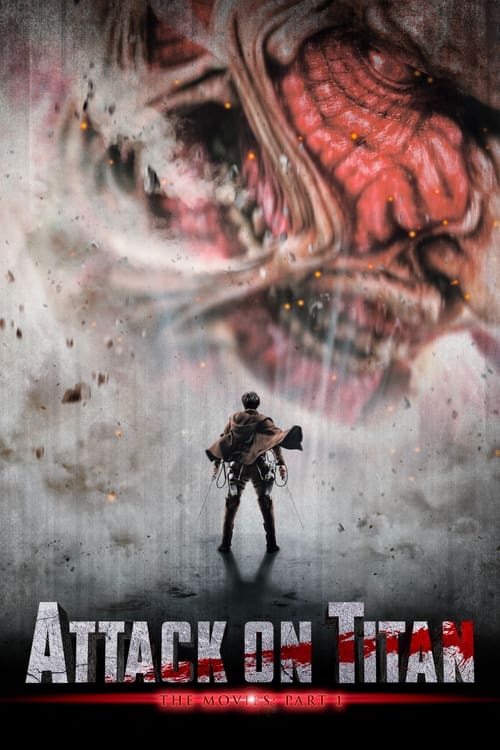
Attack on Titan (2015)
Directed by Shinji Higuchi
No — Attack on Titan is not woke, scoring 7 out of 100 on our wokeness meter.
This is two films, released in the summer and autumn of 2015 and adapted from Hajime Isayama's manga, which had already sold in quantities that made a live-action production an inevitability rather than a decision.
Consciousness Markers
Mikasa is a competent frontline soldier and Sasha gets a heroic moment, but this is inherited manga characterization rather than any articulated feminist thesis.
Shikishima's coup targets a 'corrupted government' that oppresses its people behind the walls, but this is generic anti-authoritarianism rather than an eat-the-rich economic critique.
The script carries heavy thematic undertones about fear and freedom, but it delivers them through action and melodrama rather than preachy sermonizing.
The cast is entirely Japanese, reflecting the film's domestic production and Japan-relocated setting; there is no diversity-casting intent or commentary.
No LGBTQ+ characters, relationships, or themes appear anywhere in either part.
The film engages no racial themes or identity politics; the conflict is humans versus Titans and a corrupt government.
No environmental or climate messaging; the apocalypse here is caused by a man-made Titan virus, not ecological collapse.
No body-positivity themes; the Titans are monstrous bodies to be feared and dismembered.
No neurodivergent characters or themes are present.
The film is a fictional post-apocalyptic fantasy with no historical revisionism.
Why it received this score
This is two films, released in the summer and autumn of 2015 and adapted from Hajime Isayama's manga, which had already sold in quantities that made a live-action production an inevitability rather than a decision. Shinji Higuchi directs with an affection for rubber and gristle. The Titans are enormous, wet, and unpleasant. The setting has been relocated from a Germanic analogue to something unmistakably Japanese, and the cast is entirely Japanese in consequence. There is no diversity-casting agenda here, no commentary on who gets to be on screen. The production simply went home.
The human material is thinner. Mikasa wields her blades with competence and Sasha gets a moment of genuine heroism, though both arrive as inheritance from the source, not as an argument. No thesis is advanced. The second part introduces Shikishima, who has stockpiled pre-war weapons and intends to topple a corrupted government that keeps its people docile behind walls and fear. It is a coup against authority, not a redistribution of wealth. The rich are not named. Nobody is eaten for their portfolio.
Where the script does carry weight is in its themes: fear as a governing instrument, freedom as an expensive proposition, the wall as a thing people build around themselves and then call peace. These ideas are delivered through collapsing towers, dismemberment, and melodrama. The film never stops to explain itself, which is the correct instinct and a rare one. The result is loud, messy, occasionally nonsensical, and free of sermons. Part two underperformed at the box office, which is the market's way of registering a verdict, and the verdict was unkind. The films remain a curiosity, a big-budget B picture with no interest in improving anyone. That counts for something in any decade.
One hundred years of walls, one hundred years of appetite, and not a single character asked to serve as a lesson. The classification is straightforward and the evening is saved. I would watch it again, though not on a weeknight and certainly not with anyone who wants to discuss it afterward. Some films are simply bodies in motion, and this one knows it. There is a species of honesty in that which the more earnest productions never manage, and which the more cynical ones never bother to attempt. It is not a compliment I hand out often. It is not a compliment the film asked for. It is, however, the one it earns, and I have written it down in the ledger with the appropriate sobriety and the appropriate pen. The ledger is long. The evening is late. The Titans are enormous, wet, and unpleasant, and they have been filed accordingly under the heading of things that simply are what they are, which is the only heading that has ever held up under scrutiny, and the only one I still trust after all these years of watching and counting and writing it all down for nobody in particular. The wall holds. The wall does not hold. It never matters as much as the running.
Such films exist to be classified, and I have classified this one. The pen is capped. The lights come up. The audience files out in silence, which is the correct response and the only one available. There is nothing to argue about, no positions to stake, no coalition to assemble. The Titans ate people and the people ate back. Somewhere a committee is drafting a memo about the themes. The memo will not be read. The wall holds anyway, or it does not, and either way the ocean is visible from the top of it, which is more than most films can promise and precisely what this one delivers, at speed, with gristle, and without a single word of instruction for the rest of us.
Analysis generated by our Consciousness Algorithm


Synopsis
100 years ago, titans suddenly appeared on Earth. Soon, human civilization veered on collapse due to the titans. Humans then built a giant wall to defend themselves. Within the giant walls, humans lived in peace, but, 100 years later, the giant wall is broken.
Questions about Attack on Titan
Is Attack on Titan woke?
No — Attack on Titan is not woke, scoring 7 out of 100 on our wokeness meter. That earns it a verdict of Ultra Based.
Does Attack on Titan have any woke elements?
Very few. None of the 10 markers reaches 30, the level where a marker counts as present; the highest is Eat the Rich at 10.
How does Attack on Titan compare to other 2015 movies?
It ranks #183 of the 289 films from 2015 we've scored; their average is 15. The wokest is Chi-Raq (78).
How is the Woke Score calculated?
An AI-assisted process researches the film and its reception, scores it 0–100 on ten markers, then combines those into one 0–100 Woke Score. It measures a specific set of 2020s cultural themes, not film quality.