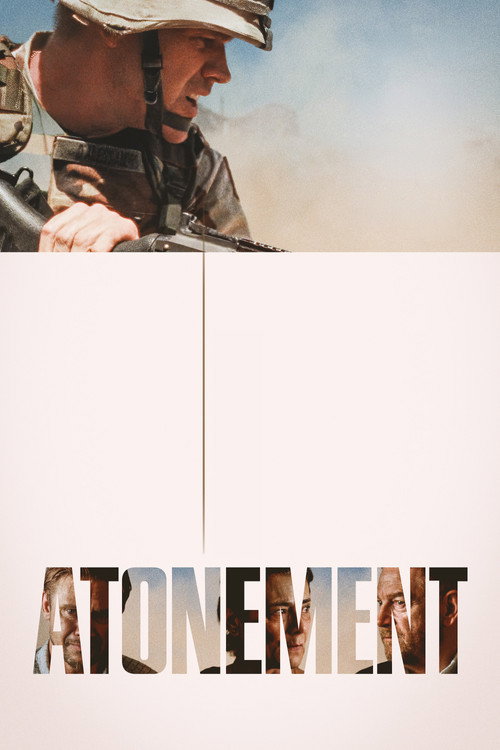
Atonement (2026)
Directed by Reed Van Dyk
Reed Van Dyk's feature debut arrives bearing the full weight of its intentions, adapted from Dexter Filkins' 2012 New Yorker dispatch and wearing its moral seriousness the way a penitent wears a hair shirt: conspicuously, and with some evident satisfaction.
Consciousness Markers
The film makes a deliberate, self-aware choice to cast prominent Middle Eastern actors (Hiam Abbass, Gheed) and centers the narrative on an Armenian-Iraqi family. Critical discourse explicitly frames this as a corrective to Hollywood's habitual reduction of Iraqi civilians to background furniture.
The film explicitly engages with how Iraqi civilians are racialized and dehumanized by American military culture, and critics noted its conscious subversion of the nameless brown civilian trope. The racial dynamic between the American soldier and the Iraqi family is a named, examined element of the film's thesis.
The film actively reframes the Iraq War away from American heroism and toward Iraqi civilian harm, using a true story to indict the broader military operation. This constitutes a considered revisionist perspective on a recent historical event that American popular culture has largely processed through a soldier-centric lens.
The film resists a tidy redemption arc, which critics praised, but its structural argument is present and pressed: American military action caused irreparable harm to innocent people, and no personal forgiveness can absolve systemic guilt. The thesis is firm, even if the delivery is restrained.
The film's critique of U.S. imperialism, institutional military failures, and the systems that send soldiers into ambiguous civilian combat zones carries a modest anti-establishment charge. It does not target capital directly, but it has little affection for the machinery that produced the war.
The failure of VA mental health resources and the psychological aftermath of combat are raised explicitly by cast members in press and are embedded in the film's treatment of the soldier's guilt. PTSD is framed as a systemic failure, not merely a personal affliction.
Female characters, particularly Mariam and Nora, occupy the emotional and moral core of the narrative. This is more humanist than programmatically feminist, but the centering of women's grief and resilience in a war film is a deliberate structural choice.
No LGBTQ+ themes, characters, or content are present in the film or its surrounding discourse.
No climate or environmental themes are present in any form.
No body positivity themes or content are present in the film.
Why it received this score
Reed Van Dyk's feature debut arrives bearing the full weight of its intentions, adapted from Dexter Filkins' 2012 New Yorker dispatch and wearing its moral seriousness the way a penitent wears a hair shirt: conspicuously, and with some evident satisfaction. The film concerns a U.S. Marine whose split-second decision in the early Iraq War destroys an Armenian-Iraqi family, and who returns years later, journalist in tow, to seek something in the vicinity of forgiveness. Van Dyk, whose previous short film addressed gun violence and de-escalation, has a clear and consistent interest in the space between catastrophic human error and the institutions that enable it. That interest is legitimate. It is also, by the time the film reaches its tense, unresolved confrontation, extremely well-telegraphed.
The film's most genuine achievement is its casting and its insistence on keeping the Iraqi family in frame. Hiam Abbass brings a grief so precise it feels archaeological, and the production's commitment to centering the Khachaturians rather than using them as backdrop for an American veteran's interior weather is a real corrective to a genre that has spent two decades doing exactly the opposite. Critics have correctly noted this subversion. Some have also noted, with equal correctness, that the soldier's guilt still commands a considerable portion of the film's running time, which raises the question of whether a corrective that shares the stage with the thing it is correcting is fully correcting anything. The film does not answer this. It is not sure it should.
Where Atonement earns its composure is in refusing the Hollywood sacrament of clean absolution. There is no cathartic embrace, no tearful mutual healing, no score swelling to indicate that the ledger has been balanced. What the film offers instead is an uneasy silence in a room where two kinds of damage sit across from each other and find they have no common currency. This is, by the standards of the genre, a brave choice. It is also, by the standards of films that know they are being brave, somewhat aware of its own bravery. Van Dyk has made a serious film about serious things. The degree to which it occasionally resembles a serious film about serious things being made seriously is the only charge worth leveling.
Analysis generated by our Consciousness Algorithm
Synopsis
In the early days of the Iraq War, a split-second decision made by a U.S. Marine during a tense standoff devastates an Iraqi family. Years later, aided by a New Yorker journalist, he seeks to reconcile with the family he destroyed.