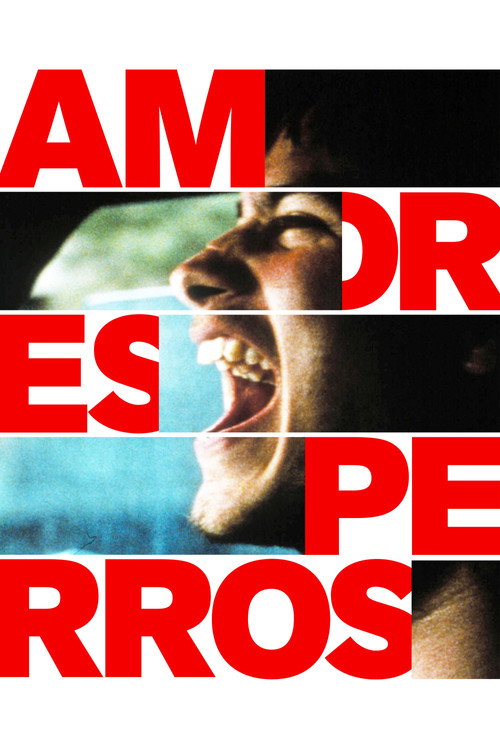
Amores Perros (2000)
Directed by Alejandro G. Iñárritu
No — Amores Perros is not woke, scoring 12 out of 100 on our wokeness meter.
Amores Perros arrives from the year 2000, a triptych of Mexico City misery stitched together by a car crash and a rotating cast of dogs.
Consciousness Markers
The three stories foreground class division and the underground economy as a survival mechanism for the poor, with the wealthy shown as corrupt, but the critique is sociological rather than an explicit eat-the-rich polemic.
The film critiques fractured masculinity and shows domestic violence against Susana, but this is thematic grit rather than a feminist agenda; Valeria's arc is tragic, not polemical.
The ensemble is entirely Mexican and Latin American, but this is a Mexican film made in Mexico with naturally Mexican characters; no casting agenda or comment is present.
The film is a bleak, observational hyperlink drama that shows rather than preaches; its social themes emerge from narrative rather than direct address.
The film's central social concern is class stratification in Mexico City, not racial consciousness; the segregation depicted is economic, not racial.
No LGBTQ+ characters or themes appear anywhere in the triptych.
No environmental or climate themes are present.
Valeria's amputation is treated as tragedy and loss, with no body-positivity framing whatsoever.
No neurodivergent characters or themes are present.
The film is a contemporary fictional drama with no historical revisionism.
Why it received this score
Amores Perros arrives from the year 2000, a triptych of Mexico City misery stitched together by a car crash and a rotating cast of dogs. Iñárritu, in his feature debut, hands us a supermodel, a teenage dogfighter, and a former guerrilla turned hitman, then lets the collision sort them out. The film is grim, propulsive, and entirely uninterested in telling us how to feel. The ensemble is Mexican because the film is Mexican, made in Mexico, about Mexicans. Nobody in the production appears to have been consulting a checklist.
The social content is real and it is bleak. Class stratification runs through all three stories: Valeria's high-rise, Octavio's working-class neighborhood, El Chivo's squat on the outskirts. The wealthy are corrupt, the poor hustle in the underground economy, and the two halves of the city would never meet without a traffic accident. This is sociology, not sermonizing. The film observes fractured masculinity and domestic violence without pausing to explain them. Valeria loses her leg and the film treats it as catastrophe, not as a teachable moment about beauty standards. There is no environmental thread, no LGBTQ thread, no historical revisionism. The dogs are metaphors, not talking points.
So we arrive at the ledger. The class critique registers as genuine and embedded, worth a modest nod. The casting is culturally specific without being a statement. A feminist reading is available to anyone who wants it, but the film declines to argue the case. Everything else sits at zero, and that is not a criticism. This is a brutal, humane, superbly constructed piece of filmmaking that predates the era of the explanatory pamphlet. It shows. It does not tell. Decades from now, someone will still be watching Cofi limp away, and no one will have been lectured.
Analysis generated by our Consciousness Algorithm


Synopsis
A fatalistic car crash in Mexico city sets off a chain of events in the lives of three people: a supermodel, a young man wanting to run off with his sister-in-law, and a homeless man.
Questions about Amores Perros
Is Amores Perros woke?
No — Amores Perros is not woke, scoring 12 out of 100 on our wokeness meter. That earns it a verdict of Ultra Based.
Does Amores Perros have any woke elements?
1 of the 10 markers register at 30 or above, led by Eat the Rich (30). On Eat the Rich: The three stories foreground class division and the underground economy as a survival mechanism for the poor, with the wealthy shown as corrupt, but the critique is sociological rather than an explicit eat-the-rich polemic.
How does Amores Perros compare to other 2000 movies?
It ranks #48 of the 125 films from 2000 we've scored; their average is 13. The wokest is But I'm a Cheerleader (72).
How is the Woke Score calculated?
An AI-assisted process researches the film and its reception, scores it 0–100 on ten markers, then combines those into one 0–100 Woke Score. It measures a specific set of 2020s cultural themes, not film quality.