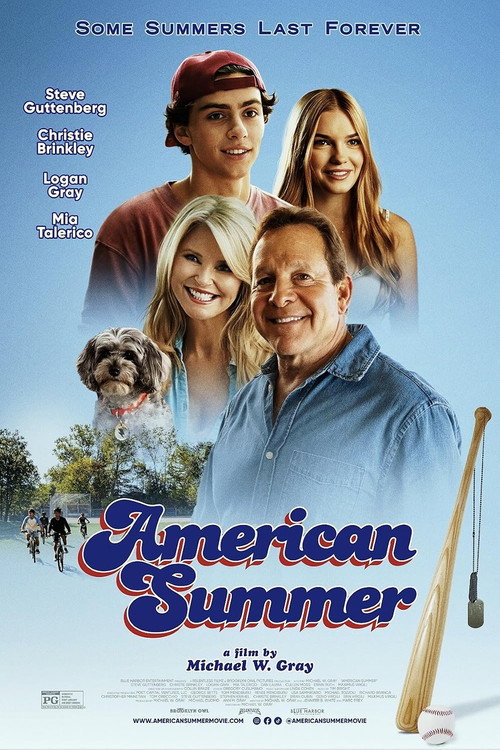
American Summer (2026)
Directed by Michael W. Gray
American Summer arrives bearing every hallmark of a film that has looked deep into the roiling cultural anxieties of the modern moment and decided, with great deliberateness, to go make a movie about baseball.
Consciousness Markers
The cast is largely conventional for a nostalgic small-town American story, with no evidence of conscious diversity casting or representation-forward choices. A marginal score is warranted only because the ensemble has not been confirmed as entirely homogeneous, but no specific representation agenda has been identified.
No LGBTQ+ themes, characters, or subtext have been identified in any available material. The romantic throughline is a straightforwardly heterosexual boyhood crush.
The narrative centers on a boy's coming-of-age journey with no discernible feminist framing. Kelly, the female lead interest, appears to function as a classic boyhood-romance archetype rather than an agent of gender commentary.
No racial consciousness, systemic racism themes, or race-forward narrative framing has been identified in any review, press material, or cultural commentary surrounding the film.
Baseball, first jobs, and missing fathers leave no room for climate messaging. None has been reported.
The film's themes of youth labor (a boy's first job) are framed nostalgically and approvingly, the opposite of anti-capitalist critique. No eat-the-rich energy detected.
No body positivity themes or commentary have been identified. The film shows no interest in this territory.
No neurodivergent characters, themes, or framing have been identified in any available material.
The film's nostalgia is entirely uncritical and celebratory of its era. There is no revisionist impulse whatsoever. It is, by all accounts, the opposite of revisionist.
The director explicitly stated he was not trying to teach or preach. Critics uniformly described the film as wholesome and earnest. The lecture podium is conspicuously unoccupied.
Why it received this score
American Summer arrives bearing every hallmark of a film that has looked deep into the roiling cultural anxieties of the modern moment and decided, with great deliberateness, to go make a movie about baseball. Director Michael W. Gray has constructed a coming-of-age nostalgia piece so thoroughly insulated from contemporary progressive sensibilities that it functions almost as a controlled experiment. The variables tested: first love, youth sports, a grandfather filling the paternal void, a first summer job. The results are, by all critical consensus, impossibly wholesome. We are dealing with a film that critics reached for apple pie metaphors to describe, and did so approvingly.
The social consciousness register here sits at a reading so low our instruments struggle to confirm it is not zero. The narrative is organized around a boy named Mikey, his crush, his baseball team, and an absent soldier father, which is to say it is organized around the foundational grammar of the 1980s family film. Steve Guttenberg and Christie Brinkley appear, which is itself a casting decision that communicates a worldview. Dan Lauria, a man whose entire screen presence suggests he has opinions about proper lawn maintenance, plays the grandfather. No character appears to be delivering a speech about systemic structures. No subplot has been identified that might cause a viewer to feel implicated in historical injustice. The film is, in the precise technical sense, inert on all ten of our markers.
This is not a criticism. It is a classification. American Summer has simply arrived from a different coordinate in the cultural landscape, one where summers are golden, fathers are heroes, and the most pressing moral question is whether a boy deserves a spot on the travel team. On our scale, it scores accordingly. We note this without judgment, the way a geologist notes the absence of a particular mineral in a rock sample. The mineral is not there. The rock is still a rock.
Analysis generated by our Consciousness Algorithm

Synopsis
Now in his 60s, Mikey vividly journeys back to his childhood during one of the best summers of his life when he met the girl of his dreams, Kelly, scored a spot on the travel baseball team, worked his first job and began his growth out of boyhood — all in the sudden wake of his father missing overseas on a military mission.