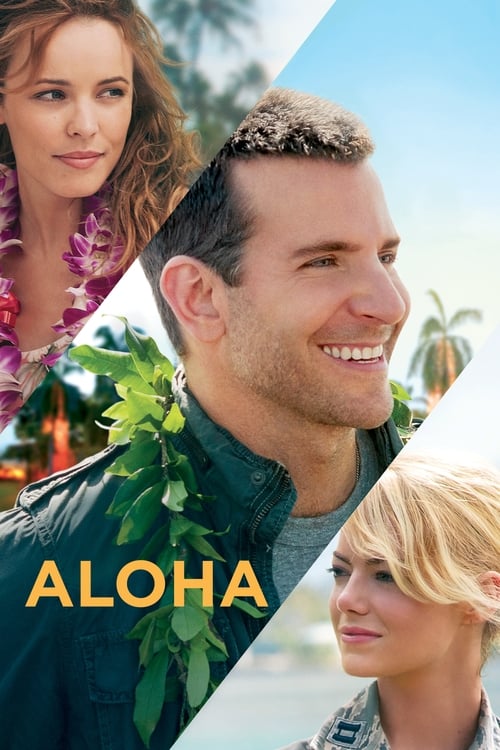
Aloha (2015)
Directed by Cameron Crowe
No — Aloha is not especially woke, scoring 27 out of 100 on our wokeness meter.
Cameron Crowe's Aloha arrives burdened by a casting decision that has aged into a cautionary tale.
Consciousness Markers
The plot engages Native Hawaiian sovereignty, land rights, and a blessing ceremony negotiated with community leader Bumpy Kanahele, giving it genuine indigenous-cultural content, though it is handled sentimentally rather than as a sustained critique.
The antagonist is a billionaire privatizing a weapons satellite over Hawaiian land, and Gilcrest's climactic act is framed around the sky belonging to everyone, giving a mild anti-privatization, anti-military-industrial message.
The film is best known for its whitewashing controversy, casting Emma Stone as a character described as one-quarter Hawaiian and one-quarter Chinese. It does feature authentic Native Hawaiian figures (Bumpy Kanahele as himself) and some diverse supporting players, but the central casting choice is a textbook representation failure.
Emma Stone's Captain Ng is a hard-charging Air Force officer and the film's moral compass, and Rachel McAdams gets a modest arc, but the women largely orbit Bradley Cooper's protagonist in a conventional romantic-comedy structure.
There is a light thematic message about shared skies and the excesses of private military enterprise, but the film is a meandering romance rather than a preachy issue movie.
No LGBTQ+ characters, themes, or subtext appear anywhere in the film.
No environmental or climate themes are present; the satellite and space-center plot is geopolitical rather than ecological.
No body-positivity themes or messaging appear in the film.
No neurodivergent characters or themes are depicted.
The film is a fictional narrative and does not attempt to revise or reinterpret historical events.
Why it received this score
Cameron Crowe's Aloha arrives burdened by a casting decision that has aged into a cautionary tale. Emma Stone plays Captain Allison Ng, a character the screenplay insists is one-quarter Hawaiian and one-quarter Chinese, a heritage the actress does not share. The film attempts to preempt the objection by having Ng over-explain her ancestry at every opportunity, which is a novel strategy: acknowledge the problem and then keep going. The gesture did not land, and the director eventually issued an apology, which is more emotional resolution than most of the plot manages.
To its credit, the film does engage with Native Hawaiian sovereignty in a way few studio romances bother to attempt. The plot turns on a land deal, a blessing ceremony, and the real community leader Bumpy Kanahele playing himself, negotiating for mountains and cell service with the weary pragmatism of a man who has done this before. The villain is a billionaire (Bill Murray) privatizing a weapons satellite, and the climax hinges on the idea that the sky belongs to everyone. It is a soft anti-corporate sentiment, delivered gently, without much conviction behind the sermon.
Elsewhere the film is a conventional love triangle in which the women orbit Bradley Cooper's brooding contractor. Stone's officer is competent and earnest, and Rachel McAdams gets a modest arc, but the structure keeps them in supporting orbits. There is no LGBTQ content, no ecological concern, no engagement with body image or neurodivergence, and no interest in rewriting history. The rest is a meandering romance with a conscience it cannot quite articulate, which is roughly the grade the whole affair earns on its own terms: a wistful shrug in a Hawaiian shirt.
Analysis generated by our Consciousness Algorithm


Synopsis
A celebrated military contractor returns to the site of his greatest career triumphs and re-connects with a long-ago love while unexpectedly falling for the hard-charging Air Force watchdog assigned to him.
Questions about Aloha
Is Aloha woke?
No — Aloha is not especially woke, scoring 27 out of 100 on our wokeness meter. That earns it a verdict of Based.
Does Aloha have any woke elements?
3 of the 10 markers register at 30 or above, led by Eat the Rich (45), Racial Consciousness (45) and Representation Casting (35). On Eat the Rich: The antagonist is a billionaire privatizing a weapons satellite over Hawaiian land, and Gilcrest's climactic act is framed around the sky belonging to everyone, giving a mild anti-privatization, anti-military-industrial message.
How does Aloha compare to other 2015 movies?
It ranks #46 of the 289 films from 2015 we've scored; their average is 15. The wokest is Chi-Raq (78).
How is the Woke Score calculated?
An AI-assisted process researches the film and its reception, scores it 0–100 on ten markers, then combines those into one 0–100 Woke Score. It measures a specific set of 2020s cultural themes, not film quality.