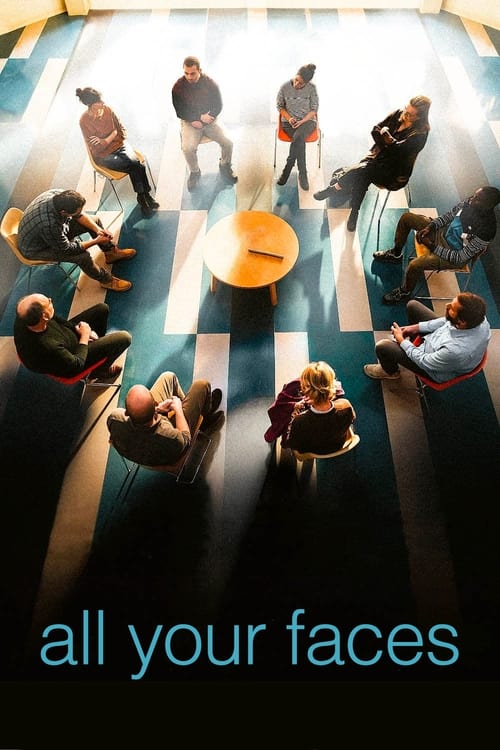
All Your Faces (2023)
Directed by Jeanne Herry
No — All Your Faces is not especially woke, scoring 32 out of 100 on our wokeness meter.
There is a moment, roughly a third of the way into All Your Faces, when a room full of strangers agrees on the rules for speaking to one another, and the film settles into the long, patient work of listening.
Consciousness Markers
The ensemble is notably diverse for a French production, with Maghrebi and Black actors (Birane Ba, Leïla Bekhti, Dali Benssalah) woven naturally into the victim/offender groups, though the diversity reflects the story's social realism rather than a casting mandate.
As a dialogue-driven advocacy piece for restorative justice, the film carries a mild didactic charge, explaining and championing the practice, though it largely trusts character drama over sermonizing.
Several central victims are women, including a survivor of childhood sexual abuse, and the film is directed by a woman, but it frames these as human dramas of justice rather than a feminist thesis.
The cast's diversity gestures at France's multiethnic reality, but race is not interrogated as a theme; the focus remains on the shared mechanics of crime, harm, and repair.
No LGBTQ+ characters, themes, or subtext appear in the film.
No environmental or climate content whatsoever.
The film concerns criminal justice and interpersonal healing, not economic critique or class warfare.
No body-image or body-acceptance themes are present.
No neurodivergent characters or themes are depicted.
The film depicts a contemporary (post-2014) French justice practice; it does not reinterpret historical events.
Why it received this score
There is a moment, roughly a third of the way into All Your Faces, when a room full of strangers agrees on the rules for speaking to one another, and the film settles into the long, patient work of listening. Jeanne Herry has built her drama around France's restorative justice programme, a real practice since 2014 in which victims and offenders of violent crime sit together under professional supervision. The ensemble is large and generous, and the film moves between a group of robbery survivors and their assailants, then breaks away to follow Chloé, a young woman preparing to confront the man who abused her as a child. Adèle Exarchopoulos won a César for that thread, and it is not hard to see why.
The cast reflects the France that actually exists, with Maghrebi and Black performers folded into both the victim and offender ranks without a word of commentary. That feels like social realism, not a casting directive, and the film treats race as background texture. Women carry several of the central roles, including a survivor of childhood sexual abuse, though Herry frames all of it as human drama about harm and repair. The camera stays close. The talk goes on. Anyone hoping for a thesis about power will find instead a workshop about grief.
Where the film leans hardest is its advocacy for the practice itself. The dialogue scenes double as demonstrations, showing us how the method works and why it might. It is preaching, gently, and it mostly earns the sermon because the performances refuse to behave like case studies. The result is a serious, well-made chamber piece about forgiveness as administrative procedure. Worth your time, if you have the patience for it. I did. Barely.
Analysis generated by our Consciousness Algorithm


Synopsis
Since 2014, France's restorative justice programmes have offered a safe space for supervised dialogue between offenders and victims. Grégoire, Nawelle, and Sabine, victims of heists and violent robberies, agree to join one of these discussion groups alongside offenders Nassim, Issa, and Thomas, all convicted of violent robberies. Meanwhile Chloé, a victim of childhood sexual abuse, prepares for dialogue with her own agressor after learning he has moved back into town.
Questions about All Your Faces
Is All Your Faces woke?
No — All Your Faces is not especially woke, scoring 32 out of 100 on our wokeness meter. That earns it a verdict of Based.
Does All Your Faces have any woke elements?
2 of the 10 markers register at 30 or above, led by Representation Casting (45) and Lecture Energy (35). On Representation Casting: The ensemble is notably diverse for a French production, with Maghrebi and Black actors (Birane Ba, Leïla Bekhti, Dali Benssalah) woven naturally into the victim/offender groups, though the diversity reflects the story's social realism rather than a casting mandate.
How does All Your Faces compare to other 2023 movies?
It ranks #49 of the 200 films from 2023 we've scored; their average is 24. The wokest is Origin (84).
How is the Woke Score calculated?
An AI-assisted process researches the film and its reception, scores it 0–100 on ten markers, then combines those into one 0–100 Woke Score. It measures a specific set of 2020s cultural themes, not film quality.