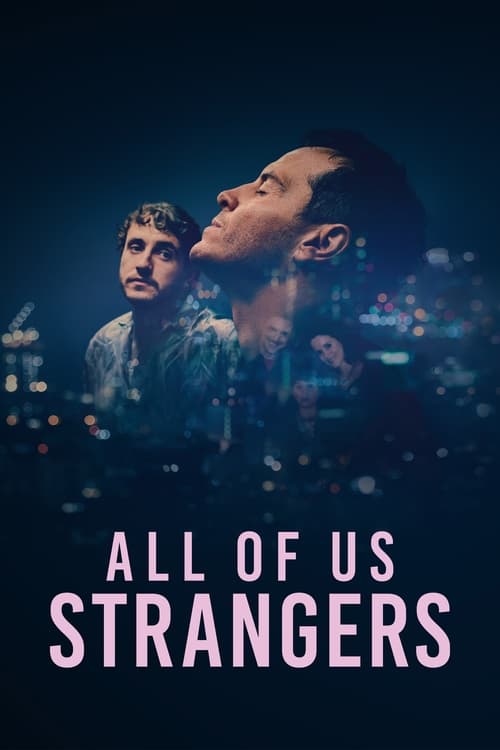
All of Us Strangers (2023)
Directed by Andrew Haigh
Yes — All of Us Strangers is woke, scoring 60 out of 100 on our wokeness meter.
Andrew Haigh's All of Us Strangers arrives as a ghost story wearing a romance's clothes, and it commits to that costume with total sincerity.
Consciousness Markers
A gay love story and coming-out narrative sit at the emotional core: Adam comes out to his deceased parents, and the film won LGBTQ Film of the Year from GALECA.
The film is built around a queer romance between two male leads (Andrew Scott and Paul Mescal), with a supporting cast anchored by gay characters and a narrative centered on a gay man's experience.
The coming-out scene and the father-son reckoning contain gentle instructional beats about acceptance, but the film remains an emotionally driven ghost story rather than a sermon.
The mother is given genuine emotional interiority and wields real weight in Adam's arc, but the film makes no structural feminist argument.
The cast and story engage no racial themes or dynamics whatsoever.
No environmental or climate content appears in the film.
Themes of loneliness and urban isolation are personal and existential, not economic critiques of capitalism.
No body-positivity themes are present.
There is no exploration of neurodivergence; Adam's alienation stems from grief and queerness, not neurotype.
The film is adapted from Taichi Yamada's novel and relocates it to 1980s-adjacent London, but this is a creative adaptation rather than ideological historical revisionism.
Why it received this score
Andrew Haigh's All of Us Strangers arrives as a ghost story wearing a romance's clothes, and it commits to that costume with total sincerity. Adam, a screenwriter adrift in a half-empty London tower block, meets Harry in a doorway, then meets his long-dead parents in the suburban house where they left him. The film is adapted from Taichi Yamada's 1987 novel Strangers, though Haigh has relocated the ache to his own 1980s adolescence. The result plays like a memory that refuses to resolve. It is beautifully made and almost unbearably sad, and the sadness is not a message.
The romance at the center is a gay one, and the film treats it as the spine of the thing, not a garnish. Adam comes out to his deceased parents, a scenario engineered so that acceptance can be granted after the fact, and the scenes land because the longing is specific and personal. A mother's mild discomfort and a father's late apology give those moments a soft instructional hum. They teach, but they never scold. The film stays a ghost story throughout, and it never pauses to deliver a thesis.
What the film declines to do is equally telling. Race, climate, body politics, neurotype, economic grievance: none of these concerns appear, and none are missed. The loneliness here is existential, not structural. A high-rise is a mood, not an indictment of capital. A mother with genuine interiority holds real emotional weight, though the film builds no argument around her. The impression left is of a work that is emotionally audacious and ideologically quiet, a combination the awards circuit rarely knows what to do with. It earns its tears. It does not demand them as tribute.
It should be said that no Academy Award came its way, and it never topped the domestic chart, so its cultural footprint rests on critical acclaim and a shelf of BAFTA nominations instead of hardware. What remains is a small, precise film about grief that happens to be queer, and it wears that fact with a grace that most of its contemporaries could study for a decade without learning a thing.
Analysis generated by our Consciousness Algorithm
Part of


Synopsis
One night in his near-empty tower block in contemporary London, Adam has a chance encounter with a mysterious neighbor, which punctures the rhythm of his everyday life.
Questions about All of Us Strangers
Is All of Us Strangers woke?
Yes — All of Us Strangers is woke, scoring 60 out of 100 on our wokeness meter. That earns it a verdict of Woke.
What makes All of Us Strangers woke?
2 of the 10 markers register at 30 or above, led by LGBTQ+ Themes (92) and Representation Casting (78). On LGBTQ+ Themes: A gay love story and coming-out narrative sit at the emotional core: Adam comes out to his deceased parents, and the film won LGBTQ Film of the Year from GALECA.
How does All of Us Strangers compare to other 2023 movies?
It ranks #14 of the 200 films from 2023 we've scored; their average is 24. The wokest is Origin (84).
How is the Woke Score calculated?
An AI-assisted process researches the film and its reception, scores it 0–100 on ten markers, then combines those into one 0–100 Woke Score. It measures a specific set of 2020s cultural themes, not film quality.