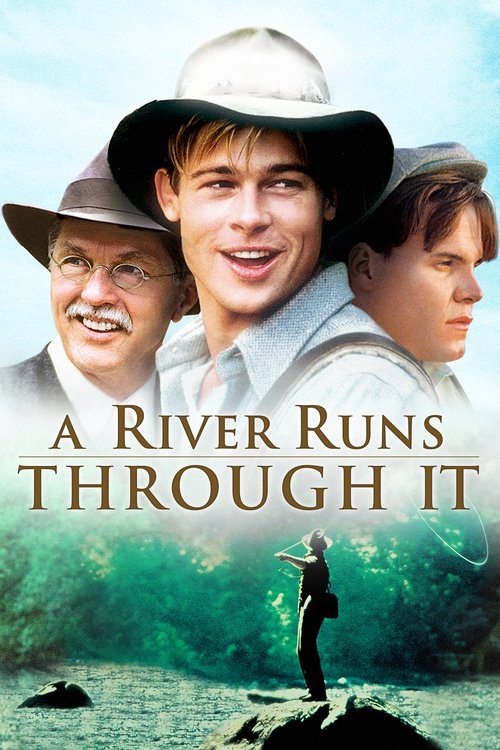
A River Runs Through It (1992)
Directed by Robert Redford
No — A River Runs Through It is not woke, scoring 8 out of 100 on our wokeness meter.
A River Runs Through It arrives on the examining table like a bottle of single malt from a cellar nobody has disturbed in thirty years.
Consciousness Markers
Mabel, a Cheyenne woman, is shown being treated as an inferior by the white patrons of the speakeasy, and Paul is arrested for defending her. This is a passing moment of racial awareness rather than a sustained theme.
The film carries a gentle moralizing tone, particularly Rev. Maclean's closing sermon about unconditional love for the self-destructive, but it is elegiac and reflective rather than preachy or didactic.
The cast is almost entirely white, reflecting the 1920s Montana setting. A Cheyenne woman, Mabel, appears briefly as Paul's date and is treated as inferior by the white crowd, but this is incidental rather than a deliberate diversity effort.
Women appear as wives, girlfriends, and mothers (Jessie, Clara, Mabel) but the film is squarely a story about brothers and their father. No feminist critique or gendered power analysis is present.
The film reveres the Blackfoot River and the natural landscape, and its release benefited river restoration fundraising, but it offers no climate advocacy or environmental-policy messaging.
No LGBTQ+ characters, themes, or subtext of any kind.
No critique of capitalism, wealth, or class structures. The Macleans are a modest minister's family and the film is indifferent to economics.
No body-positivity themes or messaging regarding body image or size acceptance.
No neurodivergent characters or themes are depicted or discussed.
The film is a faithful, affectionate adaptation of Norman Maclean's semi-autobiographical novella about his own family; it does not revise or reinterpret history for ideological purposes.
Why it received this score
A River Runs Through It arrives on the examining table like a bottle of single malt from a cellar nobody has disturbed in thirty years. Robert Redford's 1992 adaptation of Norman Maclean's semi-autobiographical novella concerns two Presbyterian brothers, a river, and a great deal of trout. The cast is white, the landscape is Montana, and the concerns are eternal: fathers, sons, fly rods, and the slow erosion of a family by one brother's refusal to be saved. There is little here for the modern classifier to seize upon, and the film seems content with that arrangement.
One scene stirs the sediment. Paul brings Mabel, a Cheyenne woman, to a speakeasy, where the white patrons treat her as inferior and Paul is arrested for striking a man who insulted her. The moment registers racial cruelty, then the film moves on and never returns. Women occupy the roles of wife, girlfriend, and mother, and the camera regards them with affection and no curiosity whatsoever. The natural world is revered, the Blackfoot River filmed like a psalm, though the reverence is aimed at trout and memory, not at policy. Money never surfaces as a subject. The Macleans are a minister's family, and the film could not care less about class.
The closing sermon, in which the reverend speaks of loving the self-destructive without understanding why, carries a gentle moral weight. It is elegiac, not preachy, a eulogy delivered at a respectful volume. What remains is craft. The cinematography took its Academy Award, and the trout fishing industry reportedly doubled in the years that followed. A film that launched a thousand fly rods and not a single argument. We file it accordingly, dust the bottle, and reach for the next vintage.
{"thematic_tags": ["oscar_winner", "true_story", "book_adaptation"]}
Analysis generated by our Consciousness Algorithm


Synopsis
The Maclean brothers, Paul and Norman, live a relatively idyllic life in rural Montana, spending much of their time fly fishing. The sons of a minister, the boys eventually part company when Norman moves east to attend college, leaving his rebellious brother to find trouble back home. When Norman finally returns, the siblings resume their fishing outings, and assess where they've been and where they're going.
Questions about A River Runs Through It
Is A River Runs Through It woke?
No — A River Runs Through It is not woke, scoring 8 out of 100 on our wokeness meter. That earns it a verdict of Ultra Based.
Does A River Runs Through It have any woke elements?
Very few. None of the 10 markers reaches 30, the level where a marker counts as present; the highest is Lecture Energy at 18.
How does A River Runs Through It compare to other 1992 movies?
It ranks #35 of the 74 films from 1992 we've scored; their average is 12. The wokest is The Crying Game (62).
How is the Woke Score calculated?
An AI-assisted process researches the film and its reception, scores it 0–100 on ten markers, then combines those into one 0–100 Woke Score. It measures a specific set of 2020s cultural themes, not film quality.