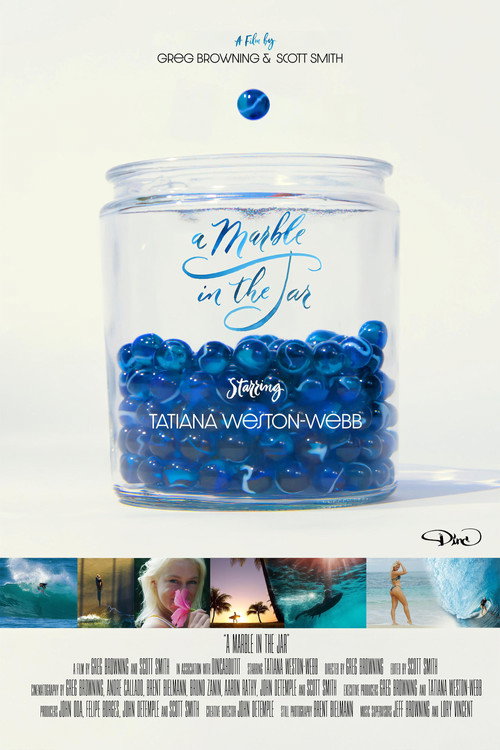
A Marble in the Jar (2026)
Directed by Greg Browning
A Marble in the Jar is a surfing documentary that has, with admirable discipline, declined to be about surfing.
Consciousness Markers
The film centers on a woman competing in professional surfing, a field historically dominated by men, and the documentary's existence implicitly acknowledges the ongoing effort for women's surfing to receive equal recognition. This is incidental to the narrative rather than its driving argument.
Publicity materials briefly position the film against the backdrop of gender equality in professional surfing, but the film itself is a personal story of mentorship and resilience. The gender dimension is ambient, not programmatic.
The film's mindfulness-and-gratitude framework carries a gentle instructional quality, as the marble metaphor is explicitly offered as a life philosophy. It is earnest rather than hectoring, but it does ask the audience to absorb a lesson.
No LGBTQ+ themes, characters, or commentary are present in the film or its surrounding materials.
Weston-Webb's Brazilian identity is noted as biographical context, but the film makes no commentary on race, racial identity, or systemic racial dynamics.
There is no climate or environmental advocacy present in the film's themes or framing, despite the ocean-based setting.
No critique of capitalism, corporate structures, or economic inequality appears in the film's narrative or reception.
Body image is not addressed. The film concerns athletic performance and emotional endurance, not physical appearance or body acceptance.
No neurodivergence themes are present. The disability dimension concerns ALS, a physical illness, framed through personal grief and human connection rather than neurodivergence advocacy.
The film is a contemporary sports documentary with no engagement with historical revisionism of any kind.
Why it received this score
A Marble in the Jar is a surfing documentary that has, with admirable discipline, declined to be about surfing. Director Greg Browning trains his lens on WSL competitor Tatiana Weston-Webb and her campaign for a world title, but the ocean footage is essentially a delivery mechanism for something the film considers more urgent: a meditation on friendship, mortality, and the therapeutic act of dropping a small glass sphere into a container. Browning was diagnosed with ALS during production, which reframes the entire enterprise. The marble jar, a gratitude ritual shared between athlete and coach, becomes a palliative practice for two people navigating loss on very different timescales. It is genuinely moving, and this critic records that observation without pleasure, having arrived prepared to be unmoved.
On the spectrum of progressive cultural signaling, the film is a near-empty glass. Weston-Webb is a woman competing at the elite level of a sport that has historically allocated its prize money and broadcast attention with some reluctance toward female athletes, and the documentary is aware of this. It does not, however, appear to have been made in order to make us aware of it. The gender dimension exists the way weather exists: as context, not argument. The film's one concession to the instructional mode is the marble metaphor itself, which is presented with the quiet insistence of a self-help framework. We are invited to adopt the practice. The invitation is gentle. It does not feel like a mandate.
What the film ultimately represents, in the taxonomy of contemporary cultural products, is a sports documentary that found a better story mid-production and had the good sense to follow it. Its social consciousness is of the oldest and least contentious variety: the kind that simply asks us to pay attention to the people in front of us before they are gone. This is not a classification that requires a high score. It is, however, a classification that requires a note of respect, however inconvenient that is to record.
Analysis generated by our Consciousness Algorithm
Synopsis
A symbolic practice of consciously acknowledging something positive—no matter how small or large—as a way of deliberately finding the good. This concept is at the heart of the story, which follows the professional surfing journey of Tatiana Weston-Webb. Documenting her upbringing, a heartbreaking loss at a World Title, and her struggle to fight her way back to the top.