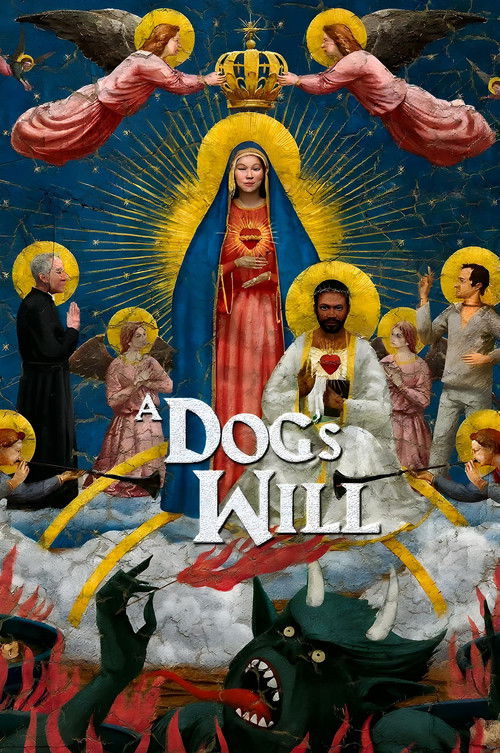
A Dog's Will (2000)
Directed by Guel Arraes
No — A Dog's Will is not woke, scoring 8 out of 100 on our wokeness meter.
A Dog's Will arrives from the year 2000, which is to say from a time before anyone thought to audit a picaresque comedy about two starving con men for ideological hygiene.
Consciousness Markers
The film satirizes greed through the priest who blesses a dog for its inheritance and the bishop who overlooks the sin for a cut of the money, but this is picaresque social comedy rather than an eat-the-rich polemic.
The afterlife trial delivers moral lessons on forgiveness and redemption, but these are traditional Catholic themes rather than modern preachy sermonizing.
A wholly Brazilian production with Brazilian actors playing Brazilian roles, which is natural casting rather than a deliberate diversity agenda. No modern representation-conscious casting choices are evident.
The Virgin Mary serves as a compassionate intercessor and Dora is a sexually forward wife, but these are religious and comedic archetypes rather than a feminist statement.
No LGBTQ+ characters, themes, or subtext appear anywhere in the film.
The film concerns class and poverty in the Northeastern sertão but makes no racial commentary or consciousness its subject.
The arid backlands are mere setting and backdrop; there is no environmental or climate messaging.
No body-positivity themes or messaging are present.
Severino's 'insanity' is invoked as a theological technicality for absolution, not as neurodivergence advocacy or representation.
The 1930s sertão setting is drawn from a literary play and folklore; it does not revise or reinterpret historical record.
Why it received this score
A Dog's Will arrives from the year 2000, which is to say from a time before anyone thought to audit a picaresque comedy about two starving con men for ideological hygiene. The film adapts Ariano Suassuna's play with obvious affection, and it cares mostly about hunger, trickery, and whether a dog can be granted funeral rites. The cast is Brazilian, the setting is the arid backlands of the 1930s, and nobody pauses to explain any of it. Natural casting, then, not a program.
The one place where the film shows anything resembling a thesis is its treatment of money. A priest blesses a dying dog because he believes it belongs to a wealthy landowner. A bishop, outraged at first, reverses himself the instant he learns the animal left the church a bequest. Greed takes a thorough beating, and the clergy absorb most of it. This is picaresque social comedy in an old tradition, a jab at clerical avarice that long predates the modern appetite for structural critique. The film is not asking anyone to eat the rich. It is asking whether the rich can be tricked out of a few crowns.
The afterlife sequence, in which Christ, the Devil, and the Virgin Mary convene a tribunal over six freshly dead souls, argues for mercy and arrives there through forgiveness. Severino, the bandit, is absolved by reason of insanity, which is a theological technicality and nothing more. Mary intercedes on behalf of the damned. Dora is forward with her suitors. Neither gesture amounts to a manifesto, and neither is presented as one. The moral instruction on offer is Catholic and several centuries old. The film lectures, gently, about forgiveness. It does not lecture about anything else. What remains is a warm, crafty comedy about desperate people surviving a hard country, and no amount of contemporary sorting will make it carry freight it never intended to haul. The sertão is a backdrop, the poverty is a premise, and the sermon is about the soul. We file it under folklore and move on to the next screening.
Thematic tags: none apply. It is adapted from a stage play, not a book or comic, so it does not qualify as a book adaptation, and it took no Academy Awards, spawned no predecessor, and reached no American box office summit.
Analysis generated by our Consciousness Algorithm
Synopsis
The lively João Grilo and the sly Chicó are poor guys living in the hinterland who cheat a bunch of people in a small town in Northeastern Brazil. When they die, they have to be judged by Christ, the Devil and the Virgin Mary before they are admitted to paradise.
Questions about A Dog's Will
Is A Dog's Will woke?
No — A Dog's Will is not woke, scoring 8 out of 100 on our wokeness meter. That earns it a verdict of Ultra Based.
Does A Dog's Will have any woke elements?
Very few. None of the 10 markers reaches 30, the level where a marker counts as present; the highest is Eat the Rich at 22.
How does A Dog's Will compare to other 2000 movies?
It ranks #65 of the 125 films from 2000 we've scored; their average is 13. The wokest is But I'm a Cheerleader (72).
How is the Woke Score calculated?
An AI-assisted process researches the film and its reception, scores it 0–100 on ten markers, then combines those into one 0–100 Woke Score. It measures a specific set of 2020s cultural themes, not film quality.