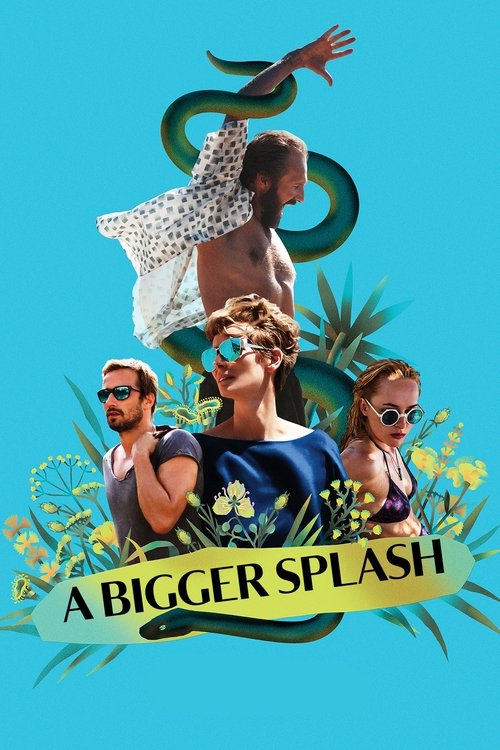
A Bigger Splash (2015)
Directed by Luca Guadagnino
No — A Bigger Splash is not woke, scoring 0 out of 100 on our wokeness meter.
For his second pass through what he calls the Desire trilogy, Luca Guadagnino relocates Jacques Deray's La Piscine to Pantelleria and hands the swimming pool to a quartet of beautiful people behaving badly.
Consciousness Markers
Cast is predominantly white European and American; no deliberate diverse casting or representation themes.
No LGBTQ+ characters or themes.
No feminist agenda; female characters are defined largely through desire and manipulation.
No racial consciousness themes; brief refugee mention is incidental and undeveloped.
No climate or environmental themes.
No anti-capitalist critique; wealthy characters' lifestyle is backdrop, not indictment.
No body positivity themes.
No neurodivergence themes.
No historical revisionism.
No preachy or lecture-like messaging; film is a psychological drama.
Why it received this score
For his second pass through what he calls the Desire trilogy, Luca Guadagnino relocates Jacques Deray's La Piscine to Pantelleria and hands the swimming pool to a quartet of beautiful people behaving badly. Tilda Swinton plays a rock singer recovering from throat surgery, reduced to whispers and gestures. Ralph Fiennes plays the producer who once loved her and now arrives uninvited with a teenage daughter in tow. There is sun, there is a villa, there is a drowning. The camera lingers on skin and stone the way it lingers on anything Guadagnino finds expensive.
On the matter of modern social consciousness, the film offers a clean slate. The cast is white and European, assembled for reasons of chemistry and cheekbones, and no representation argument is made on its behalf. No queer thread runs through the narrative. The women are creatures of appetite and calculation, which is to say the screenplay has no interest in correcting them. A boatload of refugees washes ashore near the climax, and the police mention it while taking statements. The detail exists to inconvenience the plot, not to indict a continent. Nobody lectures. Nobody explains the moral of the pool.
The wealthy here are observed, not prosecuted. Their money buys the isolation that makes the killing possible, and the film never pauses to tell us that this is bad. It assumes we can see. What we get instead is a study of desire, ego, and the specific panic of a man holding another man under water for a second too long. It is a soap opera with better cinematography and no sermons attached. There is nothing here to argue with, and nothing to agree with either. Just four attractive people, one pool, and the slow arrival of consequences.
It should be said that the exercise is not a failure of nerve. Guadagnino simply has other appetites, and they are sensual, not civic. The result is a film that can be enjoyed without taking a position, which in this climate feels almost reckless. Almost. The pool remains a pool. The splash is just a splash.
The picture was warmly received, competed for the Golden Lion, and made a modest sum. No historical record was revised in its making. No lesson was extracted. It sits on the shelf as a psychological drama about jealousy and privilege, and it declines, politely and completely, to be anything else. Some vintages are simply not built for the cellar. This one drinks fine now and asks nothing of the drinker beyond attention. That is its whole position, and it holds it without apology.
It is, in the end, a film about people who own too much and feel too much, and it never once suggests that either condition is a symptom of anything larger. The absence is not a flaw. It is a choice, executed with style and without a single raised finger. We are left to watch, and then to leave, and the leaving is easy.
None of which is a complaint. A film that refuses to instruct is a small mercy in a loud decade, and this one refuses with real elegance. The score on every progressive metric we maintain sits at zero, and the film does not seem to mind. Neither do we. There is nothing to classify beyond the obvious, and the obvious is a pool, a body, and a man who did not mean it. That is the whole affair, served cold and beautifully lit. Somebody please bring a towel.
The credits roll. The island stays. The water closes over the whole business. We file it accordingly, without enthusiasm and without objection, as a well-made entertainment about nothing we are currently obliged to discuss. It is a rare pleasure, and a rarer relief, to have so little to say. So little, in fact, that we have said it, and we are done.
A Bigger Splash is rated R. It contains adults behaving as adults do, which is to say badly, and at length, and in a pool. No further instruction is offered. None is required. The classification stands, and so does the splash, which is bigger, as promised, and then gone.
So it goes. The villa empties. The police get their autograph. Nobody learns anything, and the film is content to let them not learn it. We mark it down as one of the cleanest sheets in recent memory, and we move on to the next screening, where the pool will almost certainly be dirtier. Until then, this one will do.
It will do very well. The record shows nothing to argue with. We close the file, return the screener, and wait for the next director with an appetite and no agenda. They are getting harder to find, and this one, at least, was a pleasure. The pool, the sun, the drowning, the relief. All of it, exactly as advertised, and not a single sermon in sight.
The end, then. Classified, sealed, and shelved. Nothing more to report. The splash has landed, and the water is still.
Analysis generated by our Consciousness Algorithm


Synopsis
An American couple, Paul and Marianne, spend their vacation in Italy and experience trouble when Marianne invites a former lover and his teenage daughter to visit, which leads to jealousy and dangerous sexual scenarios.
Questions about A Bigger Splash
Is A Bigger Splash woke?
No — A Bigger Splash is not woke, scoring 0 out of 100 on our wokeness meter. That earns it a verdict of Ultra Based.
Does A Bigger Splash have any woke elements?
No. All 10 markers score zero.
How does A Bigger Splash compare to other 2015 movies?
It ranks #258 of the 289 films from 2015 we've scored; their average is 15. The wokest is Chi-Raq (78).
How is the Woke Score calculated?
An AI-assisted process researches the film and its reception, scores it 0–100 on ten markers, then combines those into one 0–100 Woke Score. It measures a specific set of 2020s cultural themes, not film quality.