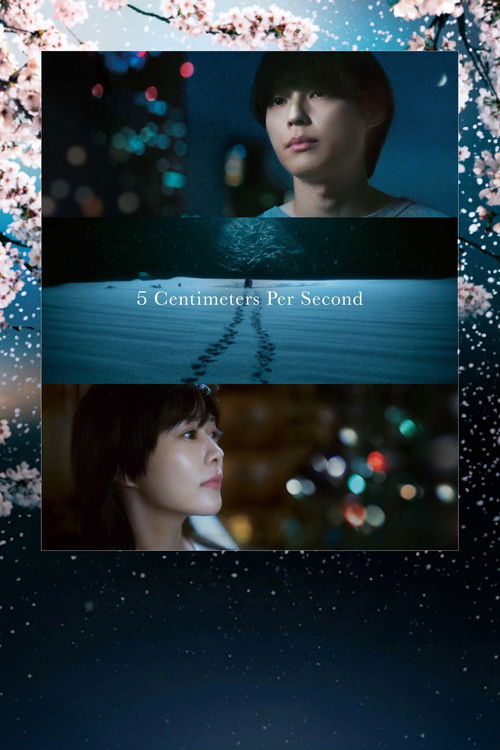
5 Centimeters per Second (2025)
Directed by Yoshiyuki Okuyama
No — 5 Centimeters per Second is not woke, scoring 2 out of 100 on our wokeness meter.
The live-action adaptation of Makoto Shinkai's 2007 animated elegy arrives in 2025 with the quiet confidence of a film that has absolutely nothing to prove to the current cultural moment, and proceeds accordingly.
Consciousness Markers
The adult Takaki is depicted as a Tokyo software engineer hollowed out by corporate routine, and the film frames this burnout as emotionally corrosive. The critique is melancholic and incidental, not ideological.
The film features an all-Japanese cast playing Japanese characters in Japan. This is the absence of a casting decision, not the presence of one.
The romantic narrative is entirely heterosexual, tracing a longing between a man and a woman across many years. No LGBTQ+ themes, characters, or subtext were identified.
The female characters exist as objects of the male protagonist's nostalgic fixation, which is the opposite of a feminist agenda, though not intentionally so. No feminist framing is present.
Racial identity is not a theme, a subject, or even a passing concern anywhere in the film or its surrounding discourse.
The changing seasons are used as emotional metaphor, not as a platform for climate advocacy. Cherry blossoms fall at five centimeters per second regardless of carbon policy.
No body positivity themes, messaging, or commentary of any kind were identified.
No neurodivergence themes, characters, or framing were identified.
The film is a live-action adaptation of a 2007 anime set in contemporary Japan. There is no historical narrative to revise.
The film's emotional register is inward, melancholic, and resolutely personal. It does not address the audience on any social topic, and shows no interest in doing so.
Why it received this score
The live-action adaptation of Makoto Shinkai's 2007 animated elegy arrives in 2025 with the quiet confidence of a film that has absolutely nothing to prove to the current cultural moment, and proceeds accordingly. Director Yoshiyuki Okuyama, a man whose previous work consists largely of music videos and commercial photography, turns out to be a reasonable choice for a story whose primary argument is that soft light on a train window can communicate more than dialogue. The film is a remake, it is adapted from an existing work, and it is Japanese. That is the full extent of its identity politics.
The narrative follows Takaki, a Tokyo software engineer whose emotional life has calcified around a childhood connection he never resolved, across a 121-minute runtime that expands Shinkai's original triptych into something more linear and, critics note, somewhat less ambiguous. The adult Takaki's corporate burnout registers as a mild indictment of modern working life, in the way that all films about sad men in offices inadvertently indict modern working life. This is not a manifesto. It is a mood. The distinction matters, and the film understands it.
Kenshi Yonezu contributes an original theme, Masayoshi Yamazaki's "One more time, One more chance" returns in remaster, and Makoto Shinkai himself has publicly endorsed the project, noting that the live-action format allowed certain narrative gaps to be addressed. What the film does not address, at any point, is the audience's social conscience. It is interested only in the specific and universal ache of distance, the kind that has nothing to do with representation metrics and everything to do with being alive. In the current critical landscape, this constitutes a form of radical restraint.
Analysis generated by our Consciousness Algorithm
Synopsis
After transferring to the same elementary school, Takaki and Akari become fast friends, bonding over the constant upheaval of moving from town to town. Just as their feelings for each other start to blossom, their shared happiness comes to an end when both of their families are forced to relocate. As the seasons change, Takaki and Akari begin to wonder if they will ever be able to see each other again, and share their secret feelings.
Questions about 5 Centimeters per Second
Is 5 Centimeters per Second woke?
No — 5 Centimeters per Second is not woke, scoring 2 out of 100 on our wokeness meter. That earns it a verdict of Ultra Based.
Does 5 Centimeters per Second have any woke elements?
Very few. None of the 10 markers reaches 30, the level where a marker counts as present; the highest is Eat the Rich at 5.
How does 5 Centimeters per Second compare to other 2025 movies?
It ranks #210 of the 217 films from 2025 we've scored; their average is 26. The wokest is STRAW (92).
How is the Woke Score calculated?
An AI-assisted process researches the film and its reception, scores it 0–100 on ten markers, then combines those into one 0–100 Woke Score. It measures a specific set of 2020s cultural themes, not film quality.