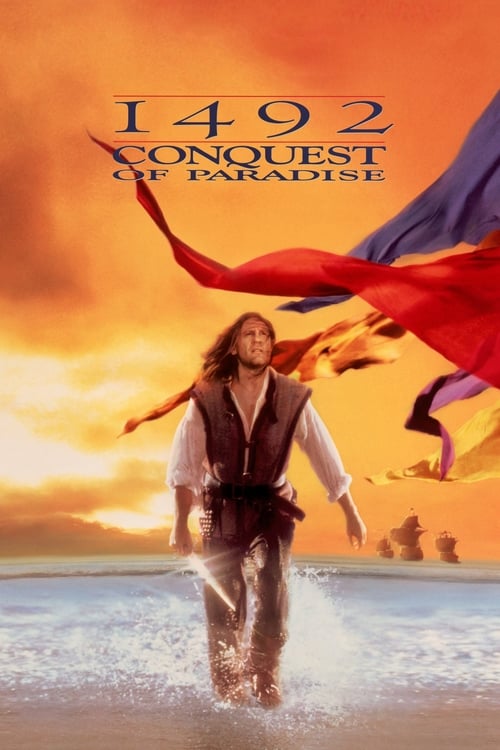
1492: Conquest of Paradise (1992)
Directed by Ridley Scott
No — 1492: Conquest of Paradise is not woke, scoring 17 out of 100 on our wokeness meter.
Ridley Scott arrived in 1992 with a sweeping historical spectacle timed to the quincentenary, and the result is a film that mostly wants to be admired for its clouds and its Vangelis score.
Consciousness Markers
The film depicts the colonization of the Americas and the brutal forced mining of Indigenous peoples, including the severing of a native's hand, but treats this as historical tragedy rather than modern racial consciousness.
The production hired roughly 170 Indigenous Costa Ricans as extras to portray Caribbean islanders, giving the native peoples an on-screen presence, though the principal cast remains European.
The film revises the traditional heroic Columbus narrative to include the violence and suffering inflicted on Indigenous peoples, though it was itself criticized for historical inaccuracy and the 'Spanish black legend.'
Gold greed and the exploitation of native labor drive the plot, but the film frames this as historical avarice rather than a modern anti-capitalist polemic.
Sigourney Weaver's Queen Isabella is granted some authority as a ruling monarch, but the film offers no feminist critique or gendered agenda.
The film is a sweeping historical spectacle rather than a preachy message movie, offering little direct moral instruction to the audience.
No LGBTQ+ characters, themes, or subtext appear anywhere in the film.
No environmental or climate themes are present.
No body positivity themes or messaging.
No neurodivergent characters or themes.
Why it received this score
Ridley Scott arrived in 1992 with a sweeping historical spectacle timed to the quincentenary, and the result is a film that mostly wants to be admired for its clouds and its Vangelis score. Gérard Depardieu plays Columbus as a man of stubborn vision, and the production dutifully includes the suffering that followed his arrival. Roughly one hundred and seventy Indigenous Costa Ricans were hired as extras to stand in for the Caribbean islanders, which gives the native peoples a face on screen even as the speaking roles remain European. The film does not interrogate this arrangement. It simply films it.
The violence of colonization is present and unflinching in places. A native who fails to produce gold has his hand severed, and the forced mining of the island population drives the second half toward war. Scott treats these horrors as tragedy, not as a summons to present-day reflection. The hunger for gold is the engine of the plot, and the film is content to let that hunger be a fifteenth-century vice, which it was, and to leave the audience to draw its own conclusions about anything larger. Queen Isabella, played by Sigourney Weaver with a regal chill, holds genuine authority, though the film has no interest in examining what that authority means for anyone but Columbus.
We are left with an epic without much grandeur or insight, to borrow a phrase from the critical consensus. It is beautiful, occasionally brutal, and dramatically inert. The film revises the old heroic Columbus story just enough to acknowledge the bodies in its wake, then declines to press the point. This is not a sermon. It is a pageant, and pageants are under no obligation to carry a thesis. The score became a worldwide hit, a Portuguese election anthem, and a wedding standard in Lebanon, which tells us where the film's true legacy resides: in the music, not the message.
Analysis generated by our Consciousness Algorithm


Synopsis
1492: Conquest of Paradise depicts Christopher Columbus’ discovery of The New World and his effect on the indigenous people.
Questions about 1492: Conquest of Paradise
Is 1492: Conquest of Paradise woke?
No — 1492: Conquest of Paradise is not woke, scoring 17 out of 100 on our wokeness meter. That earns it a verdict of Ultra Based.
Does 1492: Conquest of Paradise have any woke elements?
1 of the 10 markers register at 30 or above, led by Racial Consciousness (30). On Racial Consciousness: The film depicts the colonization of the Americas and the brutal forced mining of Indigenous peoples, including the severing of a native's hand, but treats this as historical tragedy rather than modern racial consciousness.
How does 1492: Conquest of Paradise compare to other 1992 movies?
It ranks #17 of the 74 films from 1992 we've scored; their average is 12. The wokest is The Crying Game (62).
How is the Woke Score calculated?
An AI-assisted process researches the film and its reception, scores it 0–100 on ten markers, then combines those into one 0–100 Woke Score. It measures a specific set of 2020s cultural themes, not film quality.