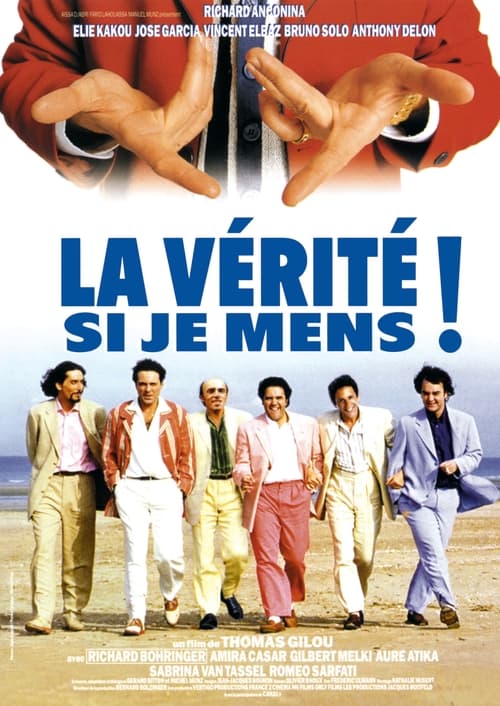
Would I Lie to You? (1997)
Directed by Thomas Gilou
No — Would I Lie to You? is not woke, scoring 10 out of 100 on our wokeness meter.
Thomas Gilou's 1997 comedy concerns Eddie Vuibert, a broke and drifting man mistaken for a Jew by a wealthy cloth manufacturer and promptly installed in the Parisian garment trade.
Consciousness Markers
The film is built on ethnic and religious identity — a gentile passing as Jewish in a tight-knit community — but treats it as farce and social comedy rather than a vehicle for racial-justice consciousness.
The cast is largely composed of French actors of Jewish and North African descent, but this reflects the natural ethnic makeup of the Parisian garment-district community the film depicts rather than a deliberate modern diversity mandate.
This is a broad 1990s French comedy of manners and mistaken identity; it aims to amuse rather than to instruct its audience.
No LGBTQ+ characters, themes, or subtext appear anywhere in the film.
The plot revolves around a man scheming to woo his boss's daughter; women are romantic prizes and set dressing, with no feminist framing whatsoever.
No environmental or climate themes are present.
The story centers on a wealthy manufacturer and the fashion trade; it celebrates commercial hustle rather than critiquing capital.
No body-positivity themes or messaging appear.
No neurodivergent characters or themes are depicted.
The film is a contemporary comedy with no historical revisionism.
Why it received this score
Thomas Gilou's 1997 comedy concerns Eddie Vuibert, a broke and drifting man mistaken for a Jew by a wealthy cloth manufacturer and promptly installed in the Parisian garment trade. He keeps the error alive, rises to sales manager, and courts the boss's daughter while posing as an Ashkenazi. The engine of the picture is ethnic mistaken identity, played for farce, and it has no interest in instructing anyone about anything.
The cast leans heavily on French actors of Jewish and North African descent, though this reflects the actual demography of the Sentier district it depicts, not a casting program with an argument behind it. The women in the story exist to be courted, married, or admired from across the room. The wealthy manufacturer is treated with open affection, and the hustle of the trade supplies the entire romance of the film. No critique of capital lives here, only a fondness for the deal and the mark-up.
No queer lives, no environmental anxiety, no body politics, no neurodivergent interiority. The identity material on offer is the older, gentler sort: a gentile sweating through Shabbat dinner for laughs, and the joke lands on the sweating. It was the highest-grossing French film of its year and collected two César nominations for its young leads. Two sequels followed, each bigger than the last. The film is a period piece now, though it never intended to become one. It wants only to amuse, and mostly it does.
Analysis generated by our Consciousness Algorithm
Synopsis
Jobless loner Eddie Vuibert gets a lucky break when a rich Jewish entrepreneur mistakes him for a Jew and gives him a sweet job in the Parisian fashion district.
Questions about Would I Lie to You?
Is Would I Lie to You? woke?
No — Would I Lie to You? is not woke, scoring 10 out of 100 on our wokeness meter. That earns it a verdict of Ultra Based.
Does Would I Lie to You? have any woke elements?
Very few. None of the 10 markers reaches 30, the level where a marker counts as present; the highest is Racial Consciousness at 22.
How does Would I Lie to You? compare to other 1997 movies?
It ranks #41 of the 109 films from 1997 we've scored; their average is 12. The wokest is Happy Together (65).
How is the Woke Score calculated?
An AI-assisted process researches the film and its reception, scores it 0–100 on ten markers, then combines those into one 0–100 Woke Score. It measures a specific set of 2020s cultural themes, not film quality.