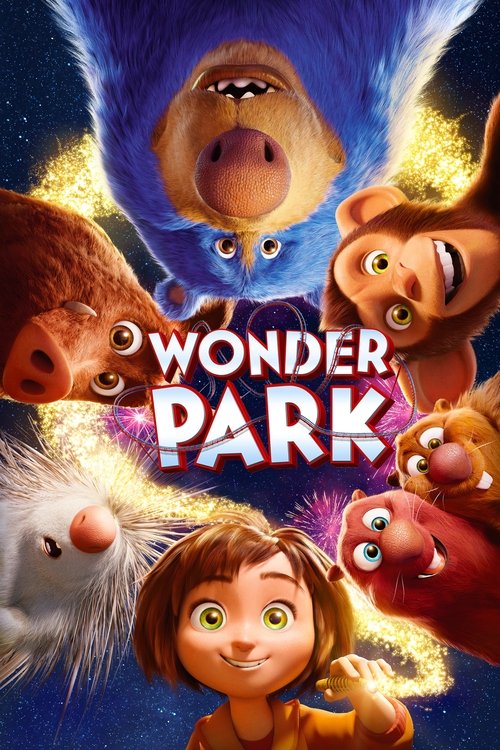
Wonder Park (2019)
Directed by Dylan Brown
No — Wonder Park is not woke, scoring 12 out of 100 on our wokeness meter.
Wonder Park arrives as a brightly colored 2019 animated fantasy about a girl named June, her mother's illness, and a magical amusement park staffed by anxious animals.
Consciousness Markers
The voice cast is led by a young female protagonist and includes Kenan Thompson and Ken Jeong in supporting animal roles, but the ensemble is predominantly white and no casting was framed around representation.
June is an imaginative girl protagonist and her mother is a capable, encouraging figure, but the film offers no explicit feminist thesis or gender commentary.
The film delivers a gentle lesson about holding onto imagination and processing a parent's illness, but it is sentimental rather than preachy or issue-driven.
No LGBTQ+ characters, themes, or subtext appear anywhere in the film.
Race is never addressed or thematized; the anthropomorphic animal cast carries no racial commentary.
The antagonistic 'Darkness' represents June's own cynicism and grief, not any environmental or climate allegory.
The amusement park setting carries no critique of commerce, wealth, or capitalism.
No body-image themes or body-positive messaging are present.
Boomer the bear is narcoleptic, but this is played as a comedic quirk rather than any neurodivergence-affirming statement.
The film is a wholly fictional fantasy with no historical subject matter to revise.
Why it received this score
Wonder Park arrives as a brightly colored 2019 animated fantasy about a girl named June, her mother's illness, and a magical amusement park staffed by anxious animals. The film has a female protagonist, a supportive mother, and a voice cast that includes Kenan Thompson and Ken Jeong among the fauna. This is representation by arithmetic, not by argument. Nobody pauses to discuss who is on screen or why it matters, and the ensemble remains mostly white. The cultural ledger here is thin, and the film seems content to leave it that way. It is pleasant enough, but pleasantness is not a cultural position.
There is no LGBTQ presence, race is never addressed, and the climate is not part of the allegory. The Darkness is June's cynicism and grief, not the carbon footprint of the rides. The park is a business only in the loosest sense, and nobody suggests the means of production should be handed to the beavers. No body-image conversation takes place. Boomer the bear has narcolepsy, which the film treats as a running gag, not a statement. The animals are quirky, not allegorical. The film has no interest in turning its menagerie into a seminar.
The lesson is gentle: keep imagining, talk about illness, repair the swings. It is sentimental, not sermonizing. June's gender is not used as a thesis, and the story has no historical revision to perform. The film remains a competently made diversion for very young viewers, as the critical consensus observed at the time. As a specimen of modern social consciousness, Wonder Park is a mostly empty park: the gates are open, the lights are on, and the rides are not making any announcements.
Analysis generated by our Consciousness Algorithm
Part of


Synopsis
A young girl named June with a big imagination makes an incredible discovery -- the amusement park of her dreams has come to life. Filled with the world's wildest rides operated by fun-loving animals, the excitement never ends. But when trouble hits, June and her misfit team of furry friends begin an unforgettable journey to save the park.
Questions about Wonder Park
Is Wonder Park woke?
No — Wonder Park is not woke, scoring 12 out of 100 on our wokeness meter. That earns it a verdict of Ultra Based.
Does Wonder Park have any woke elements?
Very few. None of the 10 markers reaches 30, the level where a marker counts as present; the highest is Representation Casting at 18.
How does Wonder Park compare to other 2019 movies?
It ranks #169 of the 284 films from 2019 we've scored; their average is 22. The wokest is Black Christmas (79).
How is the Woke Score calculated?
An AI-assisted process researches the film and its reception, scores it 0–100 on ten markers, then combines those into one 0–100 Woke Score. It measures a specific set of 2020s cultural themes, not film quality.