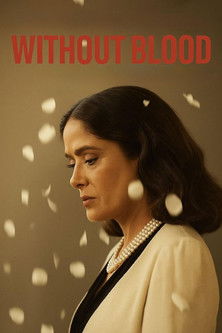
Without Blood (2025)
Directed by Angelina Jolie
Angelina Jolie's "Without Blood" arrives bearing the full weight of its director's humanitarian credentials and the solemn intention to say something important about war.
Consciousness Markers
The film is led entirely by Latin American actors, including Salma Hayek Pinault and Demián Bichir, in what constitutes a deliberate international casting strategy. The choice is notable enough to have been remarked upon by critics and press coverage, suggesting it was a conscious representational decision rather than an incidental one.
The film centers on a female survivor's experience of gender-based violence, forced marriage, and institutionalization as specific harms distinct from general wartime suffering. Critics explicitly noted the film's framing of women as bearing particular collateral damage from patriarchal violence, which is a structural feminist argument embedded in the narrative.
Jolie's own promotional framing, explicitly positioning the film as a corrective to ideological absolutism and a lesson in listening across divides, radiates considerable sermonizing energy. Critics noted the narrative's tendency toward generalized moral abstraction, and the director's TIFF remarks about 'being absolute on this side or that side' read as a thesis statement delivered directly to the audience.
The deliberately decontextualized, geography-free setting works against any specific racial consciousness framing. The all-Latin cast brings a degree of implicit cultural identity, but the film's own anti-specificity stance prevents it from making pointed racial arguments.
The film's deliberate erasure of any specific historical conflict could be read as a mild form of historical revisionism, flattening distinct political contexts into a universal moral fable. However, this is more an act of abstraction than of rewriting, so the score remains low.
No LGBTQ+ themes, characters, or storylines are present in the film or its surrounding discourse. The score is 0.
There are no climate, environmental, or ecological themes present. The score is 0.
The film engages with war and revenge but makes no critique of capitalism, wealth, or economic systems. The score is 0.
No body positivity themes or messaging are present. The score is 0.
No neurodivergence themes or characters are present. The score is 0.
Why it received this score
Angelina Jolie's "Without Blood" arrives bearing the full weight of its director's humanitarian credentials and the solemn intention to say something important about war. Based on Alessandro Baricco's novel, the film deposits its characters into a deliberately unnamed early 20th-century conflict, strips away all geographic and political specificity, and proceeds to demonstrate that violence is bad. This is, to be fair, a position with which few will disagree.
The film's most sincere commitment is to the experience of women in post-conflict societies, and here it does genuine work. The female protagonist's survival through gender-based violence and institutionalization is rendered with care, and the argument that women suffer a categorically distinct form of wartime harm is embedded structurally in the narrative, not merely gestured at. Salma Hayek Pinault carries this material with appropriate gravity. The all-Latin American cast is notable and, in a film otherwise allergic to specificity, represents the film's most concrete cultural choice.
Where "Without Blood" grows weary is in its lecture energy, which is considerable and self-aware about being considerable. Jolie's promotional circuit remarks, positioning the film as a rebuke to ideological absolutism and a call for listening across divides, function as a director's commentary track playing simultaneously with the film itself. The Guardian's critique, that contemporary cinema earns its universality through specificity rather than by dissolving it, lands with some precision. A film about everywhere and everywhen risks being, in the end, about nowhere in particular. Jolie is a serious filmmaker with serious intentions. The intentions are visible at all times, which is both the film's strength and its primary burden.
Analysis generated by our Consciousness Algorithm
Synopsis
In a frontier landscape at the beginning of the 20th century, gunmen descend on a remote farmhouse, determined to exact revenge. Their target, a doctor — alone with his son and daughter — tries desperately to protect his children. Inevitably, bullets fly.