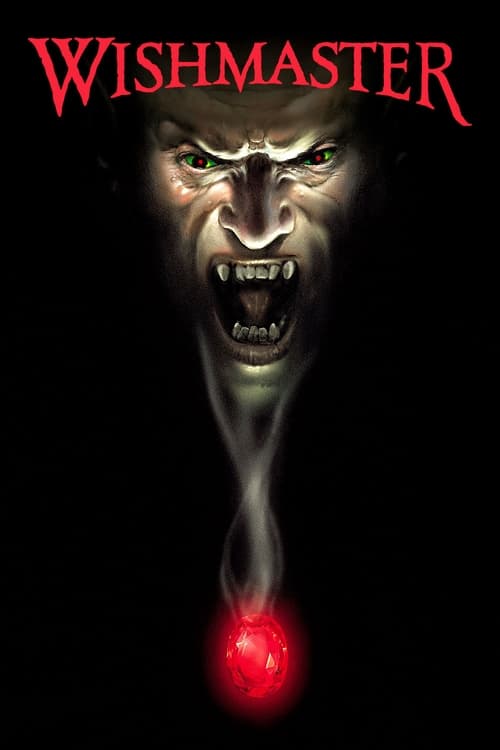
Wishmaster (1997)
Directed by Robert Kurtzman
No — Wishmaster is not woke, scoring 5 out of 100 on our wokeness meter.
Wishmaster arrives from 1997 with a fire opal, a wish-granting djinn, and the earnest ambition of launching a horror franchise.
Consciousness Markers
The folklore professor Wendy Derleth delivers exposition about djinn mythology, but this is functional horror plotting rather than moralizing or preaching to the audience.
Alexandra is a capable female protagonist who defeats the Djinn through wits rather than force, but this is a conventional final-girl/survivor structure rather than any articulated feminist agenda.
The cast is overwhelmingly white, with a couple of Black actors (Ricco Ross, Tony Todd) appearing naturally in supporting roles without any commentary or deliberate diversity agenda. Standard 1990s horror ensemble casting.
Greed drives several victims' wishes (Nick's million-dollar wish, Beaumont's opulent collection), but this is incidental horror irony, not a coherent anti-capitalist thesis.
No LGBTQ+ characters, themes, or subtext of any kind appear in the film.
The film engages no racial themes whatsoever; the Djinn's mythology is drawn from Persian folklore but treated purely as monster lore, not as commentary on race or culture.
No environmental or climate content exists in the film.
No body positivity themes; the film in fact depicts a woman transformed into a mannequin for vanity, a beauty-related punishment with no affirmative counter-message.
No neurodivergent characters or themes are present.
The brief 1127 Persian prologue is genre setup, not a revisionist reframing of real history.
Why it received this score
Wishmaster arrives from 1997 with a fire opal, a wish-granting djinn, and the earnest ambition of launching a horror franchise. Wes Craven's name hangs over the proceedings as executive producer, but the film itself has little interest in the cultural conversations that would dominate later decades. Its casting is the standard late-90s horror ensemble: overwhelmingly white, with Ricco Ross and Tony Todd appearing in supporting roles because they were working actors in a genre that knew them. Their presence carries no commentary and no agenda. The film contains no LGBTQ characters or themes. It engages no racial ideas, even though its monster comes from Persian folklore. The djinn is treated as a beast in a jewel, not as a cultural symbol.
Tammy Lauren's Alexandra is a competent protagonist who defeats the djinn through wit, reversing the crane operator's drunken mistake and trapping the creature again. That is a final-girl structure, not a feminist argument. The film's treatment of beauty is if anything hostile to body positivity: Ariella wishes for eternal beauty and becomes a mannequin. Greed motivates several victims, including Nick's million-dollar wish and Beaumont's collection, but the film uses avarice as horror irony, not as an anti-capitalist thesis. There is no climate content, no neurodivergent character, and no revisionist history. The 1127 prologue is genre setup. The Persian emperor and sorcerer exist to explain the rules.
The closest thing to a lecture comes from Wendy Derleth, the folklore professor who explains djinn mythology. Her exposition is functional. It moves the plot from jewel to apocalypse without telling the audience how to vote. The film wants to scare, gross out, and spawn sequels. On the social consciousness register, it registers only the faintest tremors. It is a low-budget fright flick respectful of its influences, and it has no interest in being anything else.
Analysis generated by our Consciousness Algorithm


Synopsis
The Djinn, having been released from his ancient prison, seeks to capture the soul of the woman who discovered him, thereby opening a portal and freeing his fellow Djinn to take over the earth.
Questions about Wishmaster
Is Wishmaster woke?
No — Wishmaster is not woke, scoring 5 out of 100 on our wokeness meter. That earns it a verdict of Ultra Based.
Does Wishmaster have any woke elements?
Very few. None of the 10 markers reaches 30, the level where a marker counts as present; the highest is Lecture Energy at 12.
How does Wishmaster compare to other 1997 movies?
It ranks #75 of the 109 films from 1997 we've scored; their average is 12. The wokest is Happy Together (65).
How is the Woke Score calculated?
An AI-assisted process researches the film and its reception, scores it 0–100 on ten markers, then combines those into one 0–100 Woke Score. It measures a specific set of 2020s cultural themes, not film quality.