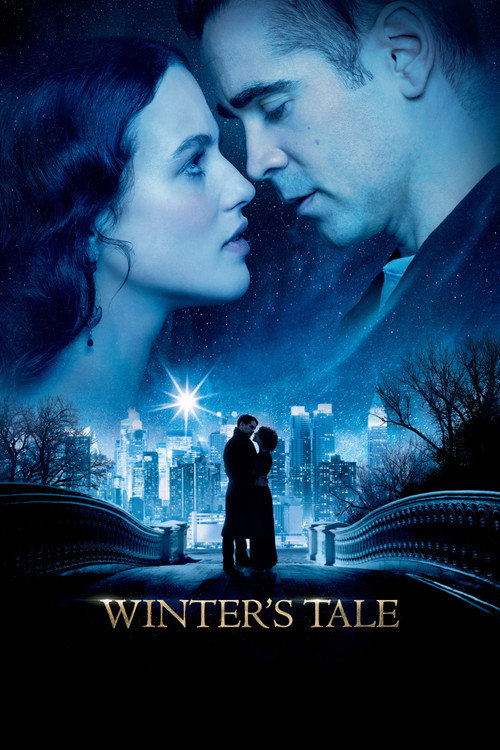
Winter's Tale (2014)
Directed by Akiva Goldsman
No — Winter's Tale is not woke, scoring 6 out of 100 on our wokeness meter.
Winter's Tale arrives as a passion project that Martin Scorsese once called unfilmable, and the finished product does little to embarrass his judgment.
Consciousness Markers
The cast is overwhelmingly white for a period New York fantasy, with Graham Greene and Will Smith in supporting roles that exist without any commentary on identity. Diversity is incidental rather than a stated aim.
The film offers a sentimental moral about everyone being born with a miracle inside and destined to become stars, but it is delivered as romantic whimsy rather than social preaching.
The opening depicts immigrant parents refused entry to Manhattan over tuberculosis, but this functions as tragic backstory rather than racial or social commentary.
Beverly and Virginia are largely defined by their relationships to Peter and their roles as dying muse and protective mother. No feminist critique or agency-driven arc is present.
No LGBTQ+ characters, themes, or subtext appear anywhere in the film.
No environmental or climate themes are present.
No critique of wealth, capitalism, or class structures; the heiress and her publishing family are treated sympathetically.
No body positivity themes; the film's central illness narrative is romanticized rather than engaged with body politics.
No neurodivergent characters or themes are present.
The film is a fantasy romance, not a historical narrative, and makes no revisionist historical claims.
Why it received this score
Winter's Tale arrives as a passion project that Martin Scorsese once called unfilmable, and the finished product does little to embarrass his judgment. Akiva Goldsman writes, produces, and directs this adaptation of Mark Helprin's 1983 novel, a romantic fantasy in which a burglar named Peter Lake loves a consumptive heiress, survives a century of amnesia, and ascends to the stars on the back of a winged white horse. The film is sincere to the point of strangeness. It is also a commercial catastrophe, grossing thirty million dollars against a budget twice that size.
The cultural ledger is thin. The cast is almost entirely white, with Will Smith and Graham Greene appearing in supporting turns that never treat identity as a subject. The opening sequence, in which immigrant parents are turned away from Manhattan because they carry tuberculosis, plays as tragic backstory instead of social argument. Beverly and Virginia exist chiefly as a dying muse and a protective mother, their interior lives subordinated to Peter's journey. There is no queer presence, no environmental concern, no critique of the publishing fortune surrounding the Penn family. Illness is romanticized rather than examined, and the body serves as a vessel for metaphor, not politics.
The film offers a sentimental doctrine, repeated with a straight face: every person is born with a miracle inside and destined to become a star. That arrives as romantic whimsy, not as a sermon, which keeps the lecturing at a low murmur. The result is a motion picture with almost no contemporary social agenda to speak of, and a surplus of earnest celestial nonsense. It means well. It means well for two hours, which is its own kind of endurance test. The white horse is the only character with a coherent plan, and it flies away before the credits, presumably to find better material. We are left with snow, name plates, and a moral about destiny that dissolves on contact. A sommelier would call this vintage forgettable. The cellar is full of it.
Classification: a book adaptation, nothing more. No Oscar, no sequel, no remake, no true story, no superhero, and a seventh-place opening weekend that keeps it far from the top of the chart. It means well. That is the entire report.
{"thematic_tags": ["book_adaptation"]}
Analysis generated by our Consciousness Algorithm
Part of


Synopsis
A burglar falls for an heiress as she dies in his arms. When he learns that he has the gift of reincarnation, he sets out to save her.
Questions about Winter's Tale
Is Winter's Tale woke?
No — Winter's Tale is not woke, scoring 6 out of 100 on our wokeness meter. That earns it a verdict of Ultra Based.
Does Winter's Tale have any woke elements?
Very few. None of the 10 markers reaches 30, the level where a marker counts as present; the highest is Representation Casting at 15.
How does Winter's Tale compare to other 2014 movies?
It ranks #185 of the 303 films from 2014 we've scored; their average is 13. The wokest is Selma (68).
How is the Woke Score calculated?
An AI-assisted process researches the film and its reception, scores it 0–100 on ten markers, then combines those into one 0–100 Woke Score. It measures a specific set of 2020s cultural themes, not film quality.