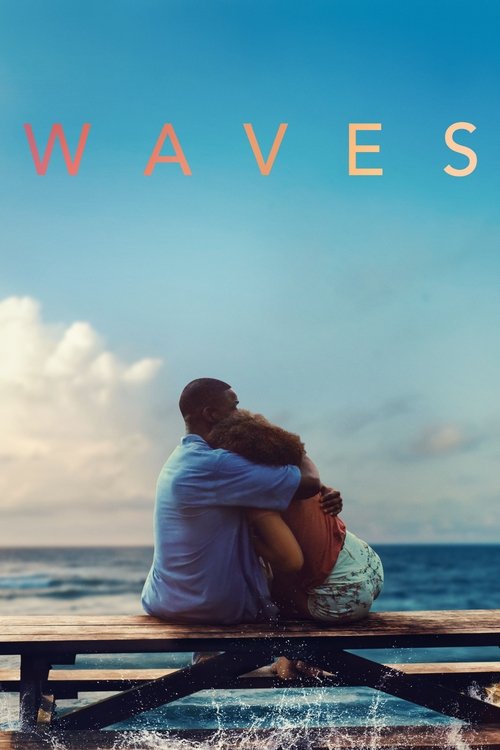
Waves (2019)
Directed by Trey Edward Shults
No — Waves is not especially woke, scoring 22 out of 100 on our wokeness meter.
Trey Edward Shults has constructed a highly pressurized examination of a family unit, placing a predominantly Black ensemble at the center of a suburban tragedy.
Consciousness Markers
A predominantly Black ensemble (Harrison, Russell, Brown, Goldsberry) anchors the film, and per the production notes the script was written race-neutral with references to the characters' Blackness added only after casting. It is color-conscious casting, though the family exists naturally rather than as box-ticking.
The film foregrounds a middle-to-upper-middle-class Black family rarely seen on screen and gestures at the pressure placed on young Black boys to excel, though race is largely subsumed into a universal family tragedy.
The second half pivots to Emily's interior journey and Alexis is given agency over her pregnancy decision and boundaries, but the film is a family grief drama rather than a feminist statement.
Themes of toxic masculinity and parental pressure surface in interviews and subtext, but the film delivers them through raw emotion and tragedy rather than preachy monologue.
No LGBTQ+ characters or themes appear anywhere in the narrative.
No environmental or climate themes are present.
No economic-justice or eat-the-rich content; the family is comfortably suburban and the film has no class critique.
No body-positivity themes; the wrestling and athletic context is about injury and pressure, not body acceptance.
Luke is characterized as awkward and kindhearted, but no neurodivergent identity or theme is present.
The film is a contemporary fictional drama with no historical revisionism.
Why it received this score
Trey Edward Shults has constructed a highly pressurized examination of a family unit, placing a predominantly Black ensemble at the center of a suburban tragedy. The film foregrounding a middle-to-upper-middle-class Black family offers a distinct visual perspective rarely seen in this specific cinematic format. However, the narrative ultimately functions as a searing domestic study of grief and control rather than a comprehensive manifesto of modern progressive sensibilities. The representation casting functions more as a setting for universal pain than a deliberate act of social commentary, though the cultural awareness is present in the periphery.
The social conscience of Waves arrives through sharp, often painful subtext. Themes regarding toxic masculinity and the immense pressure placed upon young Black men to achieve success are gestured at with careful intent. A minor pivot to the mother character grants her a degree of agency regarding reproductive decisions, but this is a small gesture within a larger scope of familial ruin. We observe these progressive sensibilities delivered through raw emotion and devastating events, avoiding the trap of being preachy or overtly sermoning. The film suggests that social pressures are present but does not elevate them to the level of a central ideological crusade.
Ultimately, Waves delivers a profound, albeit stylized, look at the weight of expectation. It is a somber exercise in tragedy where the specific social markers are subsumed by the overwhelming force of personal devastation. The film achieves its artistic aims through powerful performances and a distinct visual grammar, even if its cultural commentary remains localized to the confines of one broken family.
Analysis generated by our Consciousness Algorithm
Part of


Synopsis
A controlling father’s attempts to ensure that his two children succeed in high school backfire after his son experiences a career-ending sports injury. Their familial bonds are eventually placed under severe strain by an unexpected tragedy.
Questions about Waves
Is Waves woke?
No — Waves is not especially woke, scoring 22 out of 100 on our wokeness meter. That earns it a verdict of Based.
Does Waves have any woke elements?
2 of the 10 markers register at 30 or above, led by Representation Casting (48) and Racial Consciousness (40). On Representation Casting: A predominantly Black ensemble (Harrison, Russell, Brown, Goldsberry) anchors the film, and per the production notes the script was written race-neutral with references to the characters' Blackness added only after casting.
How does Waves compare to other 2019 movies?
It ranks #99 of the 284 films from 2019 we've scored; their average is 22. The wokest is Black Christmas (79).
How is the Woke Score calculated?
An AI-assisted process researches the film and its reception, scores it 0–100 on ten markers, then combines those into one 0–100 Woke Score. It measures a specific set of 2020s cultural themes, not film quality.