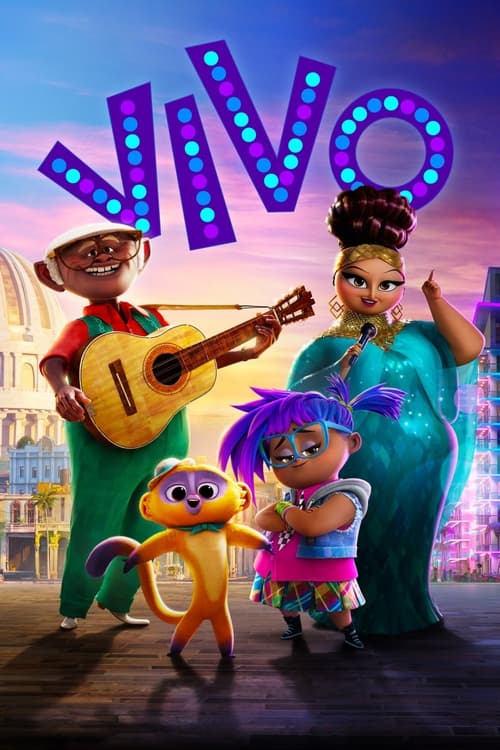
Vivo (2021)
Directed by Kirk DeMicco
Partly — Vivo is somewhat woke, scoring 44 out of 100 on our wokeness meter.
The kinkajou is the detail that tells us what kind of film this is.
Consciousness Markers
The film features a predominantly Latinx voice cast and centers Cuban music and diaspora culture, with Afro-Latinx performers in key roles.
The film celebrates Cuban and Latin American cultural identity, but it does not engage with racial justice or systemic racial themes.
Female characters drive much of the story, including the young protagonist Gabi and the legendary singer Marta, but the film does not advance an explicit feminist critique.
The film offers gentle lessons about grief, family, and following one's dreams, but it avoids preachy or lecture-like delivery.
There are no LGBTQ+ themes, characters, or relationships in the film.
There is no climate change advocacy or environmental crusade in the film.
The film contains no anti-capitalist or eat-the-rich messaging.
There is no body positivity theme or related messaging.
Gabi is described as eccentric and misunderstood, but the film does not explicitly depict or discuss neurodivergence.
The film is an original story and does not revise or reinterpret historical events.
Why it received this score
The kinkajou is the detail that tells us what kind of film this is. Vivo, a 2021 animated musical from Sony and Netflix, follows a small furry musician from a Havana plaza to a Miami stage, tasked with delivering a love song on behalf of a dead man. The premise is modest and the execution is polished. Lin-Manuel Miranda wrote the songs and voices the animal, and the whole enterprise hums with professional competence.
What is most notable about the production is the cast assembled around it. Zoe Saldaña, Juan de Marcos González, Gloria Estefan, and a deep bench of Latine performers populate a story that treats Cuban music as a living inheritance rather than set dressing. The film never stops to explain this. It simply is. That quiet confidence is rarer than it ought to be, and it deserves acknowledgment even from a critic who arrived skeptical. The child at the center, Gabi, is a girl of ten with a gift for rapping and an inability to read a room. Her oddness is presented as temperament, not condition. Nothing here diagnoses her, and nothing here needs to.
The rest of the running time is spent on grief, which the film handles with a light touch. A widowed mother, a song that survives its composer, a night in the Everglades with a lovesick spoonbill. There is no lecture delivered, no villain drawn from the ranks of the wealthy, no weather sermon. The women carry the plot without the film ever announcing that they do. The result is agreeable and slight, a pleasant way to spend ninety minutes. It aims for the heart, hits it softly, and then it ends. Not every film needs a thesis.
Analysis generated by our Consciousness Algorithm
Part of


Synopsis
A music-loving kinkajou named Vivo embarks on the journey of a lifetime to fulfill his destiny and deliver a love song for an old friend.
Questions about Vivo
Is Vivo woke?
Partly — Vivo is somewhat woke, scoring 44 out of 100 on our wokeness meter. That earns it a verdict of Woke-Adjacent.
What makes Vivo woke?
2 of the 10 markers register at 30 or above, led by Representation Casting (75) and Racial Consciousness (30). On Representation Casting: The film features a predominantly Latinx voice cast and centers Cuban music and diaspora culture, with Afro-Latinx performers in key roles.
How does Vivo compare to other 2021 movies?
It ranks #39 of the 242 films from 2021 we've scored; their average is 23. The wokest is The Forever Purge (83).
How is the Woke Score calculated?
An AI-assisted process researches the film and its reception, scores it 0–100 on ten markers, then combines those into one 0–100 Woke Score. It measures a specific set of 2020s cultural themes, not film quality.