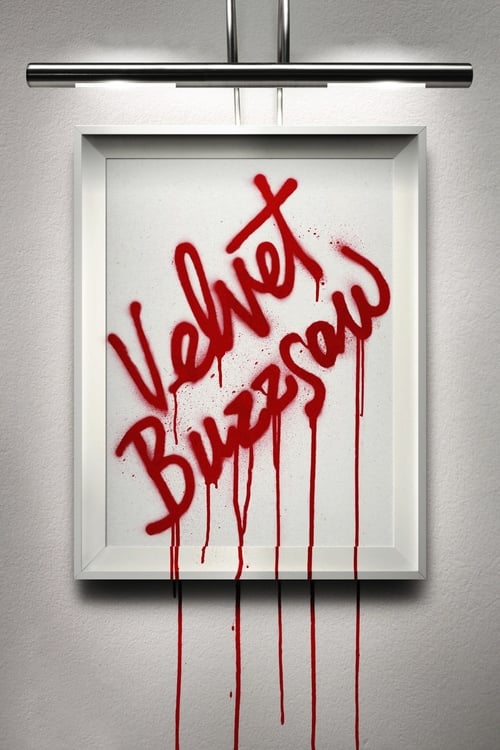
Velvet Buzzsaw (2019)
Directed by Dan Gilroy
Partly — Velvet Buzzsaw is somewhat woke, scoring 44 out of 100 on our wokeness meter.
Dan Gilroy's Velvet Buzzsaw arrives as a glossy Los Angeles satire in which the art market's most venal participants are picked off by the very paintings they hope to flip.
Consciousness Markers
The entire premise is a supernatural revenge against collectors and dealers who let greed corrupt art; commercialism and consumerism are the film's explicit targets, with the rich dispatched one by one.
Morf Vandewalt is written as sexually fluid, carrying on a relationship with his boyfriend Ed before taking up with Josephina; the director explicitly cited sexual fluidity as his intent.
The ensemble is notably diverse, with Zawe Ashton and Daveed Diggs in prominent roles, but their presence is organic to the art-world setting rather than a self-conscious representational statement.
The film carries a clear thesis about art versus commerce, but it delivers the message through genre mayhem and dark comedy rather than direct moralizing.
Rhodora, Gretchen, and Josephina wield real power and ambition in the gallery world, though the film treats their ruthlessness as satire rather than a feminist thesis.
Black characters occupy significant roles, but the film engages no racial themes or commentary whatsoever.
No environmental or climate content appears in the film.
No body-positivity themes are present.
Dease's mental illness stems from institutional abuse and human experimentation, but this is a plot mechanism rather than a neurodivergence-affirming statement.
No historical revisionism is present; the film is a contemporary satire.
Why it received this score
Dan Gilroy's Velvet Buzzsaw arrives as a glossy Los Angeles satire in which the art market's most venal participants are picked off by the very paintings they hope to flip. The premise is elegantly simple. A dead recluse's canvases, painted with blood, find their way into the hands of dealers, critics, and collectors, and then those hands are severed, those necks are broken, those buzz-saw tattoos begin to spin. The film's contempt for commerce is total and unembarrassed. Every character who confuses a price tag with a soul is dispatched with mechanical cheer, and the moral is not subtle. Art should not be a commodity. The market is a slaughterhouse. It says so with a monkey mechanic and a rampaging robot.
The cast is unusually diverse for a Netflix genre exercise, with Zawe Ashton and Daveed Diggs occupying central roles, though the film never pauses to congratulate itself on the fact. Race is simply not a subject here. Jake Gyllenhaal's critic, Morf Vandewalt, is written as sexually fluid, drifting from his boyfriend Ed into an affair with Josephina, a choice the director has discussed openly. The women, Rhodora, Gretchen, and Josephina, hold genuine power and exercise it ruthlessly, but the screenplay treats their ambition as one more symptom of a diseased ecosystem, not as a thesis about gender. Everyone is awful. That is the point.
Ultimately the film operates in the register of genre mayhem. It has a thesis about art and money, and it delivers that thesis through severed limbs and jump scares instead of speeches, which spares us the sermon. The result is uneven, occasionally clumsy, and quite pleased with its own cynicism. Still, there is something bracing about a film that lets a robotic art installation strangle a critic and calls it justice. The canvas here is broad. The brushwork is crude. And the buyer should beware.
Analysis generated by our Consciousness Algorithm


Synopsis
Big money artists and mega-collectors pay a high price when art collides with commerce. After a series of paintings by an unknown artist are discovered, a supernatural force enacts revenge on those who have allowed their greed to get in the way of art.
Questions about Velvet Buzzsaw
Is Velvet Buzzsaw woke?
Partly — Velvet Buzzsaw is somewhat woke, scoring 44 out of 100 on our wokeness meter. That earns it a verdict of Woke-Adjacent.
What makes Velvet Buzzsaw woke?
4 of the 10 markers register at 30 or above, led by Eat the Rich (75), LGBTQ+ Themes (50) and Lecture Energy (35). On Eat the Rich: The entire premise is a supernatural revenge against collectors and dealers who let greed corrupt art; commercialism and consumerism are the film's explicit targets, with the rich dispatched one by one.
How does Velvet Buzzsaw compare to other 2019 movies?
It ranks #40 of the 284 films from 2019 we've scored; their average is 22. The wokest is Black Christmas (79).
How is the Woke Score calculated?
An AI-assisted process researches the film and its reception, scores it 0–100 on ten markers, then combines those into one 0–100 Woke Score. It measures a specific set of 2020s cultural themes, not film quality.