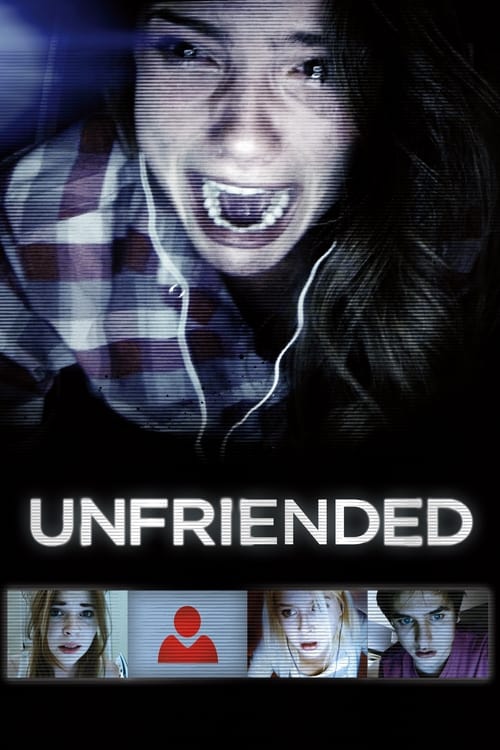
Unfriended (2014)
Directed by Levan Gabriadze
No — Unfriended is not woke, scoring 9 out of 100 on our wokeness meter.
Unfriended is a screenlife horror film in which six high school students discover that a Skype call can be haunted by the ghost of a bullied classmate.
Consciousness Markers
The film gestures at a moral about cyberbullying and online cruelty, but it delivers this through horror spectacle rather than explicit sermonizing.
The film centers on a female protagonist and a female vengeful ghost, and its bullying narrative touches on the sexual humiliation of a teenage girl, but it offers no feminist thesis or critique of patriarchy.
The cast is a uniformly white ensemble of high school archetypes with no meaningful diversity or casting commentary.
No LGBTQ+ characters, themes, or subtext appear anywhere in the film.
Race is entirely absent as a subject; the characters and their conflicts are racially unmarked.
No environmental or climate themes are present.
The film has no economic or anti-capitalist critique; it is a supernatural revenge thriller.
An eating-disorder rumor is mentioned as a plot secret, but the film makes no body-positivity argument or statement.
No neurodivergent characters or themes are depicted.
The film is a contemporary-set original story with no historical revisionism.
Why it received this score
Unfriended is a screenlife horror film in which six high school students discover that a Skype call can be haunted by the ghost of a bullied classmate. The premise is efficient, the laptop frame is novel, and the cultural agenda is thin. The cast is a uniformly white ensemble of teenage archetypes, and the film never pauses to notice this or to make a statement about it. Race is not a subject. LGBTQ themes are absent. Climate concerns do not enter the chat. Economic critique is nowhere in sight. The result is a supernatural revenge thriller with a broadband connection and a low tolerance for social commentary.
The film does center a female protagonist and a female vengeful ghost, and its plot turns on the sexual humiliation of a teenage girl and a viral video of her death. That gives the material a faint feminist charge, but no sustained argument about patriarchy. An eating-disorder rumor functions as a plot secret, not as a body-positivity statement. Neurodivergence does not appear. Historical revisionism does not apply. The film is a contemporary original story, content to scare teenagers in their bedrooms and to treat the internet as a haunted house.
A moral about online cruelty is present, though it arrives through spectacle: a blender, a curling iron, a hunting knife, and a game of Never Have I Ever. The film gestures at accountability and the mechanics of cyberbullying, but it prefers carnage to sermonizing. It has the texture of a Blumhouse genre exercise, made cheaply and blessed with a MacBook aesthetic. Its progressive sensibilities are minimal and mostly incidental: a female-centered revenge plot and a cautionary note about digital shaming. The rest is a time capsule of 2014 internet panic, well served by its gimmick and not burdened by a thesis.
Analysis generated by our Consciousness Algorithm
Part of


Synopsis
While video chatting one night, six high school friends receive a Skype message from a classmate who killed herself exactly one year ago. At first they think it's a prank, but when the girl starts revealing the friends' darkest secrets, they realize they are dealing with something out of this world, something that wants them dead.
Questions about Unfriended
Is Unfriended woke?
No — Unfriended is not woke, scoring 9 out of 100 on our wokeness meter. That earns it a verdict of Ultra Based.
Does Unfriended have any woke elements?
Very few. None of the 10 markers reaches 30, the level where a marker counts as present; the highest is Lecture Energy at 15.
How does Unfriended compare to other 2014 movies?
It ranks #139 of the 303 films from 2014 we've scored; their average is 13. The wokest is Selma (68).
How is the Woke Score calculated?
An AI-assisted process researches the film and its reception, scores it 0–100 on ten markers, then combines those into one 0–100 Woke Score. It measures a specific set of 2020s cultural themes, not film quality.