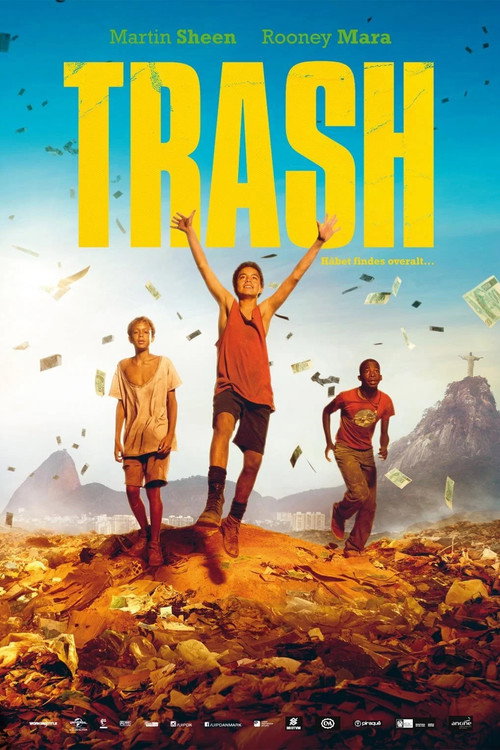
Trash (2014)
Directed by Stephen Daldry
No — Trash is not especially woke, scoring 26 out of 100 on our wokeness meter.
Stephen Daldry's Trash arrives with its conscience fully fastened, a Working Title production adapted by Richard Curtis from Andy Mulligan's novel and set among the refuse pickers of Rio de Janeiro.
Consciousness Markers
The three leads are played by actual Brazilian youths, giving the film authentic local representation, though this casting serves the story's naturalism rather than a modern representational agenda.
The villains are corrupt police and officials, giving the film an anti-establishment, system-is-rotten streak, though it targets graft rather than capitalism itself.
As a Richard Curtis-penned social-message thriller about corruption and poverty, the film carries a steady didactic, 'thought-provoking' earnestness, though it leavens it with adventure.
The film centers poor Brazilian street kids victimized by a corrupt system, but frames this as class and poverty injustice rather than a modern racial-consciousness argument.
Rooney Mara's Sister Olivia is a capable NGO worker, but the film advances no feminist thesis and the boys remain the protagonists.
No LGBTQ+ characters or themes appear in the narrative.
No environmental or climate themes are present.
No body-positivity themes or messaging.
No neurodivergence themes or characters.
The film is a contemporary fiction thriller with no historical revisionism.
Why it received this score
Stephen Daldry's Trash arrives with its conscience fully fastened, a Working Title production adapted by Richard Curtis from Andy Mulligan's novel and set among the refuse pickers of Rio de Janeiro. Three boys, Raphael, Gardo, and Rat, find a wallet in a landfill and are promptly converted into whistleblowers against a police force that has monetized its own corruption. The film is competently assembled and genuinely tense when it runs. It never lets us forget that it has Something To Say, and it says it loudly.
The three leads are played by actual Brazilian youths drawn from communities resembling the ones depicted, which lends the film a texture that a cast of imported professionals would have flattened. The injustice on offer is rooted in class and graft. The villains are cops and officials who have turned poverty into an industry, and the screenplay's sympathies run toward the poor as a category. This is old-fashioned anger at crooked institutions, not a newer vocabulary of identity, and the film seems content to let the audience finish the thought on its own.
Where the picture declines to travel is instructive. There is no romantic subplot of consequence, no engagement with sexuality, no environmental sermon, no interest in body or mind as categories of struggle. Rooney Mara's Sister Olivia is capable and largely decorative, a witness rather than an engine, and the screenplay never argues a thesis about gender. What remains is a well-meaning adventure with a sermon tucked under its arm, the sort of picture that wants credit for its subject matter and mostly earns it. It is sincere. It is occasionally moving. It is also the kind of cinema that congratulates the viewer for two hours of moral attention. A respectable vintage, if not a complicated one.
Analysis generated by our Consciousness Algorithm
Part of


Synopsis
Set in Brazil, three kids who make a discovery in a garbage dump soon find themselves running from the cops and trying to right a terrible wrong.
Questions about Trash
Is Trash woke?
No — Trash is not especially woke, scoring 26 out of 100 on our wokeness meter. That earns it a verdict of Based.
Does Trash have any woke elements?
4 of the 10 markers register at 30 or above, led by Representation Casting (40), Eat the Rich (35) and Lecture Energy (35). On Representation Casting: The three leads are played by actual Brazilian youths, giving the film authentic local representation, though this casting serves the story's naturalism rather than a modern representational agenda.
How does Trash compare to other 2014 movies?
It ranks #30 of the 303 films from 2014 we've scored; their average is 13. The wokest is Selma (68).
How is the Woke Score calculated?
An AI-assisted process researches the film and its reception, scores it 0–100 on ten markers, then combines those into one 0–100 Woke Score. It measures a specific set of 2020s cultural themes, not film quality.