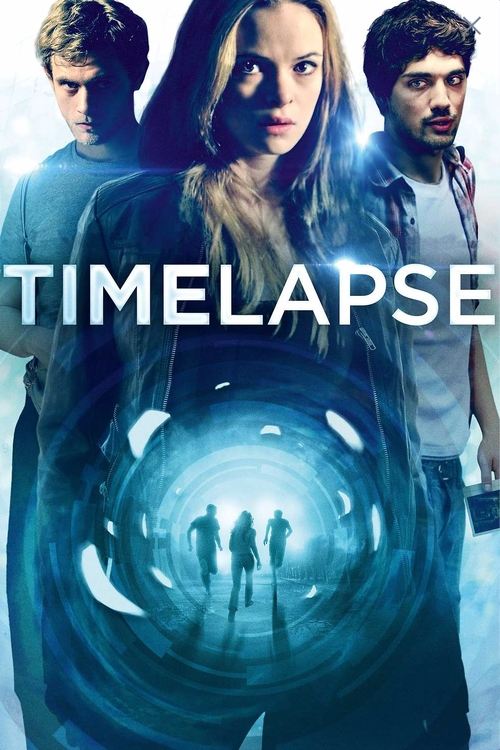
Time Lapse (2014)
Directed by Bradley King
No — Time Lapse is not woke, scoring 5 out of 100 on our wokeness meter.
Time Lapse arrives from 2014, a low-budget contraption about three friends, a dead landlord, and a camera that develops photographs of tomorrow at eight o'clock each evening.
Consciousness Markers
The cast is led by a white female and two white males, with Amin Joseph appearing as the security-guard-turned-cop Big Joe and a few other supporting players of color; these characters exist naturally in the story without any commentary on their identity.
Callie is a central, scheming figure who secretly manipulates the timeline via the morning photos, but she functions as a duplicitous antagonist rather than a vehicle for any feminist thesis.
Gambling addiction, a menacing bookie, and debt-driven greed motivate Jasper, but the film treats these as character flaws and plot mechanics rather than a critique of capitalism.
The film is a taut, puzzle-box thriller that shows rather than preaches; it offers no moralizing monologues or social messaging.
There are no LGBTQ+ characters, relationships, or themes anywhere in the film's plot or subtext.
Race is never addressed, thematized, or commented upon; the film is entirely concerned with time paradoxes and personal betrayal.
No environmental or climate themes appear in this single-location time-travel thriller.
There is no engagement with body image, size, or body-positivity themes.
No neurodivergent characters or themes are present; the protagonists' behavior is driven by greed, jealousy, and paranoia.
The film is a fictional sci-fi puzzle with no historical subject matter to revise.
Why it received this score
Time Lapse arrives from 2014, a low-budget contraption about three friends, a dead landlord, and a camera that develops photographs of tomorrow at eight o'clock each evening. It has been compared to Primer and to an old Twilight Zone episode, and both comparisons are fair. The film is a machine for generating causal loops, and it runs with the grim efficiency of a metronome. Our classification duties here are, for once, mercifully light.
The cast is white and unbothered by the fact. Amin Joseph turns up as Big Joe, a security guard who becomes a police officer, and the film lets him be a person instead of a statement. Race goes unmentioned. So does everything else. There is no queer subtext, no environmental lament, no sermon on body image, no neurodivergent arc, no historical record in need of correction. Callie, played with cold precision by Danielle Panabaker, is the most active figure in the story, and she is a liar who shoots her boyfriend and manipulates a timeline through secret morning photographs. Her gender is not the point. Her ruthlessness is. Jasper's gambling debts and the bookie who collects them are presented as personal rot, not as evidence of a broken economic order. The film has no interest in indicting anything larger than its three leads.
And that is the quiet pleasure of the thing. It shows, it does not lecture. Nobody stands in a doorway explaining what the audience ought to feel. The final note, a scrap of paper falling from a window, lands as fatalism rather than moral instruction. We grade it accordingly, with something close to gratitude.
Analysis generated by our Consciousness Algorithm


Synopsis
Three friends discover a mysterious machine that takes pictures 24 hours into the future and conspire to use it for personal gain, until disturbing and dangerous images begin to develop.
Questions about Time Lapse
Is Time Lapse woke?
No — Time Lapse is not woke, scoring 5 out of 100 on our wokeness meter. That earns it a verdict of Ultra Based.
Does Time Lapse have any woke elements?
Very few. None of the 10 markers reaches 30, the level where a marker counts as present; the highest is Representation Casting at 12.
How does Time Lapse compare to other 2014 movies?
It ranks #212 of the 303 films from 2014 we've scored; their average is 13. The wokest is Selma (68).
How is the Woke Score calculated?
An AI-assisted process researches the film and its reception, scores it 0–100 on ten markers, then combines those into one 0–100 Woke Score. It measures a specific set of 2020s cultural themes, not film quality.