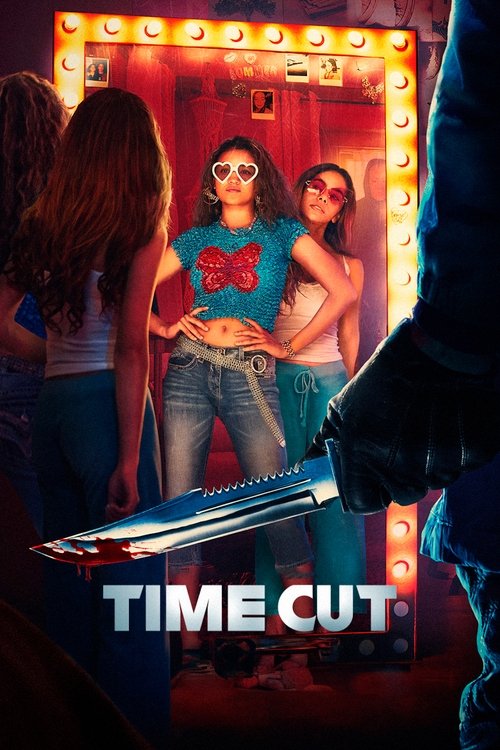
Time Cut (2024)
Directed by Hannah Macpherson
Yes — Time Cut is woke, scoring 60 out of 100 on our wokeness meter.
Time Cut arrives as a Netflix slasher in which a teenager named Lucy is flung from 2024 back to 2003, two days before a masked killer murders her older sister.
Consciousness Markers
Summer is revealed to be a lesbian, Lucy encourages her to come out, and Summer publicly confesses her love for Emmy; the subplot is central to the third act.
The film features two young women of color as the central sisters and a woman director, but the casting is not framed as a corrective or race-conscious statement.
A woman directs, the plot centers on sisterhood and a young woman saving her sister, and the female characters drive the action; however, it lacks an explicit feminist thesis.
The film includes a mild 'be yourself' coming-out acceptance beat, but it is delivered through plot and character rather than sustained preaching.
No racial themes, commentary, or racialized conflict appear; the diverse casting is not used to explore race.
No climate or environmental themes are present.
No critique of capitalism or wealth appears; the small-town decay is backdrop, not economic argument.
No body-positivity themes or body-image commentary are present.
No neurodivergence themes or diagnosis appear; Quinn's bullying is not framed as neurodivergent.
Time travel to 2003 is a genre premise, not a revisionist historical narrative.
Why it received this score
Time Cut arrives as a Netflix slasher in which a teenager named Lucy is flung from 2024 back to 2003, two days before a masked killer murders her older sister. The premise has been worked before, and critics were unkind, comparing it unfavorably to its own recent ancestor. The film does not argue with them. It is content to be light, quick, and faintly absurd, and it largely succeeds at being those things.
Where the film carries measurable social content is in its treatment of Summer, the sister, who is a lesbian. Lucy discovers the truth, encourages her to come out, and Summer later declares her love for Emmy in front of an assembled school. The beat is warm and it anchors the third act, though it arrives through plot and character instead of sustained sermonizing. The film is also directed by a woman, places two young women of color at its center, and builds its emotional engine on sisterhood and a girl racing to save a sibling. None of this is framed as a corrective. The casting is simply casting. The sisterhood is simply the plot.
What the film declines to do is lecture. There is no racial commentary, no economic critique of the decaying small town, no climate anxiety, no body-image discourse, no neurodivergent diagnosis. The 2003 setting is a genre device, not a historical argument. The result is a modest vintage: a few genuine notes of social awareness, a Hilary Duff needle drop, and a hay barn full of lasers. We have tasted worse. We have also tasted better, and we will taste both again.
Analysis generated by our Consciousness Algorithm


Synopsis
A teen in 2024 accidentally time-travels to 2003, days before a masked killer murders her sister. Can she change the past without destroying the future?
Questions about Time Cut
Is Time Cut woke?
Yes — Time Cut is woke, scoring 60 out of 100 on our wokeness meter. That earns it a verdict of Woke.
What makes Time Cut woke?
3 of the 10 markers register at 30 or above, led by LGBTQ+ Themes (80), Representation Casting (50) and Feminist Agenda (45). On LGBTQ+ Themes: Summer is revealed to be a lesbian, Lucy encourages her to come out, and Summer publicly confesses her love for Emmy; the subplot is central to the third act.
How does Time Cut compare to other 2024 movies?
It ranks #10 of the 189 films from 2024 we've scored; their average is 22. The wokest is The Six Triple Eight (92).
How is the Woke Score calculated?
An AI-assisted process researches the film and its reception, scores it 0–100 on ten markers, then combines those into one 0–100 Woke Score. It measures a specific set of 2020s cultural themes, not film quality.