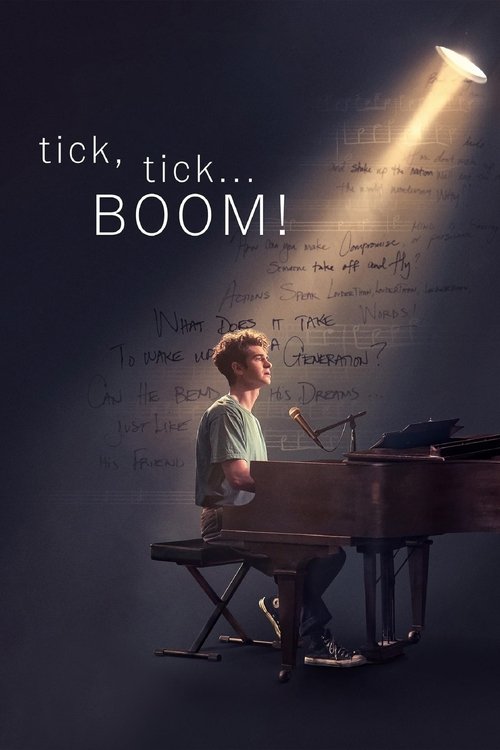
tick, tick... BOOM! (2021)
Directed by Lin-Manuel Miranda
No — tick, tick... BOOM! is not especially woke, scoring 33 out of 100 on our wokeness meter.
The film adaptation of Jonathan Larson's tick, tick...
Consciousness Markers
Michael's arc is explicitly built around being a gay man during the AIDS crisis, his HIV-positive status, and his partner David; his confrontation with Jonathan about the privilege of loving openly is a central emotional beat.
The ensemble is notably diverse for a period piece about 1990s theater, with Black, Latino, and trans performers (Michaela Jaé Rodriguez) in prominent roles, though the casting largely reflects the genuinely diverse Broadway community rather than an explicit representational mandate.
Susan is given agency to pursue her own career and end the relationship on her terms, but the narrative remains firmly centered on a male protagonist's artistic struggle.
The tension between Michael's lucrative advertising career and Jonathan's financially precarious art gestures at a critique of selling out, but it is framed as a personal dilemma about artistic integrity rather than a systemic indictment of capitalism.
Themes of artistic sacrifice and the AIDS crisis are delivered through song and character drama rather than direct moral instruction, keeping the sermonizing light.
The film features a multiracial cast and a street rapper character, but race is never a subject of commentary or thematic weight.
No environmental or climate content whatsoever.
No body positivity themes present.
The recurring 'ticking' in Jonathan's head is a metaphor for mortality and time pressure, not a depiction of neurodivergence.
The film is a faithful, affectionate adaptation of Larson's own semi-autobiographical work and does not revise or reinterpret historical events for ideological purposes.
Why it received this score
The film adaptation of Jonathan Larson's tick, tick... Boom, directed by Lin-Manuel Miranda, follows a promising composer through a week of diner shifts, workshop rehearsals, and the looming terror of turning thirty. The film is set in 1990, and it treats that milieu with affection: cramped apartments, answering machines, the specific anxiety of making art before time runs out. Andrew Garfield plays Larson as a man vibrating with deadlines, and the movie's energy comes from his panic. The social consciousness on display is selective, which is not a criticism so much as a description. This is a period piece about theater people, and it knows exactly which period it is.
The most substantial progressive thread is Michael's story. As a gay man living through the AIDS crisis, he has left acting for advertising, and his HIV-positive status reframes the film's central argument about sacrifice. His confrontation with Jonathan about the privilege of loving openly lands with real force. The ensemble is diverse in a way that feels organic to the Broadway community, with Black, Latino, and trans performers in prominent roles, though race itself is rarely a subject of commentary. Susan is allowed to end the relationship on her own terms, yet the narrative remains fixed on a male genius and his career. The tension between advertising money and theatrical poverty gestures at a critique of selling out, but it stays a personal dilemma, not a systemic indictment.
Other contemporary markers are simply absent. There is no environmental content, no body positivity theme, and the ticking in Jonathan's head is a metaphor for mortality, not neurodivergence. The film does not revise history for ideological purposes; it is a faithful, affectionate adaptation of Larson's own work. Its sermonizing is light. Themes arrive through song and character drama, not direct instruction. The result is a sincere musical that earns its emotional crescendos without turning into a lecture. It is culturally aware in the way a Broadway memorial is culturally aware: inclusive by habit, emotional by design, and careful never to push the audience too hard.
Analysis generated by our Consciousness Algorithm


Synopsis
On the brink of turning 30, a promising theater composer navigates love, friendship and the pressure to create something great before time runs out.
Questions about tick, tick... BOOM!
Is tick, tick... BOOM! woke?
No — tick, tick... BOOM! is not especially woke, scoring 33 out of 100 on our wokeness meter. That earns it a verdict of Based.
Does tick, tick... BOOM! have any woke elements?
2 of the 10 markers register at 30 or above, led by LGBTQ+ Themes (70) and Representation Casting (50). On LGBTQ+ Themes: Michael's arc is explicitly built around being a gay man during the AIDS crisis, his HIV-positive status, and his partner David; his confrontation with Jonathan about the privilege of loving openly is a central emotional beat.
How does tick, tick... BOOM! compare to other 2021 movies?
It ranks #61 of the 242 films from 2021 we've scored; their average is 23. The wokest is The Forever Purge (83).
How is the Woke Score calculated?
An AI-assisted process researches the film and its reception, scores it 0–100 on ten markers, then combines those into one 0–100 Woke Score. It measures a specific set of 2020s cultural themes, not film quality.