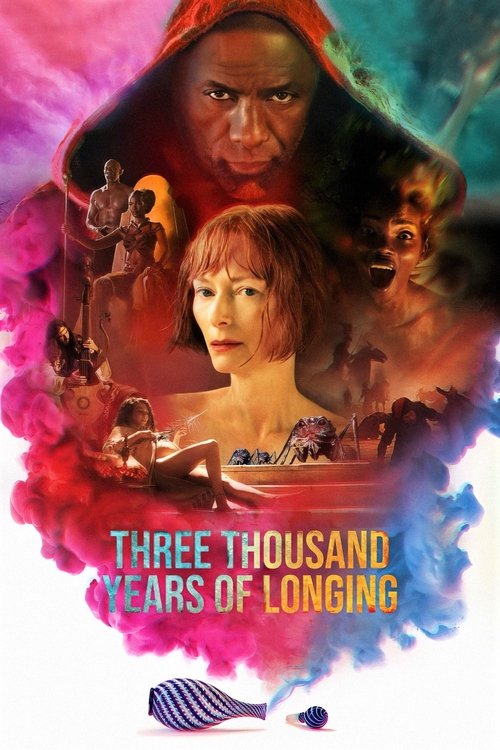
Three Thousand Years of Longing (2022)
Directed by George Miller
No — Three Thousand Years of Longing is not especially woke, scoring 20 out of 100 on our wokeness meter.
George Miller, a director who once sent a talking pig to the city and now sends a djinn to a hotel room in Istanbul, has adapted A. S. Byatt's short story with the patience of a man convinced that what the world needs is two hours of conversation between a large purple spirit and a British academic.
Consciousness Markers
A Black British actor (Idris Elba) carries the romantic lead opposite a white actress, with a notably international supporting cast including Turkish, Ugandan, and disabled performers (Sarah Houbolt). The diversity is present but largely unremarked upon within the narrative.
Alithea is a deliberately solitary, childless, self-possessed scholar who prizes her independence, and the harem vignettes center on women navigating patriarchal power. The film observes female agency without mounting an explicit feminist argument.
The Sultan Ibrahim's favorite concubine, 'Sugar Lump,' is a large-bodied woman presented as desirable and favored, a modest but genuine depiction of plus-size desirability.
The film is talky and idea-driven, with a narratology scholar discoursing on the nature of stories and wishes, but its intellectualism is literary rather than preachy or socially prescriptive.
The central romance crosses racial lines, but the film never engages race as a subject, treating the pairing as unremarkable rather than as commentary.
The film freely reimagines historical and mythological figures (Solomon, the Queen of Sheba, Suleiman, Hürrem Sultan, Murad IV) in fantastical terms, though this is mythic invention rather than ideological historical revision.
Alithea matter-of-factly experiences hallucinations of demonic figures and is characterized as an isolated, imagination-haunted mind, but the film does not frame this through a neurodivergence lens.
No LGBTQ+ characters, relationships, or themes appear anywhere in the film's nested tales or framing story.
No environmental or climate themes are present; the djinn's weakness stems from electromagnetic interference, not ecological concerns.
The film contains no critique of wealth, capitalism, or class structures.
Why it received this score
George Miller, a director who once sent a talking pig to the city and now sends a djinn to a hotel room in Istanbul, has adapted A. S. Byatt's short story with the patience of a man convinced that what the world needs is two hours of conversation between a large purple spirit and a British academic. Tilda Swinton plays Alithea, a narratology scholar who prizes her solitude and has never wanted children. Idris Elba plays the Djinn, who has spent three thousand years in a bottle and would like a few more minutes to explain why. The film is talky, literary, and largely indifferent to the trends of its moment.
That indifference deserves a closer look. The central romance crosses racial lines and the film treats this as unremarkable, which is either admirable restraint or a refusal to engage. The supporting cast wanders through Turkish, Ugandan, and disabled performers without commentary. Alithea's independence gets a hearing, though the film never argues for it. A sultan's favorite concubine, called Sugar Lump, is a large-bodied woman presented as desirable, and the film lets that stand. Alithea also hallucinates demons, treated as a quirk of an overactive imagination, not a condition. The historical figures, Solomon and the Queen of Sheba and Suleiman among them, are reinvented freely, but as myth, not as argument.
The absences are instructive. No queer thread, no climate anxiety, no class grievance. The djinn's weakness comes from cell towers, not carbon. The lecturing is real but literary: Alithea discourses on stories and wishes, and the sermon concerns narrative, not society. It is a handsome, strange, unprofitable object, and the box office was not kind to it. Miller has made a film out of step with its era, and seems entirely at peace with that.
Analysis generated by our Consciousness Algorithm


Synopsis
A solitary scholar discovers an ancient bottle while on a trip to Istanbul and unleashes a djinn who offers her three wishes. Filled with reluctance, she is unable to come up with one, so the djinn tries to inspire her with his stories.
Questions about Three Thousand Years of Longing
Is Three Thousand Years of Longing woke?
No — Three Thousand Years of Longing is not especially woke, scoring 20 out of 100 on our wokeness meter. That earns it a verdict of Based.
Does Three Thousand Years of Longing have any woke elements?
2 of the 10 markers register at 30 or above, led by Representation Casting (42) and Feminist Agenda (30). On Representation Casting: A Black British actor (Idris Elba) carries the romantic lead opposite a white actress, with a notably international supporting cast including Turkish, Ugandan, and disabled performers (Sarah Houbolt).
How does Three Thousand Years of Longing compare to other 2022 movies?
It ranks #86 of the 223 films from 2022 we've scored; their average is 22. The wokest is Bros (92).
How is the Woke Score calculated?
An AI-assisted process researches the film and its reception, scores it 0–100 on ten markers, then combines those into one 0–100 Woke Score. It measures a specific set of 2020s cultural themes, not film quality.