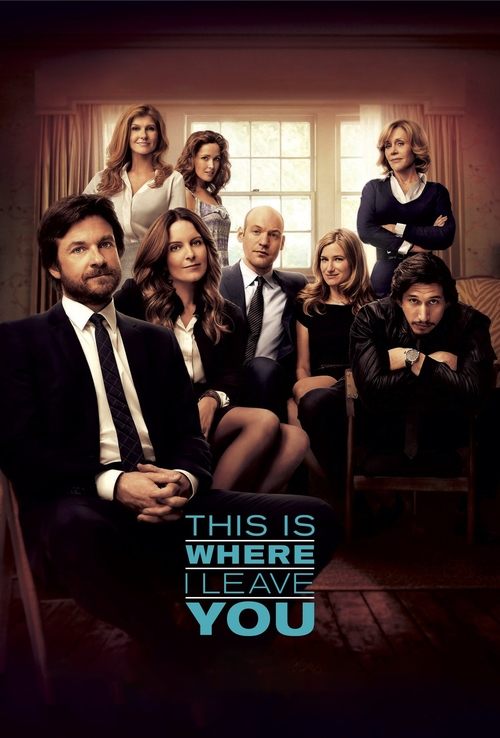
This Is Where I Leave You (2014)
Directed by Shawn Levy
No — This Is Where I Leave You is not especially woke, scoring 20 out of 100 on our wokeness meter.
Shawn Levy's 2014 adaptation of Jonathan Tropper's novel assembles an enviable cast and asks it to grieve in a living room for seven days.
Consciousness Markers
The late-film reveal that matriarch Hilary has fallen in love with her neighbor Linda, and uses the shiva to come out to her children, is a genuine and load-bearing LGBTQ+ plot element rather than a throwaway.
Tina Fey's Wendy and Jane Fonda's Hilary have agency and interiority, but the film is a conventional family dramedy rather than a vehicle for any feminist argument.
The ensemble is almost entirely white, with no meaningful effort at diverse or color-conscious casting; the only representational note is a Jewish family context that is treated as default rather than a statement.
The coming-out and family-reconciliation beats are delivered as plot twists and emotional payoffs rather than as preachy messaging, keeping the sermonizing minimal.
Horry Callen lives with a traumatic brain injury portrayed with some sympathy, but this is a disability subplot rather than a neurodivergence-conscious narrative.
There is no engagement with race, racial identity, or racial politics anywhere in the film.
No environmental or climate themes appear in the story.
The family sporting-goods business and a workaholic husband are present, but the film makes no critique of capitalism or wealth.
No body-positivity themes or messaging are present.
The film is a contemporary family story with no historical revisionism of any kind.
Why it received this score
Shawn Levy's 2014 adaptation of Jonathan Tropper's novel assembles an enviable cast and asks it to grieve in a living room for seven days. The ensemble is almost entirely white, and the family's Jewishness is offered as default texture, a fact of the household instead of a thesis. That is the extent of its representational ambition. There is no engagement with race. None with climate. None with body image. The family sporting goods business exists to give the eldest brother something to resent, not to invite an economic critique, and the workaholic husband is a plot inconvenience, not an indictment of late capitalism.
The one element carrying genuine social weight is Hilary's late revelation that she has fallen in love with Linda, the neighbor. It lands as a twist, and it reorganizes the final act, which makes it load-bearing instead of decorative. The film deserves credit for that. Elsewhere, Tina Fey and Jane Fonda are given interiority and agency, though the screenplay never argues a feminist position. These are simply women with problems. Horry Callen's traumatic brain injury is treated with a sympathy that stops short of any real neurodivergent consciousness. He is a casualty of the past, useful for Wendy's guilt.
Where the film might have lectured, it mostly does not. The coming-out scene and the family reconciliation arrive as emotional payoffs, timed for maximum dinner-table disruption, and the sermonizing stays light. This is a modest, well-acted picture that critics met with a shrug and audiences met with a B plus. It means well without meaning much. We file it accordingly, with a note of respect for the one scene where it actually risks something.
Analysis generated by our Consciousness Algorithm
Part of


Synopsis
When their father passes away, four grown, world-weary siblings return to their childhood home and are requested -- with an admonition -- to stay there together for a week, along with their free-speaking mother and a collection of spouses, exes and might-have-beens. As the brothers and sisters re-examine their shared history and the status of each tattered relationship among those who know and love them best, they reconnect in hysterically funny and emotionally significant ways.
Questions about This Is Where I Leave You
Is This Is Where I Leave You woke?
No — This Is Where I Leave You is not especially woke, scoring 20 out of 100 on our wokeness meter. That earns it a verdict of Based.
Does This Is Where I Leave You have any woke elements?
1 of the 10 markers register at 30 or above, led by LGBTQ+ Themes (55). On LGBTQ+ Themes: The late-film reveal that matriarch Hilary has fallen in love with her neighbor Linda, and uses the shiva to come out to her children, is a genuine and load-bearing LGBTQ+ plot element rather than a throwaway.
How does This Is Where I Leave You compare to other 2014 movies?
It ranks #54 of the 303 films from 2014 we've scored; their average is 13. The wokest is Selma (68).
How is the Woke Score calculated?
An AI-assisted process researches the film and its reception, scores it 0–100 on ten markers, then combines those into one 0–100 Woke Score. It measures a specific set of 2020s cultural themes, not film quality.