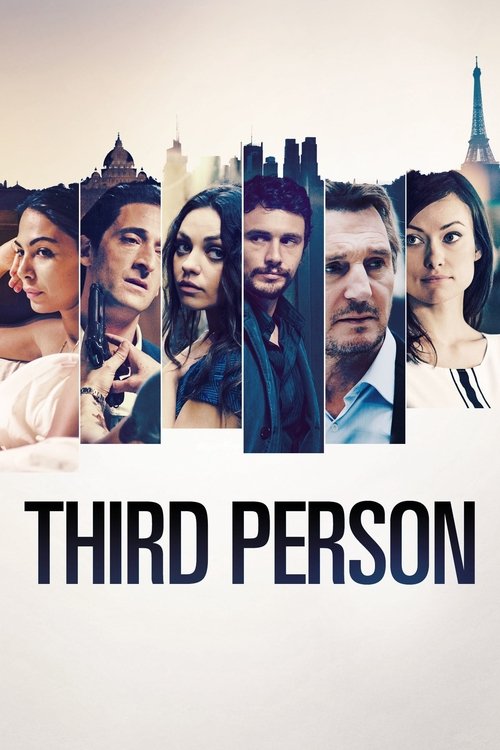
Third Person (2014)
Directed by Paul Haggis
No — Third Person is not woke, scoring 6 out of 100 on our wokeness meter.
Paul Haggis's Third Person arrives with the solemn bearing of a film convinced it has cracked the code of human intimacy.
Consciousness Markers
The ensemble is overwhelmingly white (Neeson, Kunis, Brody, Franco, Wilde, Bello, Basinger); a Romani character appears but is played by a non-Romani actress and framed as a plot device rather than a representational statement.
Women are largely defined by romantic dysfunction and maternal crisis (Kunis's custody battle, Wilde's 'inability to commit'); no feminist framework or critique is advanced.
A Romani woman figures in the Italian segment, but her ethnicity functions as exoticized plot machinery rather than a vehicle for racial commentary or consciousness.
Haggis's film is a moody, self-serious meditation on love and loss rather than a preachy message movie; any thematic weight is delivered through narrative rather than sermon.
No LGBTQ+ characters, relationships, or themes appear in any of the three interlocking storylines.
No environmental or climate themes are present in the film.
The film concerns love, grief, and infidelity; it offers no critique of wealth, class, or capitalism.
No body-positive themes or messaging appear in the film.
A keyword references 'personality disorder,' but the film does not engage with neurodivergence as a theme or advocate for neurodivergent representation.
The film is a contemporary fictional drama with no historical revisionism or reframing of past events.
Why it received this score
Paul Haggis's Third Person arrives with the solemn bearing of a film convinced it has cracked the code of human intimacy. Three stories unfold across Paris, New York, and southern Italy, each charting a relationship's beginning, middle, or end, and all of them eventually revealed to be inventions of a grieving novelist. The structure is meant to dazzle. It mostly exhausts. Neeson broods through a Parisian affair with Olivia Wilde, Kunis stands accused of harming her child in a custody war, and Brody drifts through Italy chasing a Romani woman whose daughter has been kidnapped. The cast is uniformly accomplished and uniformly white, with the exception of Moran Atias, whose Roma character exists chiefly to be rescued.
The film's social consciousness is thin to the point of transparency. Women here are defined almost entirely by romantic paralysis and maternal catastrophe: Kunis fights for custody, Wilde cannot commit, and the screenplay treats both conditions as mysteries of the feminine instead of circumstances with causes. The Romani subplot gestures toward ethnic texture but deploys it as exotic machinery, a damsel and a ransom, not a perspective. There is no engagement with queerness, with class, with the body, with the climate, or with neurological difference. Haggis has made a film about love and loss and the lies people tell, and he has kept his gaze narrow throughout.
To its credit, Third Person does not lecture. It sermonizes only in the manner of a novelist who believes his own melancholy is universal, which is a gentler sin than the message movie. The result is a moody, self-serious puzzle that never quite justifies its own gravity. We are left with a handsomely photographed shrug, and the distinct impression that the film's cultural awareness begins and ends at the casting call.
Analysis generated by our Consciousness Algorithm


Synopsis
An acclaimed novelist struggles to write an analysis of love in one of three stories, each set in a different city, that detail the beginning, middle and end of a relationship.
Questions about Third Person
Is Third Person woke?
No — Third Person is not woke, scoring 6 out of 100 on our wokeness meter. That earns it a verdict of Ultra Based.
Does Third Person have any woke elements?
Very few. None of the 10 markers reaches 30, the level where a marker counts as present; the highest is Representation Casting at 12.
How does Third Person compare to other 2014 movies?
It ranks #185 of the 303 films from 2014 we've scored; their average is 13. The wokest is Selma (68).
How is the Woke Score calculated?
An AI-assisted process researches the film and its reception, scores it 0–100 on ten markers, then combines those into one 0–100 Woke Score. It measures a specific set of 2020s cultural themes, not film quality.