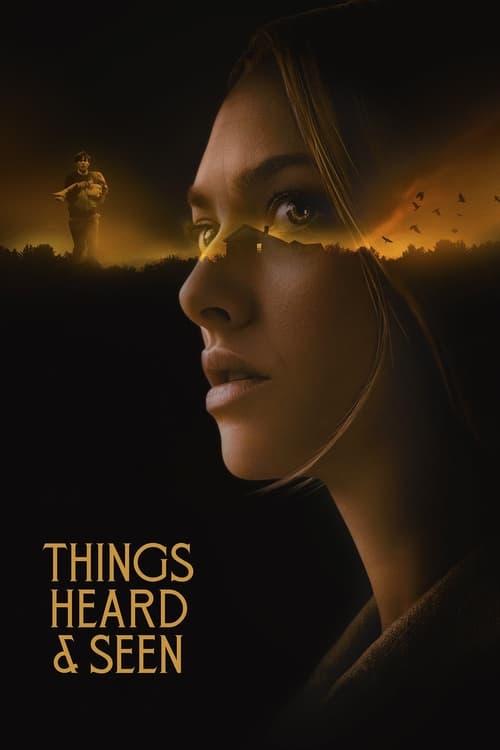
Things Heard & Seen (2021)
Directed by Robert Pulcini
No — Things Heard & Seen is not woke, scoring 12 out of 100 on our wokeness meter.
There is a house in upstate New York, and it is unhappy.
Consciousness Markers
The film centers on a woman trapped in a toxic, abusive marriage and culminates in female ghosts uniting to expose and doom the murderous husband, a mild feminist-adjacent solidarity theme, though it is framed as horror rather than advocacy.
The cast is overwhelmingly white, with F. Murray Abraham the only notable non-Anglo name; no deliberate diverse casting is evident in the ensemble.
The film gestures at Swedenborgian mysticism and moral damnation, but these are woven into the plot as atmosphere rather than delivered as a sermon to the audience.
No LGBTQ+ characters, relationships, or themes appear anywhere in the plot.
No engagement with race or racial politics; the story is entirely about a white family in upstate New York.
No environmental or climate themes are present.
No critique of capitalism, wealth, or class structures; the antagonist's sins are personal (fraud, infidelity, murder), not economic.
Catherine's bulimia is depicted as a symptom of her troubled life, not as a body-positive or fat-acceptance statement; the film offers no body-image advocacy.
No neurodivergent characters or themes are present.
The 1980 setting and Swedenborgian theology are used atmospherically, not to revise or reinterpret historical events.
Why it received this score
There is a house in upstate New York, and it is unhappy. Things Heard & Seen, adapted from Elizabeth Brundage's novel All Things Cease to Appear, follows Catherine Claire, an art restorer, as she relocates from Manhattan in 1980 with her husband George, an art history professor with a forged letter of recommendation and a taste for infidelity. The paintings on the walls are Hudson River School. The theology in the air is Swedenborgian. The mood is damp. None of this prepares anyone for the axe.
The film's social consciousness is modest and mostly structural. Catherine suffers inside a toxic marriage, is drugged, and is murdered, and the resolution belongs to a coalition of female ghosts who expose the killer and see him damned. The sympathy runs toward the abused wife and the wronged dead. It stops there. The ensemble is white, the concerns are domestic, and the supernatural machinery carries the moral weight instead of any argument about the world outside the farmhouse. Bulimia appears as a private symptom, not a statement. The 1980s setting is decoration, not commentary.
What the film offers in place of a thesis is atmosphere, generously applied. Swedenborg's heaven is more real than the world, we are told at the top, and the film keeps returning to signs, portraits, and a cross that can be flipped to indicate damnation. This material sits inside the plot as texture. Nobody turns to the camera to explain the moral. Critics were unimpressed, and the whole enterprise has the air of a well-furnished rental. We classify it as a haunted-house picture with a mild current of sympathy for the wife, and nothing more strenuous than that.
Analysis generated by our Consciousness Algorithm


Synopsis
A young woman discovers that both her husband and their new home harbor sinister secrets after they leave Manhattan for small-town life.
Questions about Things Heard & Seen
Is Things Heard & Seen woke?
No — Things Heard & Seen is not woke, scoring 12 out of 100 on our wokeness meter. That earns it a verdict of Ultra Based.
Does Things Heard & Seen have any woke elements?
1 of the 10 markers register at 30 or above, led by Feminist Agenda (30). On Feminist Agenda: The film centers on a woman trapped in a toxic, abusive marriage and culminates in female ghosts uniting to expose and doom the murderous husband, a mild feminist-adjacent solidarity theme, though it is framed as horror rather than advocacy.
How does Things Heard & Seen compare to other 2021 movies?
It ranks #152 of the 242 films from 2021 we've scored; their average is 23. The wokest is The Forever Purge (83).
How is the Woke Score calculated?
An AI-assisted process researches the film and its reception, scores it 0–100 on ten markers, then combines those into one 0–100 Woke Score. It measures a specific set of 2020s cultural themes, not film quality.