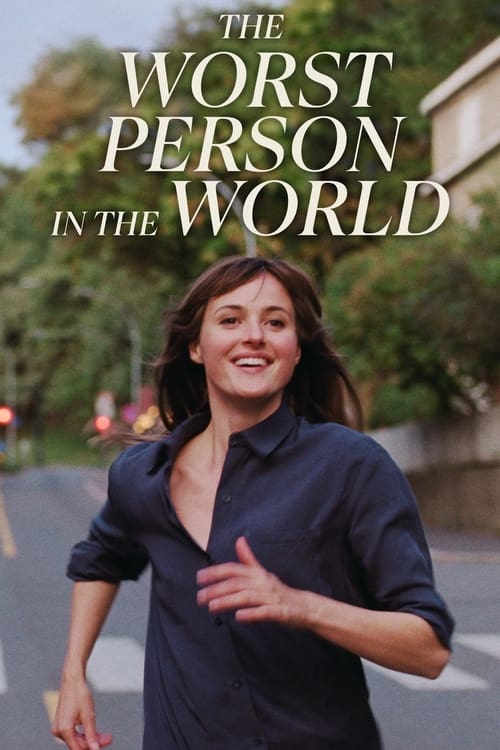
The Worst Person in the World (2021)
Directed by Joachim Trier
No — The Worst Person in the World is not woke, scoring 12 out of 100 on our wokeness meter.
Joachim Trier's The Worst Person in the World is a romantic comedy-drama that follows Julie through four years of indecision, bookshop employment, and romantic entanglements in Oslo.
Consciousness Markers
The film centers a young woman's autonomy, ambivalence about motherhood, and self-authorship, and Julie pens a short story explicitly about feminism and oral sex. It is a character study rather than a thesis, but the sensibility is present.
Sunniva is characterized as an obsessively climate- and social-justice-conscious partner whose restrictive lifestyle drives Eivind away. Climate consciousness appears only as a mildly satirized character trait, not a crusade.
The film is deliberately un-preachy, favoring ambivalence and open questions over moral instruction. The feminist short story is a plot device rather than a sermon.
The cast is a natural Norwegian ensemble, largely white and Scandinavian, with no evident effort to engineer demographic representation. A single Italian-heritage performer appears without comment.
No LGBTQ+ characters, relationships, or themes appear anywhere in the narrative.
No engagement with race or racial politics; the film is entirely concerned with white Norwegian bohemian life.
No critique of capitalism or class structures; the characters' struggles are existential and romantic, not economic.
No body-positivity themes or messaging regarding body image or size.
No neurodivergent characters or themes are present.
No historical revisionism; the film is a contemporary fictional character study.
Why it received this score
Joachim Trier's The Worst Person in the World is a romantic comedy-drama that follows Julie through four years of indecision, bookshop employment, and romantic entanglements in Oslo. The cast is a natural Scandinavian ensemble, with one Italian-heritage performer appearing without fanfare. There is no LGBTQ+ material, no racial consciousness, and no attempt to address the politics of identity. What the film does possess is a mild feminist undercurrent. Julie's ambivalence about motherhood, her shifting careers, and her short story about feminism and oral sex all point toward a young woman's self-authorship. Yet this is a character study, not a thesis. The film observes Julie's contradictions without insisting that we applaud them.
Elsewhere, the cultural markers are sparse. Sunniva, Eivind's girlfriend, is defined by an obsessive climate and social justice consciousness, and her restrictive lifestyle is treated as a comic obstacle. That is the extent of the environmental concern. There is no critique of capitalism, no body-positivity messaging, no neurodivergent character, and no revisionist history. The film is entirely occupied with white Norwegian bohemian life, its anxieties, its breakups, its cancer wards, and its psychedelic mushrooms. The lecture energy is low by design. Trier favors ambivalence, open questions, and moments of quiet humiliation over moral instruction. The feminist short story functions as a plot device, not a sermon.
The result is a film that feels contemporary without feeling engineered. Its progressive sensibilities are soft, European, and character-first: a woman's right to change her mind, a climate-conscious partner as a mild joke, a writer's transgression as a way to test a relationship. The film has been widely acclaimed, and rightly so, but it does not arrive with a checklist. It arrives with a person. Julie is messy, selfish, and unresolved, and the film lets her be those things without turning her into a lesson. That restraint is its most distinguishing feature. In an era of cinema that often speaks in bullet points, this one prefers a shrug, a sunrise, and a miscarriage in the shower.
Analysis generated by our Consciousness Algorithm


Synopsis
The chronicles of four years in the life of Julie, a young woman who navigates the troubled waters of her love life and struggles to find her career path, leading her to take a realistic look at who she really is.
Questions about The Worst Person in the World
Is The Worst Person in the World woke?
No — The Worst Person in the World is not woke, scoring 12 out of 100 on our wokeness meter. That earns it a verdict of Ultra Based.
Does The Worst Person in the World have any woke elements?
1 of the 10 markers register at 30 or above, led by Feminist Agenda (35). On Feminist Agenda: The film centers a young woman's autonomy, ambivalence about motherhood, and self-authorship, and Julie pens a short story explicitly about feminism and oral sex.
How does The Worst Person in the World compare to other 2021 movies?
It ranks #152 of the 242 films from 2021 we've scored; their average is 23. The wokest is The Forever Purge (83).
How is the Woke Score calculated?
An AI-assisted process researches the film and its reception, scores it 0–100 on ten markers, then combines those into one 0–100 Woke Score. It measures a specific set of 2020s cultural themes, not film quality.