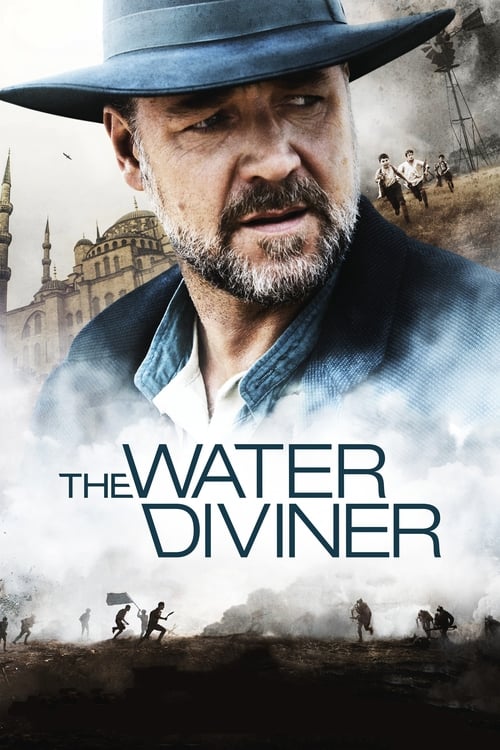
The Water Diviner (2014)
Directed by Russell Crowe
No — The Water Diviner is not woke, scoring 12 out of 100 on our wokeness meter.
The Water Diviner is a somber 2014 war drama directed by and starring Russell Crowe, who plays Joshua Connor, an Australian farmer who travels to Turkey in 1919 to recover the bodies of his three missing sons.
Consciousness Markers
The film's central reconciliation between an Australian father and Turkish officers carries a cross-cultural understanding message, but it is framed around shared grief and nationhood rather than modern racial consciousness.
Turkish actors Yılmaz Erdoğan and Cem Yılmaz appear in substantial, sympathetic roles alongside a mixed Australian and international cast, but this is organic to the cross-cultural war narrative rather than conspicuous diversity casting.
The film carries moralizing about brotherhood and shared suffering across enemy lines, but delivers it through melodrama rather than preachy social instruction.
Ayshe is a war widow pressured into marrying her brother-in-law and does assert herself, but the film treats this as personal drama rather than a feminist thesis.
The film was widely condemned for sanitizing the period by portraying the Turks purely as victims and omitting the Armenian, Assyrian, and Greek genocides, a distortion that serves Turkish state apologism rather than a progressive reframing.
No LGBTQ+ characters, themes, or subtext appear anywhere in the film.
No environmental themes, climate commentary, or ecological messaging present.
No critique of capitalism, class warfare, or economic-justice messaging present.
No body-positivity themes or messaging present.
Arthur's trauma and survival guilt are depicted as war-induced PTSD, not as neurodivergence framed through a modern identity lens.
Why it received this score
The Water Diviner is a somber 2014 war drama directed by and starring Russell Crowe, who plays Joshua Connor, an Australian farmer who travels to Turkey in 1919 to recover the bodies of his three missing sons. The film gives substantial, sympathetic roles to Turkish actors Yılmaz Erdoğan and Cem Yılmaz, and this cross-cultural casting feels organic to the story of shared grief. It is not a conspicuous diversity exercise. Crowe directs with a heavy hand and an earnest heart, which is its own kind of period piece.
The social consciousness here is intermittent. Ayshe, a war widow pressured to marry her brother-in-law, asserts herself, but the film treats her plight as personal melodrama, not a feminist thesis. Joshua's reconciliation with Major Hasan carries a message of cross-cultural understanding, though it is framed around mourning and nationhood, not modern racial politics. The historical revisionism is more troubling: the film's portrayal of Turks purely as victims drew condemnation for omitting the Armenian, Assyrian, and Greek genocides. That omission flatters Turkish state apologism. There is moralizing about brotherhood across enemy lines, but it arrives through tears and music, not sermons. The film has no LGBTQ subtext, no climate crusade, no anti-capitalist anger, no body-positivity arc, and no neurodivergence framed as identity. Arthur's trauma is PTSD, full stop.
As a piece of cultural classification, The Water Diviner sits in an awkward middle. It wants to be a humanist epic about fathers, sons, and enemies who discover each other's humanity. It succeeds in fits. The controversy surrounding its historical omissions is more compelling than the film itself. We are left with a well-meaning, slightly dull monument to grief, one that gestures at progressive sympathy without committing to any modern catechism.
Analysis generated by our Consciousness Algorithm


Synopsis
In 1919, Australian farmer Joshua Connor travels to Turkey to discover the fate of his three sons, reported missing in action. Holding on to hope, Joshua must travel across the war-torn landscape to find the truth and his own peace.
Questions about The Water Diviner
Is The Water Diviner woke?
No — The Water Diviner is not woke, scoring 12 out of 100 on our wokeness meter. That earns it a verdict of Ultra Based.
Does The Water Diviner have any woke elements?
Very few. None of the 10 markers reaches 30, the level where a marker counts as present; the highest is Racial Consciousness at 25.
How does The Water Diviner compare to other 2014 movies?
It ranks #113 of the 303 films from 2014 we've scored; their average is 13. The wokest is Selma (68).
How is the Woke Score calculated?
An AI-assisted process researches the film and its reception, scores it 0–100 on ten markers, then combines those into one 0–100 Woke Score. It measures a specific set of 2020s cultural themes, not film quality.