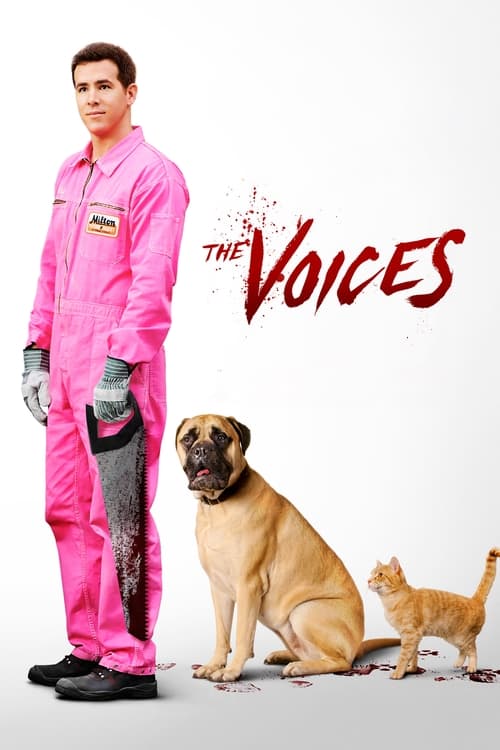
The Voices (2014)
Directed by Marjane Satrapi
No — The Voices is not woke, scoring 18 out of 100 on our wokeness meter.
The Voices arrived in 2014 with a director of genuine political pedigree, Marjane Satrapi, and promptly declined to use any of it.
Consciousness Markers
The protagonist's schizophrenia and auditory hallucinations are central, but the film treats them as a source of horror rather than through a neurodiversity-affirming lens.
The cast is predominantly white with no deliberate emphasis on diverse representation; incidental minority actors do not constitute a representation agenda.
No LGBTQ+ characters, themes, or subtext are present.
Despite a female director, the narrative does not advance a feminist agenda; women are primarily victims in a serial-killer plot.
No engagement with racial politics or consciousness.
No environmental or climate themes.
The factory setting is incidental; there is no critique of capitalism or wealth inequality.
No body-positivity themes or diverse body representation.
Not a historical film; no revisionist history.
No didactic or preachy messaging; it is a dark comedy.
Why it received this score
The Voices arrived in 2014 with a director of genuine political pedigree, Marjane Satrapi, and promptly declined to use any of it. Ryan Reynolds plays Jerry Hickfang, a plumbing fixtures factory worker whose schizophrenia manifests as a cheerful dog, a malevolent cat, and, eventually, a refrigerator full of severed heads that will not stop talking. It is a black comedy about a serial killer, which is to say it is a film that knows exactly what it is and has no interest in apologizing for it.
The clinical material deserves a small allowance. Jerry's hallucinations, his medication, the childhood that produced him, and the abusive father who haunts his dreams are all rendered with a certain care. The film does not treat his condition as a metaphor for society's ills, nor as an invitation to scold the audience about stigma. It treats psychosis as a source of dread and, occasionally, of jokes. That is not an affirming posture. It is an old-fashioned one, and it earns the film a modest credit for engaging the subject at all, while forfeiting any claim to a modern sensibility.
Everything else is absent. The cast is white, the factory is a setting and never a thesis, the women are victims and the pets are accomplices. There is no sermon, no climate anxiety, no reckoning with history. The film ends in a white void where Jerry apologizes to the women he murdered and Jesus appears and everyone sings. A viewer seeking instruction will leave empty-handed. A viewer seeking a strange, grisly, oddly tender comedy will be well served. The classification is straightforward: a film with nothing to teach and no apparent desire to try.
Analysis generated by our Consciousness Algorithm


Synopsis
A mentally unhinged factory worker must decide whether to listen to his talking cat and become a killer, or follow his dog's advice to keep striving for normalcy.
Questions about The Voices
Is The Voices woke?
No — The Voices is not woke, scoring 18 out of 100 on our wokeness meter. That earns it a verdict of Ultra Based.
Does The Voices have any woke elements?
1 of the 10 markers register at 30 or above, led by Neurodivergence (30). On Neurodivergence: The protagonist's schizophrenia and auditory hallucinations are central, but the film treats them as a source of horror rather than through a neurodiversity-affirming lens.
How does The Voices compare to other 2014 movies?
It ranks #60 of the 303 films from 2014 we've scored; their average is 13. The wokest is Selma (68).
How is the Woke Score calculated?
An AI-assisted process researches the film and its reception, scores it 0–100 on ten markers, then combines those into one 0–100 Woke Score. It measures a specific set of 2020s cultural themes, not film quality.