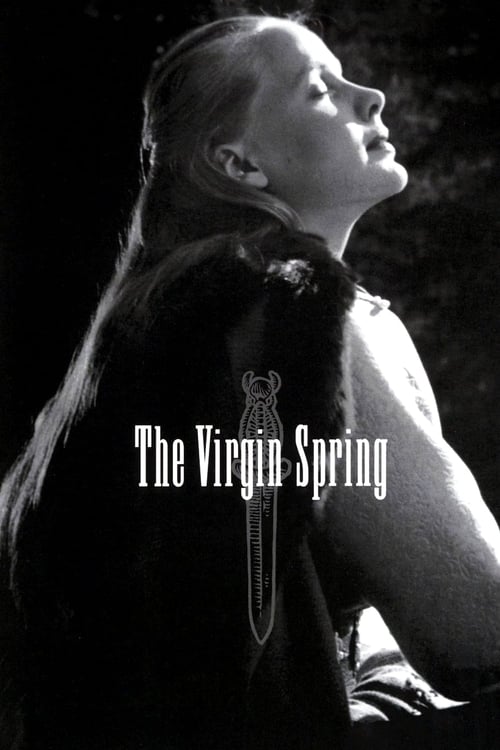
The Virgin Spring (1960)
Directed by Ingmar Bergman
No — The Virgin Spring is not woke, scoring 0 out of 100 on our wokeness meter.
The Virgin Spring is a 1960 Bergman film set in medieval Sweden, a tale of rape, murder, and a father's merciless revenge.
Consciousness Markers
The cast is entirely Swedish and white, reflecting the film's medieval Swedish setting without any modern diversity-conscious casting.
There are no LGBTQ+ themes, characters, or subtext in the film.
The film explores rape, vengeance, and religious guilt through a medieval Christian-pagan conflict, but it does not advance a modern feminist critique or agenda.
Race and racial identity are not addressed or thematized in the film.
There is no environmental or climate-related message in the film.
The film contains no critique of capitalism, wealth inequality, or economic systems.
The film does not promote body positivity or challenge conventional beauty standards.
Neurodivergence is not a theme or character element in the film.
The film adapts a medieval ballad and depicts historical religious conflict without revisionist historical framing.
The film raises moral and religious questions dramatically rather than delivering a modern didactic or preachy message.
Why it received this score
The Virgin Spring is a 1960 Bergman film set in medieval Sweden, a tale of rape, murder, and a father's merciless revenge. It is morally serious, theologically anguished, and entirely devoid of the cultural signifiers that occupy our current audit. The cast is uniformly Swedish and white, which is appropriate to the 13th-century setting and yields a representation score of zero. There are no LGBTQ themes, no racial consciousness, no climate crusade. The film's concerns are God, guilt, and the clash of paganism and Christianity. These are ancient concerns, not contemporary ones. The research summary confirms as much, noting the film's exploration of morals, vengeance, and religious belief without any modern framing.
The feminist marker also sits at zero. The film depicts violence against a woman, but it does not offer a modern feminist critique. It is a medieval morality tale about sin and grace. The anti-capitalist marker is absent because there is no capitalism to critique. Body positivity and neurodivergence are not on the agenda. Revisionist history is not present; the film adapts a medieval ballad with fidelity to its religious conflict. Lecture energy is zero because Bergman dramatizes moral questions instead of preaching them. The film trusts the audience to sit with discomfort, and the rape scene's controversy in 1960 was about censorship, not about social messaging.
The overall impression is of a film that is serious but not progressive in the contemporary sense. It won an Academy Award for Best Foreign Language Film, which is a different kind of distinction. The viewer looking for modern social signifiers will find a barren landscape. The film is a product of its time and place, and it makes no apology for that. We can respect its craft while noting its complete absence of the cultural markers we are tasked with measuring. The spring that emerges at the end is a symbol of innocence, not a climate metaphor. The classification is straightforward: zero across the board. The ledger is clean, and the sommelier can move on to the next vintage.
{"thematic_tags": ["oscar_winner"]}
Analysis generated by our Consciousness Algorithm


Synopsis
Devout Christians Töre and Märeta send their only daughter, the virginal Karin, and their foster daughter, the unrepentant Ingeri, to deliver candles to a distant church. On their way through the woods, the girls encounter a group of savage goat herders who brutally rape and murder Karin as Ingeri remains hidden. When the killers unwittingly seek refuge in the farmhouse of Töre and Märeta, Töre plots a fitting revenge.
Questions about The Virgin Spring
Is The Virgin Spring woke?
No — The Virgin Spring is not woke, scoring 0 out of 100 on our wokeness meter. That earns it a verdict of Ultra Based.
Does The Virgin Spring have any woke elements?
No. All 10 markers score zero.
How does The Virgin Spring compare to other 1960 movies?
It ranks #12 of the 17 films from 1960 we've scored; their average is 7. The wokest is Rocco and His Brothers (29).
How is the Woke Score calculated?
An AI-assisted process researches the film and its reception, scores it 0–100 on ten markers, then combines those into one 0–100 Woke Score. It measures a specific set of 2020s cultural themes, not film quality.