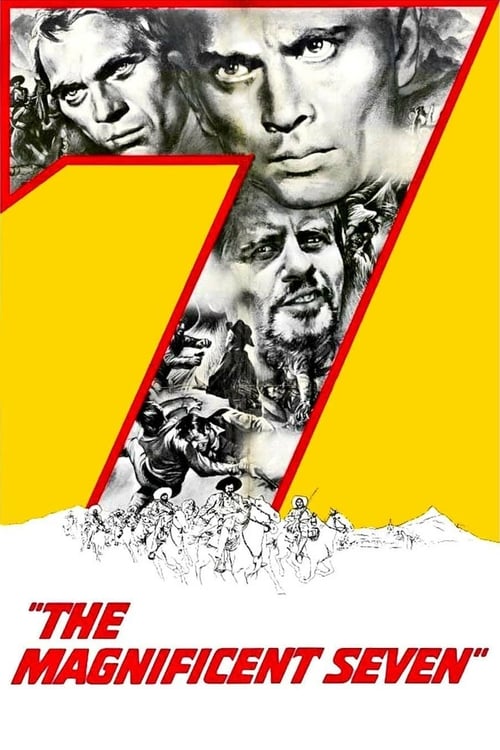
The Magnificent Seven (1960)
Directed by John Sturges
No — The Magnificent Seven is not woke, scoring 6 out of 100 on our wokeness meter.
John Sturges delivers a meticulously crafted, albeit decidedly unchallenging, exercise in the Western genre.
Consciousness Markers
The Mexican villagers are largely played by Mexican actors and the setting is authentically south-of-the-border, but the seven leads are white Hollywood stars and no deliberate diversity-casting agenda is present.
No LGBTQ+ characters, themes, or subtext of any kind.
Women are hidden away for fear of rape and Petra exists mainly as a romantic prize for Chico; no feminist framework whatsoever.
The peasant-versus-bandit conflict is economic and moral, not racial; no modern racial-consciousness commentary is present.
No environmental or climate themes.
The 'men are cheaper than guns' line is a wry observation about mercenary economics, not a critique of capitalism.
No body-positivity themes.
Lee's nightmares and lost nerve are depicted as battle trauma, not framed as neurodivergence.
A straightforward Western remake of Seven Samurai; no historical revisionism.
The film delivers its themes through action and character rather than preachy monologue.
Why it received this score
John Sturges delivers a meticulously crafted, albeit decidedly unchallenging, exercise in the Western genre. This adaptation of a Japanese cinematic classic functions as a straightforward morality tale of mercenaries and marginalized communities. The film navigates its rural landscape with a clear economic and moral conflict, yet it remains curiously untouched by the specific cultural obsessions of the modern era. We observe no overt attempts to advance progressive sensibilities, which is perhaps the film's most defining characteristic in a contemporary context.
The narrative avoids the heavy-handed sermonizing often found in later social dramas. The characters operate within established genre parameters, and their struggles are defined by survival and immediate threat rather than complex, modern systemic critiques. The depiction of gender roles is purely functional; women are relegated to protected spaces and lack any agency or representation outside of being a romantic or emotional prize. Furthermore, the conflicts are resolved through gunplay and tactical acumen, leaving no room for any discussion of neurodivergence, climate anxiety, or anti-capitalist theory.
What results is a highly effective period piece that achieves its dramatic goals without ever attempting to engage with the contemporary discourse of representation. The casting utilizes established stars to anchor the action, ensuring the focus remains firmly on the visceral experience of the frontier. It is a film that exists outside the current cultural conversation, and for that, it is perhaps surprisingly stable. The lack of ideological baggage allows the sheer kinetic energy of the gunfights to stand entirely on its own merits.
Analysis generated by our Consciousness Algorithm


Synopsis
An oppressed Mexican peasant village hires seven gunfighters to help defend their homes.
Questions about The Magnificent Seven
Is The Magnificent Seven woke?
No — The Magnificent Seven is not woke, scoring 6 out of 100 on our wokeness meter. That earns it a verdict of Ultra Based.
Does The Magnificent Seven have any woke elements?
Very few. None of the 10 markers reaches 30, the level where a marker counts as present; the highest is Representation Casting at 15.
How does The Magnificent Seven compare to other 1960 movies?
It ranks #6 of the 17 films from 1960 we've scored; their average is 7. The wokest is Rocco and His Brothers (29).
How is the Woke Score calculated?
An AI-assisted process researches the film and its reception, scores it 0–100 on ten markers, then combines those into one 0–100 Woke Score. It measures a specific set of 2020s cultural themes, not film quality.