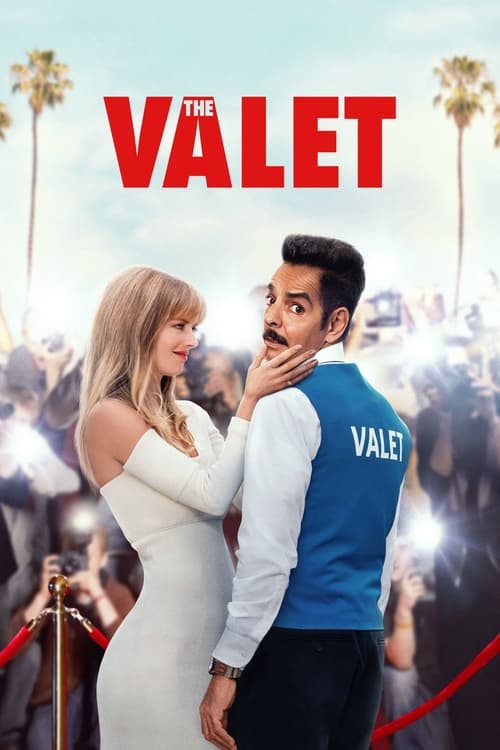
The Valet (2022)
Directed by Richard Wong
Partly — The Valet is somewhat woke, scoring 48 out of 100 on our wokeness meter.
The Valet arrives as a remake of a 2006 French comedy, the sort of provenance that usually signals a lazy afternoon on a streaming service.
Consciousness Markers
The film deliberately re-centers a French remake around a Latino valet, his immigrant family, and a bilingual Los Angeles community, with a predominantly Latino cast and a Korean supporting character.
The story foregrounds Latin American immigrant life, gentrification, class/wealth divides, and the harsh treatment of service workers by the upper class, giving it clear racial and ethnic consciousness.
The plot criticizes billionaire developers, gentrification, and wealth inequality, though its critique remains mild and is partly resolved by a wealthy character's change of heart.
Female characters have agency—Olivia ends a controlling affair, Kathryn takes over the company after divorce, and Natalie fights gentrification—but the film is not structured around a feminist agenda.
Social commentary on gentrification, immigration, and class is present but delivered through character and plot rather than heavy-handed preaching.
No LGBTQ+ characters, relationships, or themes are present in the film.
There is no climate-change theme, environmental crusade, or ecological messaging in the film.
No body-positivity themes, body-diversity messaging, or related commentary appear in the film.
No neurodivergent characters, diagnoses, or related themes are present.
The film does not revise or reinterpret historical events or figures; the Amelia Earhart film-within-the-film is not used for historical revisionism.
Why it received this score
The Valet arrives as a remake of a 2006 French comedy, the sort of provenance that usually signals a lazy afternoon on a streaming service. Richard Wong's version transplants the premise to Los Angeles and hands the title role to Eugenio Derbez, and in doing so it performs a quiet act of demographic re-engineering. The valet is now Antonio Flores, an immigrant father sharing custody of a teenage son, and the community around him is Latino, bilingual, and under siege from developers. The film casts its world accordingly, filling the margins with relatives, coworkers, and a Korean landlord named Mr. Kim who courts Antonio's mother without a shared language. This is representation as architecture, not ornament, and it holds the picture together.
The social consciousness on display is real but restrained. Gentrification drives the plot, a billionaire's scheme to raze the neighborhood, and the film takes visible pleasure in the humiliation of service workers by the wealthy. Antonio stands up for his occupation at a premiere. Kathryn, the billionaire's wife, takes over the company and cancels the demolition, which is the sort of resolution that flatters an audience while leaving the actual power structure undisturbed. The critique lands, but softly. Olivia ends a controlling affair and Natalie fights for her bike shop, granting the women agency without making a thesis of it.
What the film declines to do is instructive. There is no climate sermon, no body-diversity subplot, no neurodivergent arc, no historical revisionism, despite a film-within-the-film about Amelia Earhart that could easily have been pressed into service. The messaging arrives through character and incident, the least objectionable delivery method available. The result is a romantic comedy that wears its progressive sensibilities lightly, like a good jacket, and mostly wants to make you feel warm. It succeeds. The classification is unremarkable, but it is not empty.
Analysis generated by our Consciousness Algorithm
Part of

Synopsis
World famous movie star Olivia faces a PR disaster when a paparazzi snaps a photo of her with her married lover, Vincent. The hard-working valet Antonio accidentally appears in the same photo and is enlisted to pose as Olivia’s new boyfriend as a cover-up. This ruse with Olivia thrusts Antonio into the spotlight and unexpected chaos.
Questions about The Valet
Is The Valet woke?
Partly — The Valet is somewhat woke, scoring 48 out of 100 on our wokeness meter. That earns it a verdict of Woke-Adjacent.
What makes The Valet woke?
5 of the 10 markers register at 30 or above, led by Representation Casting (75), Racial Consciousness (65) and Eat the Rich (45). On Representation Casting: The film deliberately re-centers a French remake around a Latino valet, his immigrant family, and a bilingual Los Angeles community, with a predominantly Latino cast and a Korean supporting character.
How does The Valet compare to other 2022 movies?
It ranks #30 of the 223 films from 2022 we've scored; their average is 22. The wokest is Bros (92).
How is the Woke Score calculated?
An AI-assisted process researches the film and its reception, scores it 0–100 on ten markers, then combines those into one 0–100 Woke Score. It measures a specific set of 2020s cultural themes, not film quality.