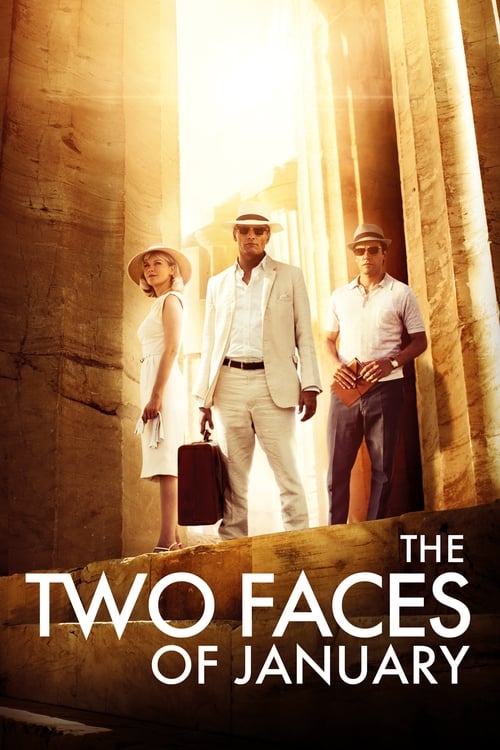
The Two Faces of January (2014)
Directed by Hossein Amini
No — The Two Faces of January is not woke, scoring 3 out of 100 on our wokeness meter.
The Two Faces of January arrives on a wave of Mediterranean light and the unmistakable aroma of a well-aged Patricia Highsmith novel, and it asks nothing of us beyond our attention.
Consciousness Markers
Cast is overwhelmingly white Anglo-American leads with Greek locals filling incidental roles; no deliberate diverse casting agenda, but the on-location Greek supporting cast exists naturally.
Chester is a swindler who fleeced investors, but the film treats this as personal villainy rather than a systemic indictment of wealth or capitalism.
Colette is largely a passive object of male desire and jealousy, and the film offers no feminist critique of its period setting or gender dynamics.
No LGBTQ+ characters or themes whatsoever; the plot concerns a heterosexual marriage and a love triangle.
No engagement with race or racial politics; the story unfolds among white American expatriates abroad.
No environmental or climate content of any kind.
No body-positivity themes; bodies are framed through conventional romantic-thriller aesthetics.
No neurodivergent characters or themes are present or implied.
Faithful period adaptation of a 1964 Highsmith novel; no historical revisionism or reframing of events.
A Hitchcockian suspense thriller with no moralizing, messaging, or didactic impulses toward the audience.
Why it received this score
The Two Faces of January arrives on a wave of Mediterranean light and the unmistakable aroma of a well-aged Patricia Highsmith novel, and it asks nothing of us beyond our attention. Hossein Amini, making his directorial debut after years of writing screenplays for other people, serves up a 1962-set thriller in which a con man, his wife, and an impressionable young American drift from the Acropolis to Crete to Istanbul, leaving bodies and passports behind them. It is handsome, tightly wound, and entirely untroubled by any need to say something about the world. The period setting is decoration, not argument. Nobody turns to the camera to explain the era's failings.
The trio's arrangements are strictly of the old school. Colette exists to be looked at, wanted, and squabbled over, and the film declines to interrogate this arrangement in the slightest. Chester's fraud is the stuff of personal villainy, a swindle worked on individual investors, treated as a character flaw instead of a symptom of anything larger. The supporting cast is drawn from the Greek streets and harbors, present as scenery and function, with no casting agenda on display. Racial politics, environmental concern, and the inner lives of the neurodivergent are absent from the proceedings, and the absence is not felt.
Which leaves the picture with no message at all. It wants to grip, to seduce, to end badly, and it does all three. There is no sermon, no righteous finger raised at the audience, no sense that the filmmakers regard us as students in need of correction. For a certain kind of viewer this will read as an artifact from a lost age. For the rest of us it is a competent, elegant entertainment, and the classification comes out clean.
Analysis generated by our Consciousness Algorithm


Synopsis
After he kills a detective, a con artist and his wife must trust a potentially dangerous stranger to help them get out of Greece.
Questions about The Two Faces of January
Is The Two Faces of January woke?
No — The Two Faces of January is not woke, scoring 3 out of 100 on our wokeness meter. That earns it a verdict of Ultra Based.
Does The Two Faces of January have any woke elements?
Very few. None of the 10 markers reaches 30, the level where a marker counts as present; the highest is Eat the Rich at 5.
How does The Two Faces of January compare to other 2014 movies?
It ranks #256 of the 303 films from 2014 we've scored; their average is 13. The wokest is Selma (68).
How is the Woke Score calculated?
An AI-assisted process researches the film and its reception, scores it 0–100 on ten markers, then combines those into one 0–100 Woke Score. It measures a specific set of 2020s cultural themes, not film quality.