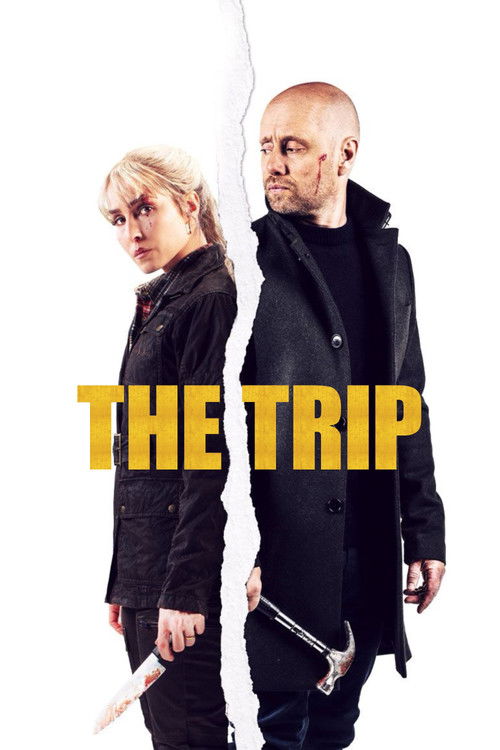
The Trip (2021)
Directed by Tommy Wirkola
No — The Trip is not woke, scoring 0 out of 100 on our wokeness meter.
Tommy Wirkola's The Trip arrives with a premise of admirable economy: two spouses, one cabin, two competing murder plots, and a collapsing ceiling that deposits three fugitives into the middle of a marital dispute.
Consciousness Markers
The cast is predominantly white Norwegian actors; any diversity in minor roles is incidental and not framed as representative casting.
A dark joke about a male captive being targeted does not constitute LGBTQ+ thematic content or representation.
Noomi Rapace's Lisa is a co-lead and combatant, but the film offers no feminist agenda or gendered critique beyond misanthropic violence.
The film does not engage with race, racism, or racial identity in any substantive way.
No environmental or climate themes are present.
The murder-for-insurance plot is driven by personal greed and marital hatred, not an anti-capitalist critique.
No body-positive themes or messaging appear.
No neurodivergence themes or representation are present.
The film is a contemporary fictional dark comedy with no historical revisionism.
The film is deliberately politically incorrect and nihilistic rather than preachy or moralizing.
Why it received this score
Tommy Wirkola's The Trip arrives with a premise of admirable economy: two spouses, one cabin, two competing murder plots, and a collapsing ceiling that deposits three fugitives into the middle of a marital dispute. What follows is an escalating sequence of injuries, improvised betrayals, and a body count the film regards with the enthusiasm of a child at a fireworks display. There is no message here, no lesson, no invitation for us to improve ourselves. The characters are petty and vain, willing to drown a man in a lake and then sell the story to Hollywood. The film approves. That is its entire moral architecture.
Those who arrive hoping for the consolations of contemporary social consciousness will leave empty-handed. The cast is Norwegian and white. The leads are a man and a woman locked in mutual loathing, which is not a gender critique but a hobby. Race, climate, capital, and the body's relationship to itself are all absent, not suppressed but simply unimportant to a screenplay whose chief concerns are hammers, tasers, and the correct angle at which to shoot a friend. A single dark joke about whom a captive intends to violate is the closest the film comes to any identity content, and it treats that as a punchline, not a position. Nobody in this cabin is being lectured to, and nobody watching it will be either.
The result is a comedy of pure misanthropy, assembled with real craft and no agenda beyond the next gag. Noomi Rapace and Aksel Hennie commit fully to the ugliness, and the film rewards them with gore, Norwegian pop songs, and a finale in which the couple repackages their own cowardice as heroism for a paying audience. It is refreshing in a way that is difficult to recommend in polite company: a film that wants nothing from us but our willingness to laugh at the worst people available. An American remake already exists. Of course it does.
Analysis generated by our Consciousness Algorithm


Synopsis
A dysfunctional couple head to a remote lakeside cabin under the guise of reconnecting, but each has secret designs to kill the other. Before they can carry out their respective plans, unexpected visitors arrive and the couple is faced with a greater danger than anything they could have plotted.
Questions about The Trip
Is The Trip woke?
No — The Trip is not woke, scoring 0 out of 100 on our wokeness meter. That earns it a verdict of Ultra Based.
Does The Trip have any woke elements?
No. All 10 markers score zero.
How does The Trip compare to other 2021 movies?
It ranks #234 of the 242 films from 2021 we've scored; their average is 23. The wokest is The Forever Purge (83).
How is the Woke Score calculated?
An AI-assisted process researches the film and its reception, scores it 0–100 on ten markers, then combines those into one 0–100 Woke Score. It measures a specific set of 2020s cultural themes, not film quality.