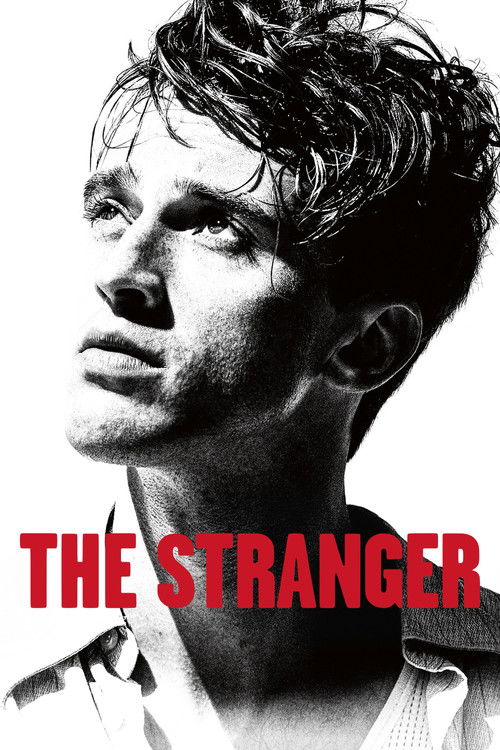
The Stranger (2025)
Directed by François Ozon
François Ozon's adaptation of Albert Camus's L'Étranger arrives in 2025 carrying the full weight of a director who has read the post-colonial scholarship and would like you to know it.
Consciousness Markers
The film's central revisionist act is racial: Ozon opens with colonial archival newsreel footage, introduces the murdered Arab's grieving sister as a new character, and frames the killing explicitly within systemic colonial privilege and anti-Arab discrimination. The director stated on record that it is 'no coincidence' Meursault kills an Arab. This is the film's dominant ideological preoccupation.
Ozon openly positions the film as a corrective to Camus's philosophical abstraction, using archival colonial footage and invented characters to recontextualize a canonical text within the realities of French imperial violence. The director described this as essential for 'today's viewers.' This is revisionism applied to both history and literary canon simultaneously.
Critics noted a tension between the film's post-colonial framing and Camus's original absurdist detachment, with some reviewers observing that the social-drama mode occasionally overtakes the philosophical one. The director's own public statements are unambiguous about his corrective intent, and that intent is legible on screen.
Ozon introduces a new character entirely absent from Camus's novel: the grieving sister of the murdered Arab man, played by Hajar Bouzaouit. This is a deliberate structural intervention to give an Algerian face and presence to a figure the original text leaves nameless and invisible. The casting is purposeful, not incidental.
Ozon meaningfully expanded the role of Marie Cardona beyond her function in the novel, granting her greater emotional agency and narrative presence. Critics specifically noted this as a corrective to the source material's treatment of women as peripheral to Meursault's inner life.
Reviewers noted a 'queer-inflected' visual framing and a focus on tactile eroticism, consistent with Ozon's established directorial sensibility. There is no documented LGBTQ narrative or character arc, but the directorial gaze carries a recognizable queer aesthetic register.
Meursault's famous emotional flatness and social detachment have long been read by some scholars through a neurodivergent lens. The film does not appear to explicitly code him this way, but the character's presentation of profound affective difference from social norms earns a minimal score.
No climate themes are present. The film is set in 1938 colonial Algeria and concerns existentialism, colonial violence, and the French legal system. The sun is oppressive, but it is not making a policy argument.
No anti-capitalist themes are evident in the research or the source material's plot. Class is present in the colonial social structure, but the film does not appear to frame it through an anti-capitalist lens.
No body positivity content is present or documented. The film's erotic framing is sensory and aesthetic, not a statement about body acceptance.
Why it received this score
François Ozon's adaptation of Albert Camus's L'Étranger arrives in 2025 carrying the full weight of a director who has read the post-colonial scholarship and would like you to know it. The film is handsome, shot in black and white with the kind of period precision that signals serious literary intent, and Benjamin Voisin renders Meursault's famous emotional vacancy with considerable skill. The problem, if we are being precise about it, is that Ozon has come not merely to adapt Camus but to correct him, and the film oscillates between these two projects with the slightly strained energy of a thesis defense conducted in a beach house.
The revisionist machinery is not subtle. Ozon opens with real archival newsreel footage from French colonial Algeria, a move that functions as a pre-emptive editorial note informing us how to read every subsequent scene. More significantly, he invents a new character entirely absent from the novel: the grieving sister of the murdered Arab man, played by Hajar Bouzaouit, whose presence transforms an unnamed philosophical prop into a human being with loss and consequence attached to her. This is a genuinely interesting dramaturgical choice, and it lands with real weight. The director has also expanded Marie Cardona from a peripheral figure into someone with actual interiority, correcting a different erasure from the same source text. Ozon is, in effect, running two simultaneous rescue operations on a book that has been assigned in French lycées for eighty years, and he approaches both with the focused determination of a man who has identified specific problems and brought tools.
Where the film earns its place on the cultural ledger is in the gap between what Camus left unnamed and what Ozon insists on naming. The racial consciousness here is not decorative but structural: the murder is framed as an act inseparable from colonial privilege, the courtroom becomes a theater of systemic indifference, and the sun that famously made Meursault pull the trigger is contextualized within a society organized around the disposability of Algerian lives. Some critics found this framing at odds with Camus's cosmic absurdism, and they are not wrong that a tension exists. Whether that tension is a flaw or the point is a question the film leaves productively open, which is the most Camusian thing about it.
Analysis generated by our Consciousness Algorithm


Synopsis
Algiers, 1938. Meursault, a quiet and unassuming employee in his early thirties, attends his mother's funeral without shedding a tear. The next day, he begins a casual affair with Marie, a work colleague. He quickly slips back into his usual routine.
Critic Reviews
“The movie benefits greatly from Mr. Amoedo’s largely steady direction and the uniform acting skills of its Chilean cast (performing in English).”
“Once Amoedo lays all the cards out on the table, The Stranger feels like a piece of genre revisionism only in its deliberate, grinding pace, not in any refreshing turns of the plot. ”
“While the director/screenwriter is to be commended for avoiding the usual bloodsucker clichés, he hasn't replaced them with anything particularly interesting, with the result that the story plays like a quasi-mystical melodrama featuring characters about whom we care little.”
“The movie touts a “Presented By” credit for modern horror maven Eli Roth, but there’s none of that director’s shock or sly subversion. Don’t bother getting to know this stranger.”